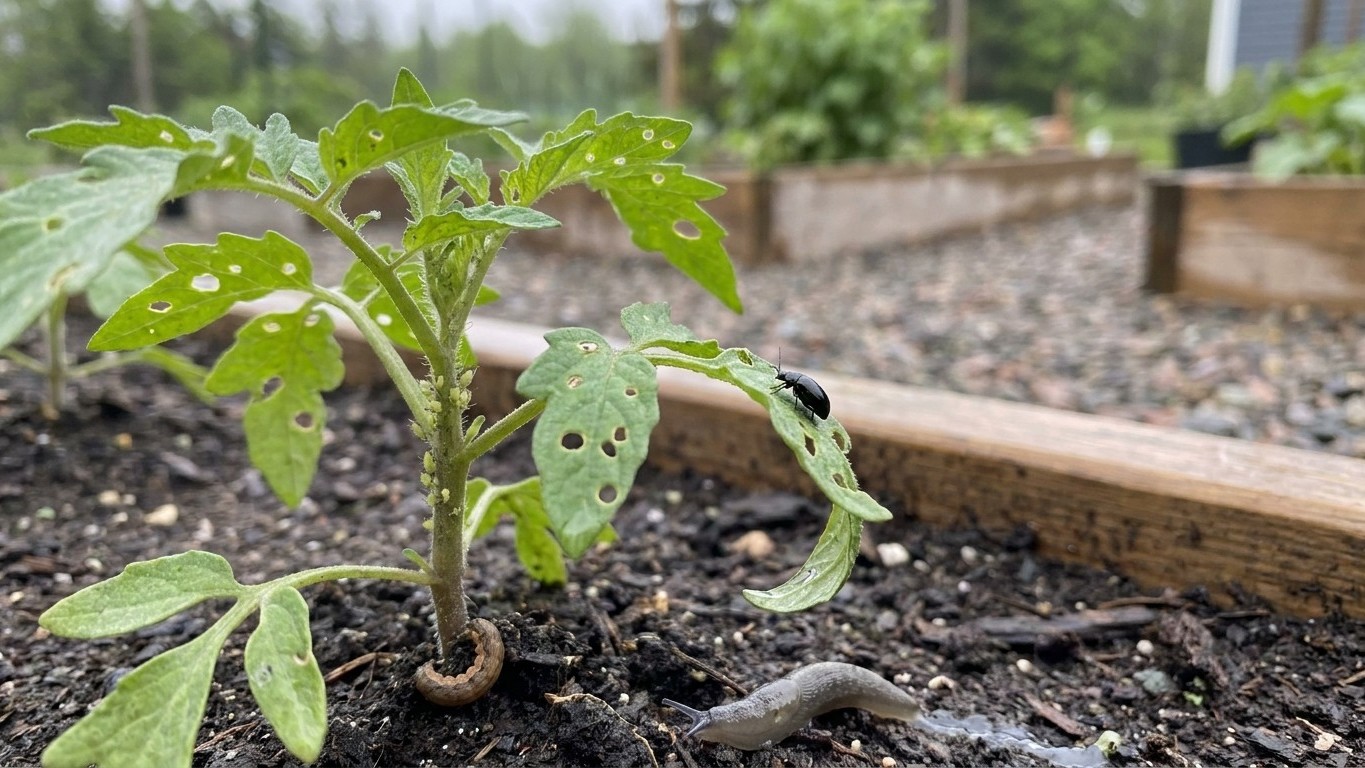

New Brunswick’s tomato pests follow a short, predictable script tied to the province’s compressed growing season. Flea beetles and cutworms hit seedlings first, aphids and Colorado potato beetles build through summer, slugs show up whenever the weather turns damp, and tomato hornworms arrive late, if they arrive at all. Here’s how to tell them apart and what actually helps.
What this comes down to in New Brunswick
With a frost-free window running on average from May 23 to October 2 around Moncton, New Brunswick gardeners are working with roughly four and a half months to get a tomato plant from transplant to ripe fruit while also fending off a handful of pests. That short window matters for pest pressure as much as it matters for ripening: several insects that cause serious damage further south simply don’t have time to build up more than one generation here, while others, especially ones that thrive in cool, damp conditions, do just fine.
The list below is ordered the way it plays out in a real garden, starting with the pests that show up within days of setting plants out and ending with the one that, if it shows at all, usually shows in August.
Flea beetles
Tiny, shiny black or bronze beetles, barely a sixteenth of an inch long, that jump like fleas when a leaf is disturbed. The adults are the ones doing the damage, chewing a scatter of small round holes through the leaves of young transplants, sometimes within a day or two of planting out. Floating row cover kept on until the plants start flowering is the most reliable protection; a light dusting of diatomaceous earth around the stems helps in a pinch.
Cutworms
Dull gray-brown caterpillars, one to two inches long, that curl into a tight C-shape when disturbed and hide just under the soil surface during the day. The larval stage is the problem: a single cutworm can sever a transplant stem right at the soil line overnight, and a plant that was fine at dusk can be lying flat by morning. A simple collar, a strip of cardboard or foil pushed an inch into the soil around each stem, blocks them completely.
Aphids
Small, soft-bodied, pear-shaped insects around an eighth of an inch, usually pale green but sometimes black, that cluster on the undersides of leaves and on new growth. Both nymphs and adults feed by sucking sap, which curls and yellows leaves and leaves behind a sticky honeydew that can grow sooty mold. A firm spray of water or a round of insecticidal soap knocks a colony back, and ladybird beetles usually keep populations in check on their own if nothing broad-spectrum is sprayed nearby.
Colorado potato beetle
A hard-shelled beetle about three-eighths of an inch long with bold yellow-and-black stripes down its wing covers. It’s the reddish-orange, hump-backed larvae that do most of the damage, stripping leaves down to the veins in a matter of days. New Brunswick’s potato acreage gives this pest a strong local presence, and many populations have grown resistant to certain sprays over the years, which is part of why handpicking adults, larvae, and the clusters of orange eggs on leaf undersides remains the most dependable control.
Slugs
Gray or brown, shell-less, up to two inches long, most active after dark or during stretches of wet weather. They rasp large, ragged holes in leaves and in fruit sitting close to the soil, and they leave a telltale silvery slime trail behind. New Brunswick’s damp maritime stretches make slugs a recurring nuisance rather than a rare one; shallow saucers of beer, iron phosphate bait, or a morning check under mulch and boards usually keeps them from doing serious harm.
Tomato hornworm
A large green caterpillar, up to four inches long, with white diagonal stripes and a curved horn near the rear end. It’s the caterpillar stage that strips whole branches of foliage and can chew into green fruit, but it tends to show up later here than in warmer regions, often in smaller numbers, since the short season leaves little time for a second generation to build up. Handpicking is usually enough to keep it from doing real damage.
Working it out for your own garden
Identifying which of these pests you’re actually dealing with comes down to matching three things: the calendar, the part of the plant affected, and the kind of damage left behind. Timing narrows the list fast. If leaves on a freshly transplanted seedling show small round holes within the first week or two after the frost-free window opens around May 23, flea beetle is the likely cause, since nothing else on this list is active that early in that particular way. If instead a whole plant is simply gone, toppled at the soil line, cutworm is the more likely explanation, and checking just under the soil surface near the stub usually turns one up.
Move a month or two later, once plants are established and flowering, and the diagnostic questions change. Curled, yellowing leaves with a cluster of small soft insects on the underside point to aphids. Leaves stripped to the veins, with hard-shelled striped beetles or reddish larvae nearby, point to Colorado potato beetle, and a quick look under the leaves for clusters of small orange eggs will usually confirm it before the larvae do much damage. If the damage instead looks like large ragged chunks torn from lower leaves or fruit, especially after a rainy stretch, and there’s a slime trail glistening in the morning light, that’s slugs rather than any insect, which changes the response completely since sprays aimed at insects do nothing for a mollusk.
By the time August rolls around, a sudden disappearance of whole leaves or small branches, paired with a green caterpillar the length of a finger clinging to the stem, points to tomato hornworm. Because New Brunswick’s season is short enough to prevent most of these pests from overlapping in force at the same time, the calendar alone eliminates several possibilities before you even look closely at the damage, which makes diagnosis here simpler than it is in places with a longer, more crowded pest season.
What changes across the state
New Brunswick isn’t one climate, and pest pressure shifts with it. Coastal areas near the Bay of Fundy and the Northumberland Strait tend to stay cooler and damper through the growing season, which favors slugs in particular, since they need moisture to move and feed. Inland and upriver areas, especially the upper Saint John River Valley around the province’s potato-growing belt, carry heavier Colorado potato beetle pressure simply because the pest has a larger host base nearby to build up on before moving into garden tomatoes.
Elevation and latitude push the calendar itself. Northern and upland districts run their frost-free window later and shorter than the reference figures from the Moncton area, which delays the arrival of every pest on this list by a stretch of weeks rather than days, since insects and slugs alike depend on soil and air warming up before they become active. A garden in the province’s northern reaches should expect the whole sequence, from flea beetles through hornworm, to lag behind a garden closer to the coast or in the milder south.
None of this changes which pests to expect, only when to start watching for them and how heavy the pressure runs. A gardener moving from one part of the province to another should treat the sequence described above as a guide to order and identification, not to exact dates.
The mistakes this state punishes
The costliest mistake in a short-season province like New Brunswick is losing time. Skipping row cover on transplants to save a few dollars, then losing two or three weeks of growth to flea beetle damage, is a setback the season often can’t absorb, since there’s no slack left before the average October 2 frost closes things out. Planting into soil that’s still cold and wet after a single warm spring day is another: the plants sit stressed and slow to establish, which is exactly the window cutworms and slugs use to do the most damage.
Waiting too long to check leaf undersides for Colorado potato beetle eggs is a third. A cluster of orange eggs left unchecked for even a week can hatch into larvae capable of stripping a plant’s foliage fast, and in a season this compressed, a defoliated plant rarely has time to recover and still ripen fruit before frost. The fix in all three cases is the same: act early, check plants often in the first month after transplanting, and treat that early stretch as the period that decides how the rest of the season goes.
Checking this against your county
The Moncton-area frost window and hardiness rating used here are a starting point, not a guarantee for every backyard in the province. Local pest pressure, frost timing, and soil warm-up all shift with elevation, coastal exposure, and local microclimate in ways a province-wide figure can’t capture. For anything specific to a particular county or growing area, the federal agriculture department’s site is a reasonable place to start: https://agriculture.canada.ca/en.
Common questions
Does late blight count as a pest here?
No. Late blight is a fungal disease, not an insect or mollusk, and it spreads differently and needs different management than anything covered on this page.
Is the tomato hornworm really a concern in New Brunswick?
It shows up, but usually later and in smaller numbers than in warmer regions, since the short season limits how many generations it can produce. Handpicking is normally enough.
What’s the very first pest to watch for after transplanting?
Flea beetles and cutworms both strike early, often within days of setting plants out, which is why row cover and stem collars matter most in that first stretch.
Do I need to spray every year regardless of what I see?
No. Checking plants regularly and identifying the actual pest first avoids unnecessary spraying, and several of the pests on this list, aphids especially, are often kept in check by natural predators if left alone.