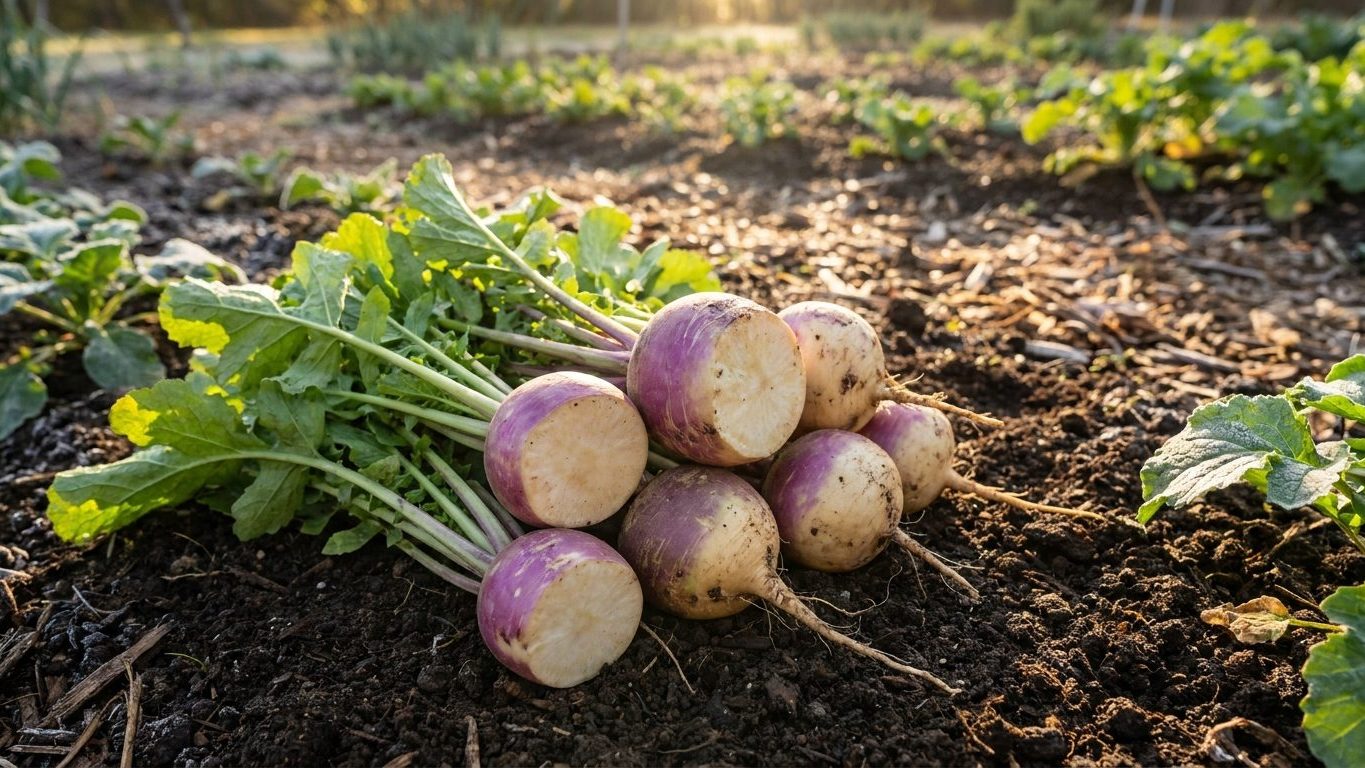

Growing turnips in New Brunswick comes down to timing the sowing to warm soil, which arrives after the May 23 average last frost at Moncton, not on it. Both crops are built for cool weather and sweeten after frost. The window is workable but not generous. Dates, cold, damp and the type you buy decide whether you pull sweet roots or woody ones.
When the soil is warm enough in New Brunswick
The last spring frost falls, on average, on May 23 at the Moncton station (Environment and Climate Change Canada, Canadian Climate Normals 1981-2010, climate ID 8103100). Treat that date as the middle of a window rather than a safe date. It is an average, so in one year out of two the last frost comes later. Put seed in the ground on May 23 and you are betting on a coin flip.
Frost is a stand-in for the thing you actually need
Turnips and rutabaga don’t care about the calendar. They wait for warm soil, and soil lags the air. It warms after the frost risk ends, not at the same moment. A bed can be frost-free and still be cold, wet and slow, and seed sown into it sits or rots. Check the soil rather than the date. It should crumble in your hand instead of smearing, and it should feel cool-to-mild instead of chilled. A soil thermometer takes the guesswork out, and your provincial agriculture department can tell you the threshold it recommends for root crops in your district.
One caution about the source. The Moncton figure describes southeastern New Brunswick, and a province is not one climate. Northern and upland districts run weeks behind it, so gardeners there should push their own first sowing later. The normals also cover 1981-2010, while the US figures elsewhere on this site cover 1991-2020, so don’t line the two sets up date for date.
Types, not variety names
Quick-maturing turnips for greens and small roots, larger main-crop turnips, and rutabaga all follow the same soil rule, but they ask different things of the season. Rutabaga is the slow one and should go in as soon as the soil allows. Turnips can wait, since they can be sown later and still size up in the cool of fall. This page does not name varieties, because it cannot source which ones have been trialled in New Brunswick. Your provincial agriculture department and local seed suppliers can, and the section on choosing types below explains where to ask.
Both crops are brassicas, in the same family as cabbage, kale and mustard. They share those crops’ pests and diseases, so a bed that held cabbage last year is not a fresh bed for turnips. Rotation only works when you move them away from the whole family. The crop rotation guide on this site spells out how long to wait. For the general picture of the crop, start with Growing Turnips and Rutabaga: An Autumn Crop, Sweetened by Frost.
How long the season lasts here
Count from the average last spring frost on May 23 to the average first fall frost on October 2, both from the Moncton station. That gives 132 days, a little under 19 weeks. Both dates are means, so in a given year the real window can open later or close earlier, and the gap is only a planning figure.
What 132 days allows
A window this size sits in the middle. It is long enough for a spring sowing and a second sowing later in the season, which is not true everywhere. A territory with a much shorter gap between frosts has one shot, and every day lost to a cold spring comes out of the only crop. Here you have room for one correction, and you should plan around it. A first sowing that fails to emerge in cold ground, or gets hammered by flea beetles, can be redone without writing off the year.
Remember that the usable window is shorter than 132 days. Soil warms after May 23, so the real start is later. And the first fall frost on October 2 is not the end for these crops, because light frost does them no harm and begins the sweetening. The clock that matters is how long the roots need to size up before the ground freezes hard. That is a few weeks past the frost date, but it varies with the year and the district.
Slow rutabaga earns the early slot, and turnips are the better candidate for a later sowing. The succession sowing guide on this site shows how to space those sowings so they do not all mature at once and crowd the harvest into one weekend.
Transplanting: usually not worth it
With a window this size, the case for starting indoors is weak. Roots resent disturbance. A damaged taproot forks or stunts, and a root crop that forks is a poor crop. A short season would justify the risk, and a moderate one like this does not. Direct sowing into warm soil is the simpler path. If you transplant anyway, handle the root as little as possible and expect uneven roots.
For comparison, the neighbors differ sharply. Growing Turnips and Rutabaga in Prince Edward Island covers a maritime climate across the Northumberland Strait, and Growing Turnips and Rutabaga in Yukon shows what a genuinely short window does to the plan.
Heat and water in New Brunswick
The verified facts for this page include no count of days above 90 F and no summer rainfall total, so neither figure is quoted here. That is better than guessing. What the page can say is that turnips and rutabaga are autumn crops, and the two facts that govern them are cold ones. Heat is not the main worry. In hot spells turnips generally turn pungent and woody, but with no hot-day count for Moncton to point to, it would be wrong to write the hot-climate paragraph. Expect cool, damp conditions as the more likely trouble.
What a cool damp summer brings instead
Cool, wet weather slows ripening and favors disease. The usual suspects are mildew on the foliage, rots in waterlogged ground, and clubroot, a soil disease of brassicas that thrives in wet, acidic conditions and persists for years once established. Because turnip and rutabaga are brassicas, the same trouble hits cabbage, kale and mustard, and rotating into a cabbage bed rotates nothing. Space the plants so air moves through the leaves, avoid watering late in the day, and thin early. Raised or well-drained beds help in heavy soil.
The coldest month and the roots in the ground
At Moncton, the mean daily minimum of the coldest month is -13.9 °C (6.9 °F, given only so US readers can compare). That is an average night low, and individual nights run colder. It decides whether roots can stay in the ground under mulch or must be lifted. For most gardeners, the answer is to lift. A deep layer of straw or leaves can extend the fall harvest by weeks, but by midwinter, with the ground frozen hard, leaving the crop out is a gamble. The Canadian hardiness zone for Moncton is 5a (Natural Resources Canada, 1991-2020 normals). That is a Canadian system built on seven climate variables, and it does not convert to a USDA zone. Don’t map it onto a US zone number.
The fall frost on average October 2 also sets how much sweetening the crop gets. Cold nights push the roots to convert starch to sugar, which is why a fall root tastes better after frost than before. The stretch between that first frost and the ground freezing hard is the sweetening window. In a mild fall it is long, and in a fast freeze it can be short.
Anything lifted for storage needs a careful inspection. Check every root for soft patches, weeping spots and a moldy crown. If you find any of those, the root is out, whatever the rest of it looks like. Don’t trust a sound-looking root, and don’t count on a particular keeping time. Only your own inspection tells you what is safe to eat.
Which turnips and rutabaga suit New Brunswick
Choose by type, and let this province’s conditions set the order of your questions. The first criterion is disease resistance, because cool damp summers and clubroot make it the main risk. The second is earliness, because a window of 132 days between average frosts, shrunk by a late soil warm-up, favors types that mature without dawdling. The third is airflow and shade at the root. Heat matters less here, but dense foliage that stays wet is a problem of its own.
In practice that gives you a short checklist when reading a seed catalog:
- Resistance or tolerance to clubroot, where the seed packet states it.
- Earlier-maturing types for turnips, especially for a second sowing.
- Rutabaga types suited to a cool, moderate-length season, sown as early as the soil allows.
- Upright foliage that lets air move through the row.
This page names no varieties, and that is the right answer rather than a gap. The recommendation that means something is the one from trials run in New Brunswick, because a variety that thrives in another province or state can fail here. This page does not have those trial results, and inventing a name would only mislead you. Ask the provincial agriculture department, and start at Agriculture and Agri-Food Canada, where the federal department’s pages can point you to provincial services. Local garden centers and seed growers in the Maritimes are the next stop, since they stock what has done well nearby.
Finally, remember that the Moncton figures describe one corner of the province. A gardener in a northern or upland district should shift every date here later and weigh disease resistance even more heavily.
Common questions
Can I sow turnips on May 23 in New Brunswick?
You can, but it is not a safe date. May 23 is the average last frost at Moncton, so in half of years frost comes later. Check the soil first, since turnips wait for warm soil rather than a date.
Is New Brunswick too cold for rutabaga?
No. Both crops like cool weather and sweeten after frost. The risks are a cold, wet spring that delays sowing and a damp summer that favors disease. Sow rutabaga early, since it is the slower crop.
Can I leave roots in the ground over winter?
Not reliably. The mean daily minimum in the coldest month at Moncton is -13.9 °C, and the ground freezes hard. Mulch can extend the fall harvest, but plan to lift roots before deep freeze.
Can I plant turnips where cabbage grew last year?
No. Turnips and rutabaga are brassicas, like cabbage, kale and mustard, and they share the same pests and diseases, including clubroot. Rotate to a bed that has been free of the whole family.