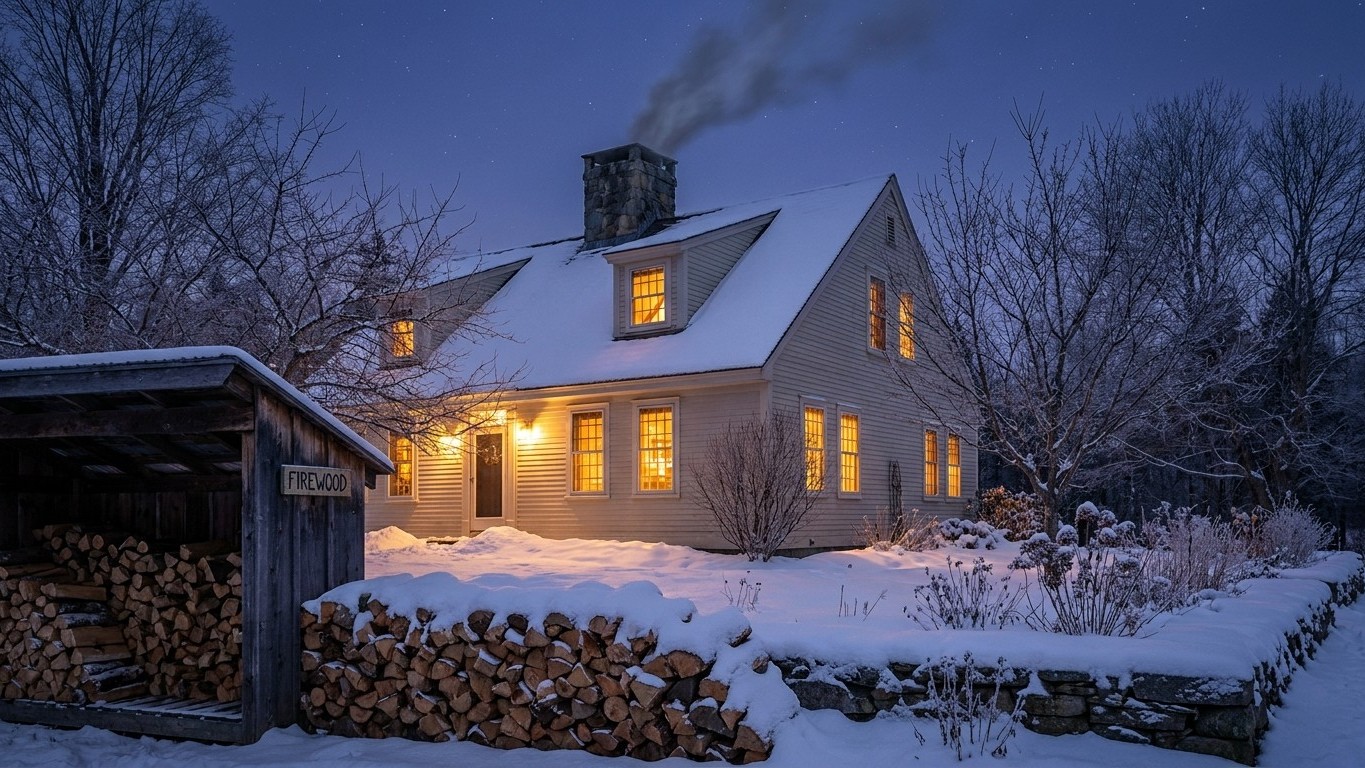

Manchester’s coldest month averages a low of 17.1°F, and that single number explains most of what New Hampshire households spend on heat. It’s not brutally arctic, but it’s cold long enough to matter. Here’s what that means for the equipment, the wood, and the timing of a real New Hampshire winter.
How cold it gets, and for how long

The mean daily minimum for the coldest month in Manchester sits at 17.1°F, based on NOAA’s 1991-2020 Climate Normals. That’s not the record low some radio host loves to mention on a bad night. It’s the average low, the temperature a furnace or a woodstove is fighting against, night after night, for the entire stretch of deep winter.
What matters more than that single figure is duration. New Hampshire doesn’t do a brief cold snap followed by a thaw. The heating season here typically runs from October into April, sometimes longer at higher elevations or in the North Country. That’s six months, give or take, where a house needs supplemental or primary heat just to stay livable. Compare that to a milder mid-Atlantic state where heating might be a three-month affair, and you start to see why New Hampshire households burn through fuel budgets and firewood stacks that would look absurd somewhere warmer.
A house built or heated for this climate needs to handle sustained cold, not just occasional dips. That changes the math on everything from insulation to stove sizing. A woodstove rated for shoulder-season use in a milder state will run flat out here for months, and an oil or propane furnace sized without accounting for a long, steady cold spell will cycle constantly, burning more fuel than the same unit would in a shorter winter.
None of this means New Hampshire is uniquely harsh. It means the state’s winter is a marathon, not a series of sprints, and any heating plan (wood, oil, propane, or a heat pump paired with backup) has to be built around that endurance test rather than a single worst night.
What a cord of wood is worth here
A cord of well-seasoned hardwood delivers about 20 million BTU, according to Michigan State University Extension. That’s the figure worth memorizing before any conversation with a wood seller, because it’s also where most confusion, and most shortchanging, happens.
A cord is a volume, not a weight and not a truckload guess. The legal measure is a stack 4 feet high, 4 feet deep, and 8 feet long, which works out to 128 cubic feet total (some of that space is air gaps between splits, which is normal). Buy less than that and you’ve bought a fraction of a cord, no matter what the seller calls it.
| Measurement | Value |
|---|---|
| Dimensions | 4 ft x 4 ft x 8 ft |
| Total volume | 128 cubic feet |
| Heat output (seasoned hardwood) | about 20 million BTU |
MSU Extension puts that in terms a homeowner can actually use: one cord of seasoned hardwood is roughly equivalent to 145 gallons of #2 fuel oil, or 215 gallons of LP gas. Given a six-month heating season and that 17.1°F coldest-month low, that single cord doesn’t stretch nearly as far as it sounds. Most New Hampshire households burning wood as a primary or major supplemental heat source go through several cords, not one, to get from October to April.
The 20 million BTU figure is an average, and it moves a lot depending on species and moisture. A cord of dense oak or hard maple will outperform a cord of pine or poplar burning at the same moisture content, because more actual wood mass is packed into that same 128 cubic feet. Which brings up the part that decides almost everything else: how dry the wood actually is.
How long wood takes to dry in New Hampshire
Firewood needs to reach around 20 percent moisture or less before it burns efficiently, per Michigan State University Extension. Green, freshly cut wood can sit above 60 percent moisture, which means well over half its weight is water that has to be boiled off before the wood releases usable heat.
Split and stacked so air can move through the pile, most hardwood common in New Hampshire reaches that 20 percent threshold after one full summer of seasoning. That’s the key phrase: split and stacked, not left in rounds under a tarp. Rounds dry from the outside in, slowly, and a lot of what looks like “seasoned” wood on the outside is still soaked through at the core.
Red oak is the named exception worth knowing if you’re buying or cutting locally. MSU Extension notes it dries slower than other species because of its cell structure, so a single summer often isn’t enough. Wood sold as “seasoned” without species or stacking history attached is a claim worth questioning, not accepting.
Burning wood before it’s actually dry doesn’t just mean a weaker fire. The energy that should be heating the house instead goes into boiling off trapped water, so the stove runs cooler and less efficiently even with a full firebox. The unburned moisture and incomplete combustion also send more creosote up the flue, which builds up faster in a chimney and shortens the interval between sweepings. In a state with a six-month heating season, that’s not a minor maintenance note. It’s the difference between one chimney cleaning a year and two.
Where to check before you buy
New Hampshire runs from the seacoast to the White Mountains, and elevation, exposure, and local microclimate shift the numbers above in either direction. Everything in this guide is anchored to Manchester as the reference station, and a property at higher elevation or further north should expect a colder, longer season than what’s described here.
Species availability also varies by region, and so do burn practices. Before buying a season’s worth of wood, or committing to a wood-heavy heating plan, it’s worth checking with the UNH Cooperative Extension for guidance specific to your part of the state, including what species are locally abundant and reasonably priced.
Burn restrictions are another local matter, and they’re not fixed. Some municipalities and fire districts set seasonal rules around outdoor burning or wood smoke, and those rules can change from year to year based on drought conditions or air quality concerns. Checking with local authorities or the extension service before a delivery arrives beats finding out about a restriction after the wood is already stacked.