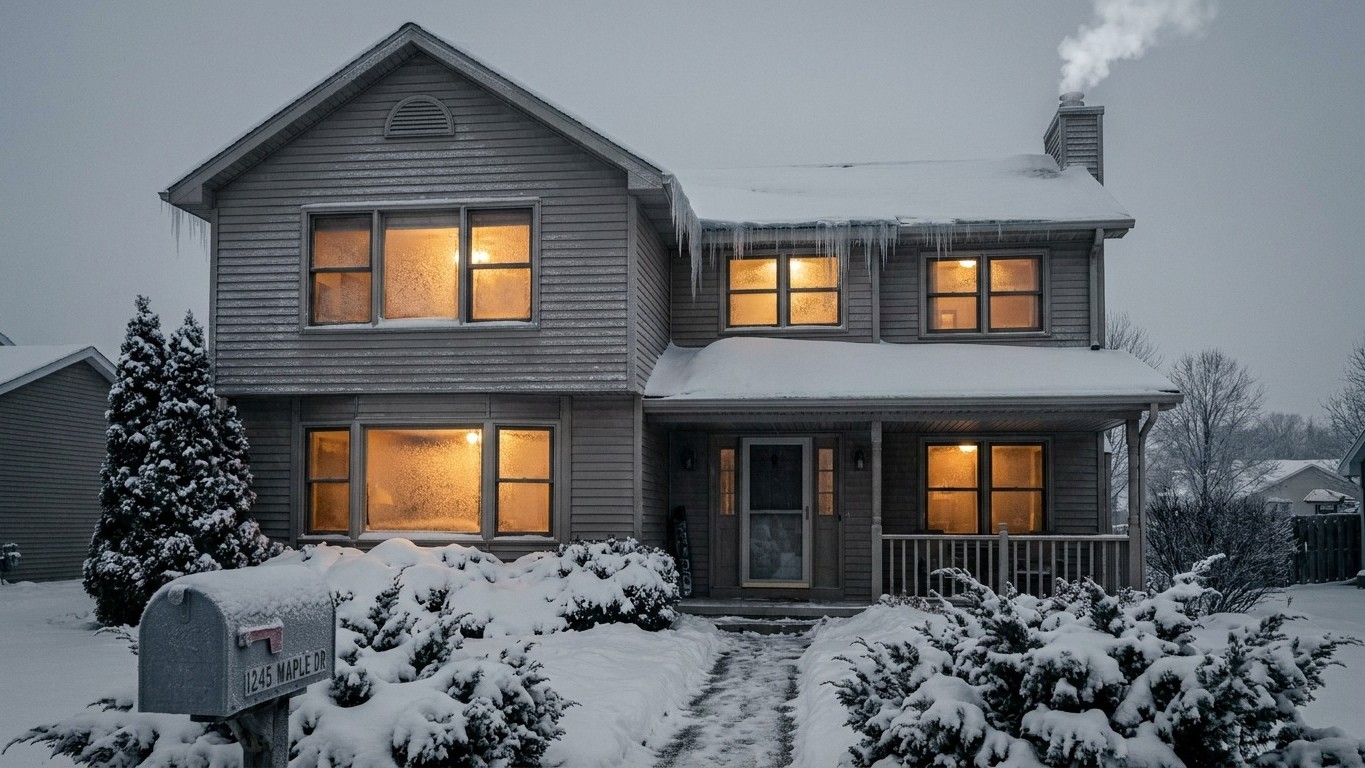

Winter in Wisconsin doesn’t just get cold, it stays cold. The coldest month averages a low of 17.2°F, and that number alone explains why heating bills here run higher than in most of the country: it’s not one brutal week, it’s a season that refuses to let go.
How cold it gets, and for how long

That 17.2°F figure comes from NOAA’s Climate Normals for 1991-2020, using Milwaukee as the reference station. It’s not the record low some radio host brags about after a polar vortex. It’s the average daily minimum for the coldest month, which is the number that actually decides how a furnace behaves night after night.
A mean minimum in the high teens tells a different story than a mean minimum ten degrees colder. In places where winter dips to single digits or below for weeks, a furnace runs in long, near-continuous cycles just to hold a house at 68°F. In Wisconsin’s case, 17.2°F sits in that middle zone: cold enough that heating systems work hard from November through March, but not so extreme that equipment sized for the Upper Midwest struggles to keep up on its worst night.
What this means practically: When Does the Heating Season Start in Wisconsin? The answer here isn’t a two-month sprint. It’s a slow grind that starts when the first hard frost hits in October and doesn’t fully release its grip until April. A furnace or wood stove sized for a mild climate will fall behind by December. One sized for this state’s actual pattern, four to five months of real demand, is what keeps a house comfortable without running flat-out around the clock.
The distinction matters for anyone thinking about supplemental heat, too. A wood stove that adds a pleasant evening glow in a place with a short winter becomes, in a climate like this one, a real contributor to the household heat budget. That’s the context worth carrying into the next question: how much heat is actually packed into the fuel itself.
What a cord of wood is worth here
A cord is a measurement of volume, not weight, and that single fact is where most firewood buyers get shorted. A cord is a stack measuring 4 feet by 4 feet by 8 feet, which works out to 128 cubic feet of space, whether that space is filled with dense oak or light, punky wood that’s mostly air pockets. Two cords can look almost identical stacked in a yard and still contain wildly different amounts of actual burnable mass.
According to Michigan State University Extension, a cord of well-seasoned hardwood holds about 20 million BTU of heat energy. MSU frames that in terms a homeowner can actually use: one cord is roughly equivalent to the heat from 145 gallons of #2 fuel oil, or 215 gallons of LP gas. Given a heating season that runs four to five real months, one cord is a starting reference point, not a season’s supply, for anyone leaning on wood as a primary or serious supplemental source.
The cord, measured
| Dimension | Measurement |
|---|---|
| Stack size | 4 ft x 4 ft x 8 ft |
| Total volume | 128 cubic feet |
| Heat content (seasoned hardwood) | about 20 million BTU |
| Fuel oil equivalent | about 145 gallons (#2 oil) |
| LP gas equivalent | about 215 gallons |
The 20 million BTU figure is an average, and it moves in both directions depending on species and, more than anything, moisture. That’s the piece that trips up even people who’ve burned wood for years: the number on a delivery invoice tells you the volume you bought, but it says nothing about how much of that volume is actually going to become heat instead of steam.
How long wood takes to dry in Wisconsin
Wood you can burn safely and efficiently needs to sit at 20 percent moisture or less. Green wood, fresh off the tree, can hold more than 60 percent moisture, and every bit of that water has to boil off before the wood starts releasing its stored heat. That’s not a minor inefficiency. It’s the mechanism that decides whether a stove load throws real warmth into a room or just hisses and smokes while barely taking the chill off.
Split green wood typically reaches that 20 percent target after one full summer of seasoning, provided it’s split and stacked so air can move through the pile, not left in rounds under a tarp. Wisconsin’s humid summers and genuine warm stretches are enough to pull moisture out of split wood over those months, but the operative word is split. A round log, bark still wrapping the whole thing, can sit for two summers and still be too wet to burn well.
Red oak is the notable exception. MSU points out that its cell structure makes it dry slower than most other hardwoods, so wood cut this year won’t necessarily be ready by next winter the way ash or maple might be. Anyone counting on oak for a specific season should have it split and stacked at least a year ahead, not scrambling in October.
Burning too soon has real consequences beyond a smokier fire. Wet wood spends most of its early burn energy boiling off water instead of heating the house, so the same stove load delivers noticeably less warmth. The unburned compounds driven off by that damp wood condense in a cooler flue as creosote, which builds up faster and means a chimney needs sweeping sooner than it would with properly dried fuel. None of this requires panic, just a plan: cut and split earlier than feels necessary, and check with a moisture meter before assuming a pile is ready.
Where to check before you buy
Everything above describes conditions around Milwaukee, the reference station behind the coldest-month figure. Wisconsin stretches from Lake Superior’s shoreline to farmland near the Illinois border, and elevation, lake effect, and local exposure shift both winter severity and how fast wood dries from one county to the next. A homestead near Lake Superior faces a different snow and moisture pattern than one two hours south.
For guidance tailored to a specific area, including which tree species are locally abundant and easy to source, University of Wisconsin-Madison Extension is the right first stop. Extension offices track regional conditions county by county, which a national average simply can’t capture.
It’s also worth checking local burn restrictions before stocking up. Many counties and municipalities set their own rules around open burning and, in some cases, wood stove use during air quality alerts, and those rules aren’t fixed. They get revisited and revised from year to year based on local air quality and fire risk. A quick call to the county extension office or local fire department before burning season settles in beats finding out about a restriction the hard way.
What each heat source costs to run in Wisconsin
At Wisconsin’s average residential prices, this is what one million Btu of heat delivered into the house costs with each system. It compares fuels on the same unit: it is not a yearly bill, and it leaves out the price of the equipment.
| System | Cost per million Btu delivered |
|---|---|
| Electric resistance (baseboard, 100% efficient) | $55.69 |
| Heat pump at 8.1 HSPF2 (seasonal COP about 2.4) | $23.46 |
| Natural gas furnace at 97% AFUE | $10.68 |
Cheapest to run in Wisconsin: natural gas furnace, $12.78 less per million Btu than the heat pump.
Prices: U.S. Energy Information Administration (EIA), average residential prices. Efficiencies: ENERGY STAR criteria. A heat pump’s figure is a seasonal average; in the coldest weather its efficiency drops.