
Yes, Insulation keeps a New Hampshire home cooler, but the honest picture is smaller than in a Sun Belt state. Summer here is short and heat spikes are brief, so the biggest payoff from attic and floor Insulation still shows up on the winter heating bill. Cooling savings are real, just secondary.
The short answer for New Hampshire

At the Manchester reference station, the average is 10.9 days a year reaching 90 F or higher. That’s the whole summer heat load in one number, and it’s modest. Compare it to a Gulf Coast city where 90-plus days run into the triple digits, and you get a sense of scale: New Hampshire’s hot stretch is closer to two weeks scattered across June, July, and August than a season that defines the year.
That number matters because it tells you which side of the country’s climate divide this state sits on. New Hampshire’s ten counties split across two IECC climate zones: 6A covers five counties, 5A covers the other five. Both are heating-dominated zones, the kind where the code writers assume a long cold season and a comparatively brief warm one. There’s no single zone answer for the whole state, and a page that gives you a single number for every county would be wrong for half its readers. But in either zone, the pattern is the same: winter degree-days outnumber summer ones by a wide margin.
None of that means Insulation is pointless in July. A well-insulated attic still blocks heat from cooking the rooms below on the days that do hit 90, and it still keeps an air conditioner from working harder than it needs to. But if you’re deciding where to spend a limited insulation budget, the calculation in a 5A or 6A county tilts toward winter performance first, with summer comfort as a welcome side effect rather than the main event.
That’s a different story from a homeowner in Phoenix or Atlanta, where cooling costs can rival or exceed heating costs across the year. In New Hampshire, the furnace runs far more hours than the air conditioner ever will. So when you read that “insulation fights summer heat,” treat it as accurate but proportional: it helps on the hot days, and it helps a lot on the cold ones, which is most of the year here.
What follows works from that starting point. The mechanism is identical whether it’s January or July, the equipment people actually use to cool their homes here reflects a short cooling season, and the extras that hot-climate homes rely on largely don’t apply to a state with 10.9 hot days a year.
What happens above the ceiling
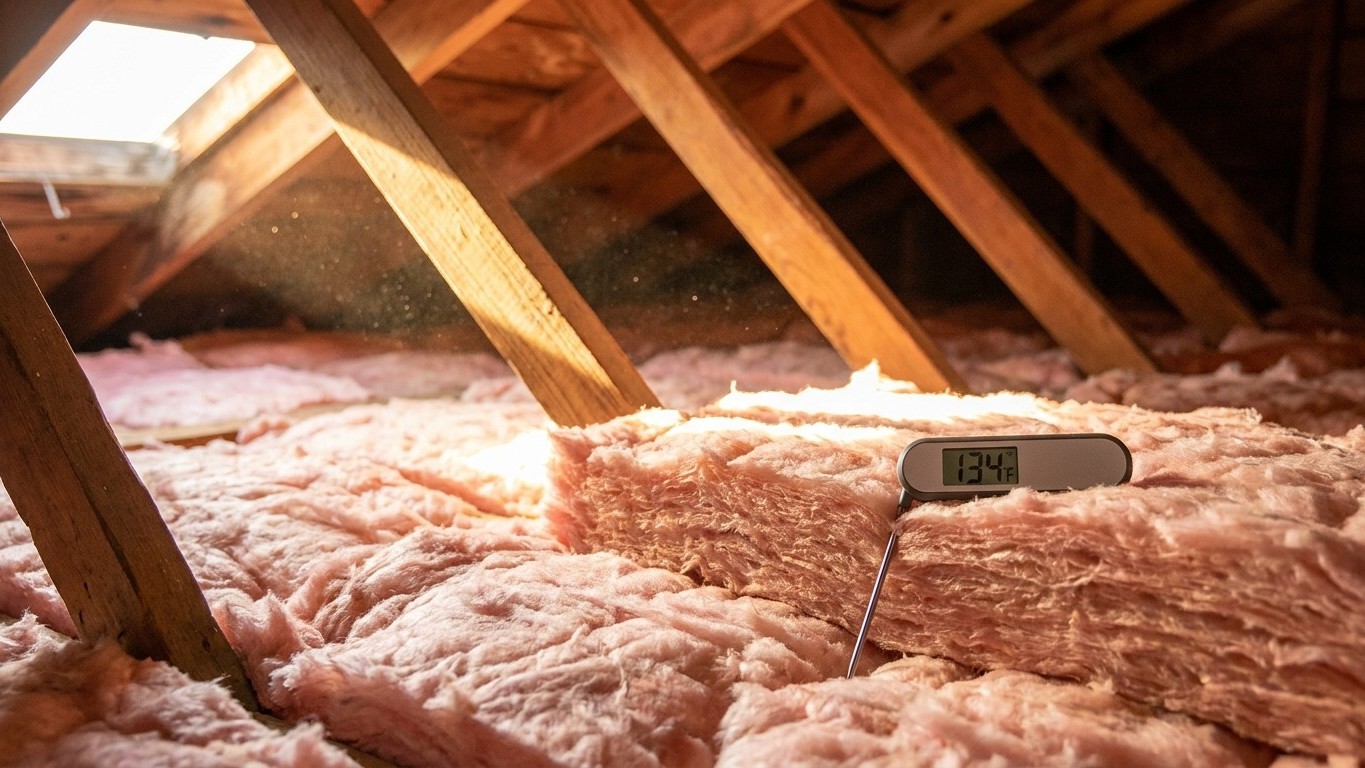
A roof deck sitting in direct sun absorbs solar energy fast, and an uninsulated or under-insulated attic can climb well past outdoor air temperature, sometimes 40 or 50 degrees above it on a clear afternoon. Everything under that roof deck, the drywall ceiling, any ductwork running through the space, boxes stored for the winter, sits inside that superheated air. Heat then moves downward into the living space below, the same way it moves upward and out in January, just reversed.
That’s the point worth understanding: attic insulation isn’t a winter-only product that happens to have a summer side effect. It’s a resistance to heat flow, full stop, and heat flow runs in whichever direction the temperature gradient points. In February, the warm side is inside the house and insulation slows heat escaping upward. In July, the warm side is the attic and insulation slows heat pushing downward. Same material, same job, opposite direction. It’s the one upgrade in a home that pulls double duty across both seasons, which is exactly why it matters even in a state where summer is short.
How much insulation, by zone
ENERGY STAR publishes retrofit recommendations for existing wood-framed homes, organized by IECC climate zone. New Hampshire’s counties fall into zones 5A and 6A, and the source table groups those together with zone 4C under a single row:
| Zone | Attic if uninsulated | Attic if you already have 3-4 inches | Floor |
|---|---|---|---|
| Zones 6, 5 and 4C | R60 | R49 | R30 |
These figures are retrofit targets for an existing house, not new-construction minimums, and they cover an attic that’s currently bare as well as one that has a few inches already down. The floor column is a separate number, meant for floors over unheated crawl spaces, and it shouldn’t be confused with either attic figure. Since the state spans two zones, the safest move is to confirm which zone applies to a specific address using the ENERGY STAR climate zone map or a county-level lookup, rather than assuming one number fits every New Hampshire home.
What homes in New Hampshire cool with
Federal survey data on how New England homes actually cool themselves helps put insulation’s role in context. Nationally reported figures show that 78% of homes use some form of air-conditioning equipment, but only 21% use a central air-conditioning unit, while 59% rely on individual equipment: window units, wall units, portables, or ductless mini-splits. Another 58% use ceiling fans, often alongside one of the other methods rather than instead of it. Those percentages describe the households surveyed, not every house standing, so a state with plenty of older homes and short summers should be read with that caveat in mind.
That gap between “has air conditioning” and “has central air” tells a real story. In a state where the cooling season is brief, spending on a full central system with attic-run ductwork is a harder sell than in a place running the AC five months straight. It’s cheaper and often more practical to cool the two or three rooms that need it, which is exactly what a window unit or a ductless mini-split does.
The connection to insulation depends on which path a given house took. If central air runs through ducts routed in the attic, those ducts are sitting in the hottest space in the building, the same superheated air discussed above. Ceiling insulation does nothing to protect that ductwork; sealing and insulating the ducts themselves is a separate project, and it matters because air moving through a 130-degree attic loses cooling capacity before it ever reaches a supply register. Homes that use window units or mini-splits sidestep that problem entirely, since there’s no attic duct run to lose efficiency in, and what matters instead is the insulation and air sealing around the specific room or zone being cooled.
Either way, insulation and cooling equipment are two different jobs that happen to interact. For the duct side, this site’s duct sealing and insulation guides go into the specifics of that work. For the individual-equipment side, the room air conditioner guides cover sizing and placement for window and portable units, which is the more common setup across a state with New Hampshire’s cooling profile.
What the heat asks for that the cold does not
Two features belong specifically to hot-climate construction, and neither one is designed with a New Hampshire summer in mind.
A radiant barrier is a reflective layer, usually foil-faced, installed to bounce radiant heat back before it ever gets a chance to warm the attic air. It carries no R-value, which means it isn’t insulation and doesn’t substitute for it. Its whole job is reflecting the intense radiant load of a roof deck baking under strong, sustained sun, the kind of load a Florida or Texas attic sees for months on end. With 10.9 days a year above 90 F, New Hampshire’s roof decks simply don’t carry that kind of radiant load often enough to justify the product. It’s not that a radiant barrier would do nothing here; it’s that the return on it is too thin to recommend, and the insulation levels in the table above already do the heavier lifting for this climate.
The second hot-climate feature is about moisture direction, not heat. In a warm, humid climate, water vapor tends to push from outside toward the cooler, air-conditioned interior, which is the reverse of what happens in a heating-dominated state, where indoor moisture pushes outward toward the cold. That’s why the model building code doesn’t require an interior vapor retarder in its warmest, most humid zones, since one there would trap moisture in the wrong place. New Hampshire’s zones don’t share that warm-humid profile, so the vapor barrier question here follows the cold-climate logic instead, not the reversed logic that applies further south. That’s a distinct topic with its own rules for placement and permeability, and it deserves its own answer on this site’s vapor barrier page for New Hampshire rather than a shorthand version here.
What the work is worth
ENERGY STAR’s own estimate is the most useful number to close on: “EPA estimates that homeowners can save an average of 15% on heating and cooling costs (or an average of 11% on total energy costs) by air sealing their homes and adding insulation in attics, floors over crawl spaces, and accessible basement rim joists.” Both percentages matter, and both need their denominator attached. Fifteen percent applies to combined heating and cooling costs, not cooling alone. Eleven percent applies to total energy costs, a broader category that includes everything else the home consumes, from water heating to appliances.
The reason that combined figure fits this page specifically is that it doesn’t split winter and summer savings apart. It measures the two together, which is the accurate way to think about insulation in a state like New Hampshire: the same material working in both directions, generating a heating-season saving that dominates the total and a cooling-season saving that’s smaller but not zero. Treating the 15% as though it belonged only to July would overstate summer’s share; treating it as though it belonged only to January would understate the point of this page.
Two caveats keep this number honest. It’s an average drawn from energy modeling of a typical existing U.S. home, not a guarantee for any specific house, and actual results depend on the home’s current insulation levels, air sealing condition, and equipment. And the figure covers a specific set of locations: attics, floors over crawl spaces, and accessible basement rim joists. It doesn’t extend to wall insulation, window replacement, or door upgrades, even though those are common companion projects. For a New Hampshire home in zone 5A or 6A, the attic work described earlier in this page is the largest single piece of that combined saving, and it’s worth checking current attic and floor levels against the ENERGY STAR retrofit table before deciding what, if anything, still needs adding.