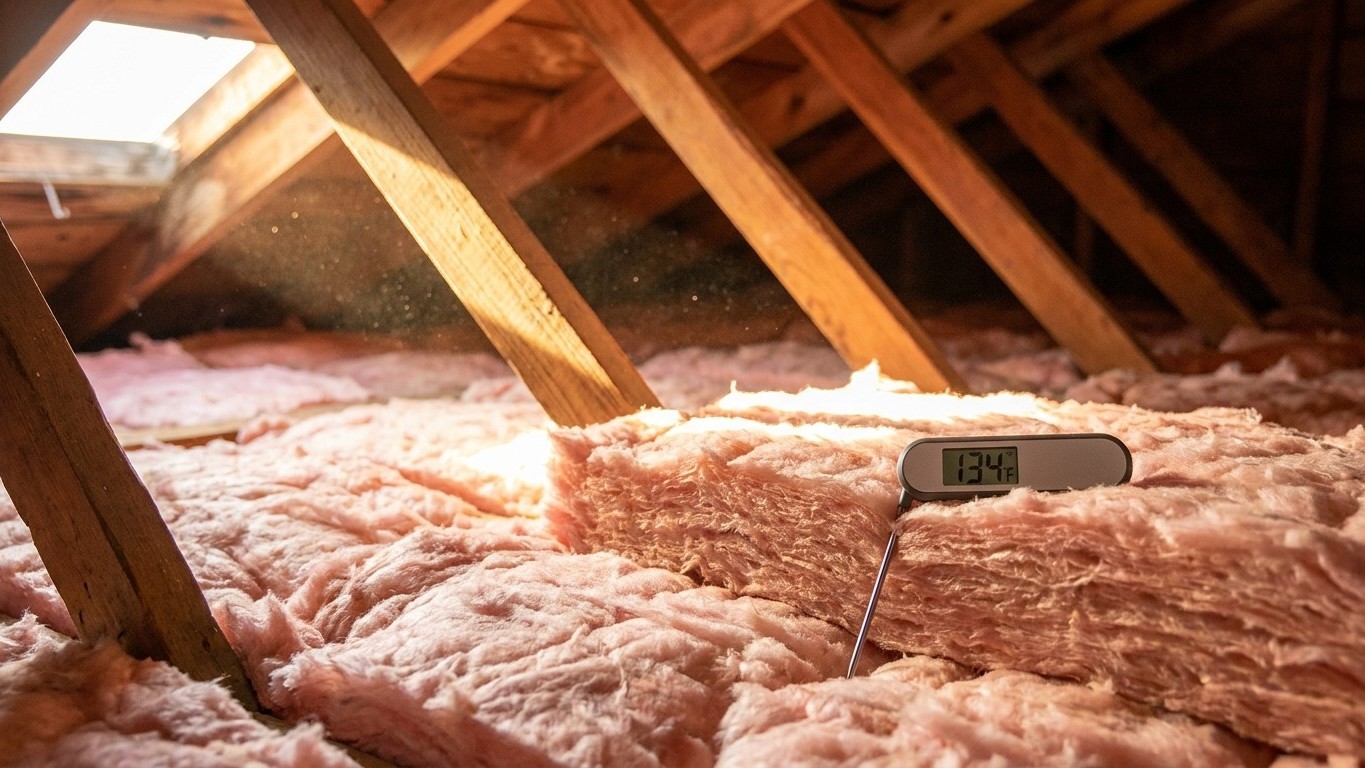

Yes, insulation keeps a Texas home cooler, and here the summer isn’t a side issue, it’s most of the year’s energy story. With over a hundred days a year hitting 90°F or higher at the Houston reference station, this is a state where the attic works against you for months at a stretch, and insulation is one of the few fixes that touches both ends of the thermostat.
The short answer for Texas

Yes, and the number that explains why is 102.4 days a year above 90°F at the Houston reference station, per NOAA’s 1991-2020 Climate Normals. That’s not a heat wave. That’s roughly a third of the calendar spent with outdoor air pressing hard against every wall, window, and roof deck in the state. In a place with eight or ten days like that, insulation would still matter but the winter heating bill would carry the bigger argument. Texas isn’t that place.
The state also sits on a genuine divide, and it’s worth being honest about that rather than flattening it into one line. Texas spans six IECC climate zones across its 254 counties: 81 counties in zone 2A, 70 in zone 3B, 58 in zone 3A, 28 in zone 4B, 14 in zone 2B, and 3 in zone 1A, according to the 2021 International Energy Conservation Code. Zone 1A and 2A are the hottest, least demanding-in-winter zones in the entire code; zone 4B, out toward the Panhandle and parts of West Texas, still sees real winter cold. A county count isn’t a population share, so this isn’t a claim about where most Texans live. It’s a reminder that a homeowner in Brownsville and a homeowner in Amarillo are solving different halves of the same problem.
Why the count of counties isn’t the whole picture
None of this changes the headline answer. Even the zone 4B counties, the coldest slice of the state, still log plenty of 90-degree days most summers. What changes is emphasis. In the 2A and 1A counties, cooling load dominates the energy bill essentially year-round, and insulation upgrades pay off almost entirely on the summer side of the ledger. In the 3B and 4B counties, winter still matters, but the summer load hasn’t gone anywhere. Nobody in Texas gets to skip this question. The right amount of insulation for a given house still depends on which of those zones it sits in, and that’s a county-by-county detail, not something this page can assign to any one reader.
What happens above the ceiling
A roof deck under direct Texas sun doesn’t just get warm. It routinely runs 40 to 60 degrees hotter than the outdoor air reported on the evening news, and that heat has nowhere to go but down, into the attic space, and from there into anything sitting under it: the ceiling drywall, the ductwork if it’s routed through the attic, whatever boxes have been stored up there since the last move. An attic with too little insulation acts less like a buffer and more like a funnel.
The part that surprises people is that the fix isn’t seasonal. Attic insulation doesn’t work one way in January and a different way in July. It resists heat flow, full stop, and in winter that flow runs upward, out of the warm house into the cold sky. In summer it reverses, running downward, from the blistering attic into the conditioned rooms below. Insulation slows both. It’s the rare home improvement that isn’t a trade-off between the two seasons, it’s the same resistance doing double duty.
ENERGY STAR’s recommended levels, by zone
ENERGY STAR publishes retrofit targets for existing wood-framed homes, based on climate zone, and since Texas spans zones 1A through 4B, several rows of that table apply somewhere in the state. These figures are for retrofitting, not new construction, and they’re not a single number that applies to every Texas address:
| Zone | Attic if uninsulated | Attic if you already have 3-4 inches | Floor |
|---|---|---|---|
| Zone 1 | R30 | R25 | R13 |
| Zone 2 | R49 | R38 | R13 |
| Zone 3 | R49 | R38 | R19 |
| Zones 4A and 4B | R60 | R49 | R19 |
Finding which row applies means finding which zone a specific county falls into, using ENERGY STAR’s own zone map or a county-level table, not guessing from this page. What’s consistent across every one of those rows is the underlying logic: more resistance above the ceiling means a cooler house in August and a warmer one in January, from the same material.
What homes in Texas cool with
Insulation only does its job alongside the equipment actually running, and in Texas that equipment is overwhelmingly central air. According to the U.S. Energy Information Administration’s 2020 Residential Energy Consumption Survey, 95% of Texas homes surveyed use some form of air-conditioning equipment, and 83% of homes surveyed use a central air-conditioning system specifically. A further 16% of homes surveyed rely on individual equipment, meaning a ductless mini-split, a window or wall unit, or a portable unit. Ceiling fans show up in 88% of homes surveyed, which tells you Texans are also managing heat the old-fashioned way, by moving air rather than just chilling it.
That 83% central-air figure is where insulation and equipment intersect, and it’s worth being precise about the connection instead of assuming ceiling insulation covers everything. In most Texas homes with central air, the ductwork itself runs through the attic, the single hottest space in the building on a summer afternoon. Ceiling insulation, sitting above the living space, does nothing to protect that ductwork from the heat surrounding it up there. Leaky, uninsulated ducts in a 140-degree attic can lose a large share of their cooled air before it ever reaches a supply register, and that’s a separate repair from anything discussed in this article.
For the 16% of homes surveyed running window units, wall units, or mini-splits, the calculation shifts. There’s no attic ductwork to worry about, but the insulation of the specific room, or the specific zone a mini-split serves, becomes the thing standing between that equipment and the outdoor heat. A well-insulated bedroom with a window unit can coast through the afternoon; a poorly insulated one just makes the compressor work harder. Readers dealing with attic ductwork specifically should look at this site’s duct sealing and duct insulation guides; readers running window or portable units should check the room air conditioner guides for sizing and placement advice suited to that equipment.
What the heat asks for that the cold does not
Two products belong specifically to hot climates, and Texas’s summer numbers put both of them on the table here.
A radiant barrier is not insulation, and it doesn’t carry an R-value. It’s a reflective layer, typically foil-faced, installed to bounce radiant heat back toward the roof deck instead of letting it radiate down into the attic. It earns its keep specifically under a sun-loaded roof, which describes exactly the condition driving 102 days a year above 90°F at the Houston reference station. In a state with a short, mild summer, a radiant barrier would be solving a problem that barely exists; in Texas, it’s addressing the actual mechanism described above, the same roof deck running dozens of degrees hotter than the air outside it.
Vapor movement is the second item, and it’s the one this page won’t settle on its own. In summer, humid outdoor air pushes moisture inward through a wall assembly, the reverse of the winter direction, which is exactly why the model energy code doesn’t require an interior vapor retarder in its warmest, most humid zones. Given how much of Texas sits in warm, humid territory under the IECC’s moisture designations, getting the vapor barrier decision wrong can trap moisture inside a wall rather than keep it out. That’s a call worth making on this site’s dedicated Texas vapor barrier page, where the zone-by-zone moisture regime gets the detail it needs, rather than a paragraph here.
What the work is worth
ENERGY STAR’s own estimate ties the two seasons together in a single sentence, and it’s worth quoting exactly rather than paraphrasing: “EPA estimates that homeowners can save an average of 15% on heating and cooling costs (or an average of 11% on total energy costs) by air sealing their homes and adding insulation in attics, floors over crawl spaces, and accessible basement rim joists.” Both numbers matter, and so do their denominators. Fifteen percent applies to the combined heating-and-cooling bill, not to summer alone. Eleven percent applies to the entire energy bill, including everything insulation doesn’t touch, like lighting and appliances.
That combined framing is the whole reason this page exists. The 15% figure isn’t a winter saving that happens to carry over into July, it’s modeled across both seasons together, which matches exactly what section two described: the same attic fix resisting heat flow in both directions. It’s also worth being clear about where that modeling was done. The estimate covers attics, floors over crawl spaces, and accessible basement rim joists, not walls, not windows, not doors. And it’s an average pulled from energy modeling of a typical existing U.S. home, not a guarantee for any specific Texas address, county, or roofline.