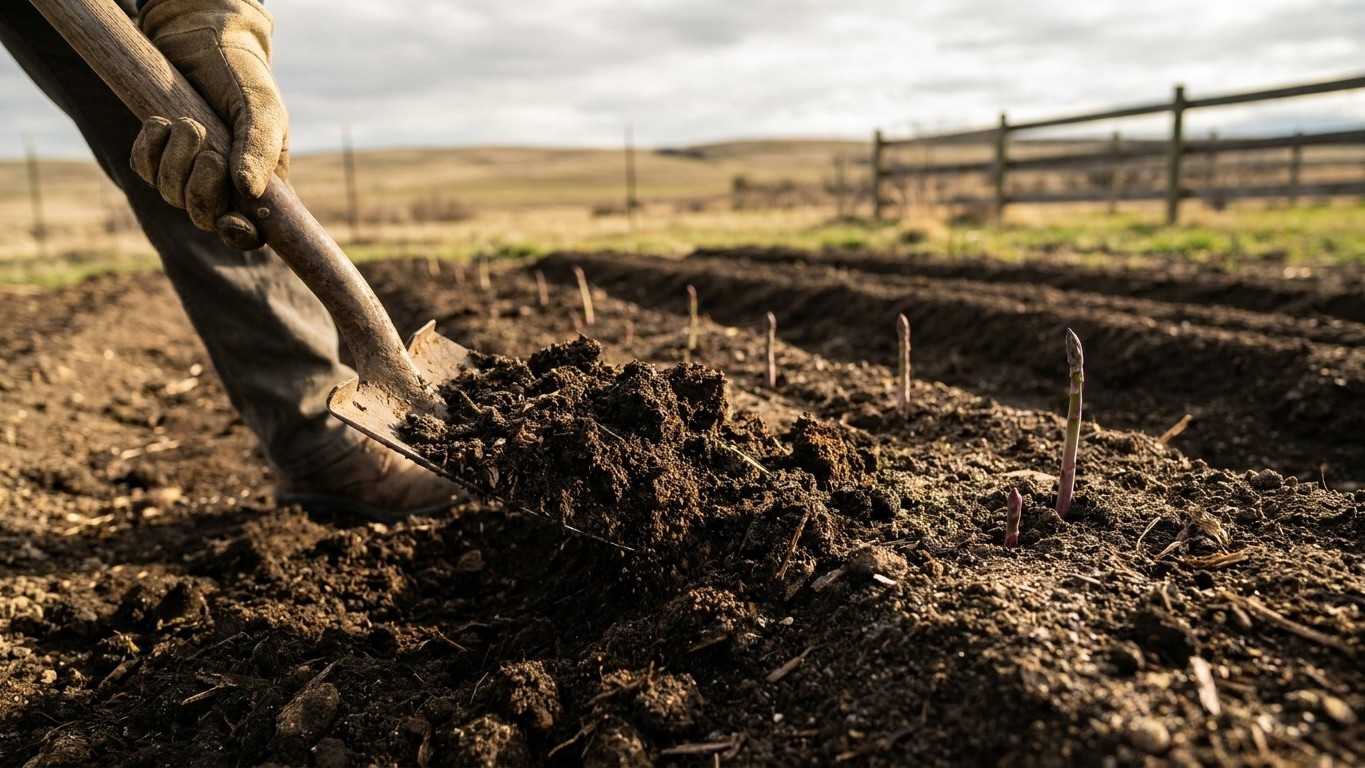

New Hampshire’s ground works for asparagus almost everywhere the state’s own soil survey has mapped it, provided the bed drains. The soil that stands in for the whole state, the Marlow series, comes back from USDA as well drained despite a clay-heavy label that might make a gardener nervous. The catch: once crowns go into the ground here, the bed runs 10 to 15 years. That’s not a season’s experiment. That’s a decision a gardener doesn’t get to quietly revise two summers in, which raises the real question of Will New Hampshire Soil Hold an Asparagus Bed for Fifteen Years? and makes knowing When to Plant Asparagus Crowns in New Hampshire worth getting right from the start.
The short answer
USDA’s representative soil for New Hampshire is the Marlow series, a Spodosol that built up under conifer forest across the state’s hill country. Its surface horizon runs 57 percent sand, 38 percent silt and just 5 percent clay, a loam-to-silt mix that in practice sheds water rather than holding it in a swamp. That’s the good news for asparagus, since the only real soil rule Utah State University Extension gives for this crop is that it needs ground that drains. Most soils will do, the source says, as long as water doesn’t sit.
Two numbers from that same Marlow record deserve a caution before anyone plants by them. The surface pH sits around 3.5, strongly acid, and the organic matter reads near 85 percent. Neither is a number to carry into your own garden. That organic-matter figure describes a natural forest floor, pine needles and duff built up over centuries, not a bed a gardener has turned and worked. A cultivated plot won’t look anything like it. And the pH is a mapped average across 215 soil components statewide, not a reading from your own dirt. Asparagus’s actual pH preference isn’t published in the source at all, so don’t borrow a number from anywhere else to fill that gap.
What matters practically is the drainage classification, and the state soil says well drained. If your own yard tells a different story, standing water after a rain, a lawn that stays spongy into June, the fix isn’t to abandon asparagus. It’s to build up rather than dig down: a raised bed or mounded row lifts the crowns above a wet subsoil without needing a full yard renovation. A cheap soil test from your county extension office will tell you in a season what fifteen years of guessing would otherwise cost you.
The other side of that long timeline is patience at the harvest end. There’s no cutting spears the first two years at all. Year three brings a short four-week harvest window. That stretches to six weeks the year after, then eight weeks once the planting is fully established. After that, the rule isn’t a date on a calendar. It’s a look at the spears themselves: when most of what’s coming up runs thinner than a pencil, harvest stops for the season, no matter what week it happens to be.
Will the summer here water it for you?
Asparagus crowns want 1 to 2 inches of water every other week for their first two years in the ground, then ease off to roughly the same amount every three weeks once established. New Hampshire’s summer rainfall doesn’t arrive on that schedule by accident, so it’s worth lining the two up before assuming the sky will handle it.
- What the bed asks for early on: 1 to 2 inches every 14 days across June, July and August during the first two years, when roots are still shallow and unforgiving of a dry stretch.
- What New Hampshire’s summer delivers: about 10.7 inches of rain total across June, July and August, based on the 1991-2020 normals from the state’s reference weather station. Broken down, June averages 4.04 inches, July 3.3 inches, and August 3.35 inches.
- Where the gap shows up: July is the driest of the three months by a clear margin. A young bed asking for roughly 2 to 4 inches that month on the every-other-week schedule can land close to what July’s normal supplies, but a single dry July with fewer, heavier storms can leave a young planting short even when the seasonal average looks fine on paper.
- What changes after year two: once the schedule eases to every three weeks, the state’s summer rainfall is more often enough on its own, since the interval between waterings stretches out and gives more chances for a rain event to land inside the window.
- The practical move: a rain gauge staked next to the bed for the first two summers, checked weekly, tells a gardener far more than any state average. If two weeks pass with less than an inch showing in the gauge, that’s the signal to run a hose, not a calendar reminder.
When to put the crowns in
Crowns go into the ground in early spring, set into furrows about 8 inches deep according to Utah State University Extension. In New Hampshire, that window sits around the state’s mean last spring frost date, which the National Centers for Environmental Information puts between April 16 and April 27 at the reference weather station. That’s a mean, not a promise, so treat it as the middle of a range rather than a fixed morning to circle. Gardens outside the immediate area of that station, especially those set back from town centers or sitting higher on a hillside, often see frost linger later into spring than the reference figure suggests.
Once the crowns are set into their furrow, the furrow itself isn’t filled in all at once. It’s backfilled gradually across the year, adding about 2 inches of soil back into the trench every other month as the young shoots grow taller, rather than burying the crowns under a full 8 inches of soil on planting day.
The source names four varieties, and it’s worth being upfront about what it does and doesn’t say about them. Jersey Giant and Jersey Knight are listed as all-male varieties. UC 157 F1 and Purple Passion are listed as male and female. That’s the extent of what’s published here: no flavor comparison, no yield figures, no stated reason to prefer one over another. A gardener choosing between them is choosing based on availability and personal preference, not on any documented performance difference in this source.
- Jersey Giant (all-male)
- Jersey Knight (all-male)
- UC 157 F1 (male and female)
- Purple Passion (male and female)
Some gardeners start asparagus from seed rather than buying crowns. The source’s detail centers on the crown method, but starting from seed generally means growing seedlings on for a season before they reach crown size and are ready to go into the permanent bed, adding time to the front end of an already long-term planting.
Checking this against your own county
A state soil series and a single reference weather station describe New Hampshire in broad strokes. They don’t describe your particular yard, your particular slope, or the particular week frost tends to leave your particular county. The most reliable next step is a call or a visit to UNH Cooperative Extension, the state’s land-grant extension service, which can point to local frost records, run a soil test on your actual bed site, and flag anything specific to your part of the state that a statewide average would smooth over. Fifteen years is a long time to bet on an average.
Common questions
Can I harvest any spears the first two years?
No. The source is direct on this point: no harvest at all during the first two years, regardless of how vigorous the planting looks. Year three brings the first four-week harvest window.
How do I know when to stop cutting for the season?
Not by counting weeks. Stop when most of the spears coming up are thinner than a pencil. That signal matters more than any fixed date on a calendar, since a warm spring or a cool one shifts the timeline year to year.
Does New Hampshire’s soil need lime or acidifying before planting?
The source used here is silent on asparagus’s pH preference, and the Marlow series pH figure describes a mapped forest surface, not a worked garden bed. A soil test through your local extension office is the only reliable way to answer that question for your specific plot.
What if my yard doesn’t drain like the state soil suggests?
Build up rather than fight it. A raised or mounded bed lifts asparagus crowns above a wet subsoil without requiring a full yard regrade, and given a fifteen-year planting, that upfront work pays for itself many times over.