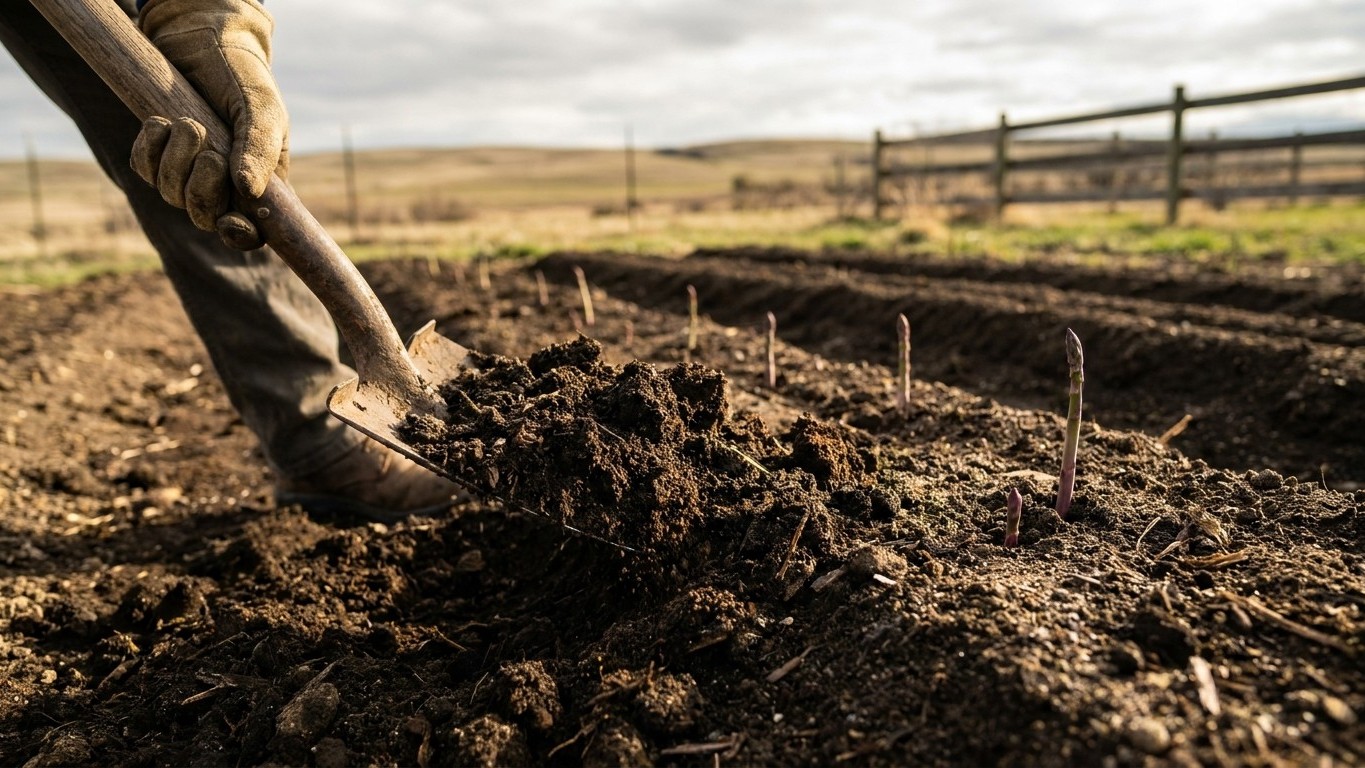

Alberta’s dominant farmland soil, a Chernozem, drains well by nature, which matters more for asparagus than for almost anything else you’ll plant. A bed put in this year is still feeding you fifteen years from now, so the real question isn’t whether this soil works this season. It’s whether it still works in a decade.
The short answer
Start with what a fifteen-year commitment actually means for soil choice, or as the underlying question really goes: Will Alberta Soil Hold an Asparagus Bed for Fifteen Years? Most vegetables forgive a bad year: a heavy, slow-draining patch is an annoyance you fix with compost each spring. Asparagus doesn’t give you that chance. Once the crowns go in, that ground is spoken for through year three of establishment and then another ten to fifteen years of harvest, according to Utah State University Extension. Getting the soil check right matters just as much as knowing When to Plant Asparagus Crowns in Alberta, since timing and drainage together decide whether the bed survives. Pick wrong and you’re not redoing a season, you’re redoing over a decade.
The good news for most Alberta gardeners: the province’s most common soil order, the Chernozem, covers about 40 percent of the mapped agricultural surface and comes back as well drained, according to the Canadian Soil Information Service’s reading of soil components across the province. That’s the deep, dark grassland soil the prairies are known for, rich in organic matter, sitting around 5.2 percent organic matter with a texture that leans loam to silt (37 percent sand, 21 percent clay, 42 percent silt). Asparagus doesn’t ask for much beyond drainage, and this profile clears that bar on paper.
What “well drained” doesn’t tell you
None of that is a diagnosis of your own backyard. The 2,154 soil components behind that figure describe the mapped agricultural regions of the province, not the far north, and certainly not the specific quarter-acre where you’re thinking of digging a furrow. River bottoms drain differently than upland fields. Any lot that’s been scraped, filled, or compacted by construction equipment can behave nothing like the provincial median, no matter what soil order shows up on a map. Luvisolic soils, the second most common order in Alberta, tend to hold more water near the surface and can sit wetter after a spring melt.
So the practical move is simple: dig a hole about a foot deep after a rain, fill it with water, and time how long it takes to disappear. If it’s gone within a few hours, you’re likely sitting on something close to that well-drained Chernozem profile and you can plant with reasonable confidence. If water is still standing after a day, that spot is a poor match for a fifteen-year crop no matter how good the province’s average soil looks on a government map. The fix at that point isn’t amending the whole bed once. It’s raising it: a mounded or raised bed lifts the crowns above the standing water table and lets gravity do what the native soil won’t. Skipping that step is the single most common way a fifteen-year planting fails in year four.
Will the summer here water it for you?
Asparagus has a fairly specific thirst during its first two seasons, and Alberta’s summer rainfall doesn’t fully cover it on its own. Here’s how the numbers line up against what the crop actually needs, according to Utah State University Extension’s watering guidance and Environment and Climate Change Canada’s Calgary climate normals.
- What the crop asks for: during the first two years after planting, a new bed wants 1 to 2 inches of water every other week. Once established, that eases to roughly the same amount every three weeks.
- What a full growing week costs: at the upper end of that ask, two years of establishment means the bed is looking for something in the neighborhood of an inch a week, delivered every other week rather than daily.
- What Calgary’s summer actually delivers: the Calgary Int’l A station averages about 8.5 inches of rain across June, July and August combined, roughly 3.7 inches in June, 2.58 in July, and 2.24 in August, the driest of the three.
- Where the gap shows up: June’s rainfall roughly lines up with a new bed’s every-other-week target, but July and especially August fall short of what an establishing bed wants, particularly in the exact stretch when a young crown is building the root reserves that carry it through its first real winter.
- What that means with a hose in hand: plan to supplement by hand or with irrigation through the back half of summer, especially in August, rather than assuming rainfall alone will carry a first- or second-year bed. A rain gauge staked next to the bed is the only way to know what your particular yard received that week, since a single thunderstorm can dump most of its water as runoff rather than soaking into the root zone.
None of this is a forecast. These are long-term normals for one reference station, and a slope, a windbreak, or a city microclimate can shift what falls on your own plot. Treat the 8.5-inch summer figure as what the region can usually expect, and let your own watering can do the rest.
When to put the crowns in
Crowns go into the ground in early spring, planted about 8 inches deep in a furrow, according to Utah State University Extension. In Alberta, “early spring” has to be read against a frost calendar that runs later than in much of the country. The Calgary Int’l A station’s average last spring frost lands around May 21, based on Environment and Climate Change Canada’s 1981-2010 climate normals.
That word “average” carries real weight here. A mean frost date is a midpoint, not a guarantee: in roughly half of all years, the last frost actually falls later than May 21. Treat that date as the center of a window rather than a green light, and lean toward the later side of “early spring” if the soil is still cold and wet. Crowns set into cold, soggy ground before it has warmed can rot before they ever push a shoot, which defeats the entire purpose of picking a well-drained spot in the first place.
Backfilling the furrow
The furrow isn’t filled in all at once. Crowns go in at the bottom of that 8-inch trench, and soil is added back gradually over the course of the year, roughly 2 inches every other month, rather than burying the crown completely on planting day. That staged backfill gives the emerging shoots room to push through loose soil instead of fighting their way up through several inches of compacted fill.
The alternative route is seed rather than crowns, which Utah State University Extension names as a valid option, though it adds an extra year to the timeline before the plant is established enough to handle the transplant into its permanent bed. For most home gardeners working with a fifteen-year bed, starting from crowns is the more direct path, since it skips that extra seed-starting season entirely.
Whichever route you take, the harvest clock doesn’t start early. No spears get cut in year one or year two, no matter how vigorous the plants look. Harvest begins in year three, and even then it starts light: about 4 weeks of cutting, then 6 the following year, then 8 once the bed is fully established. The rule for When to Stop Cutting each season isn’t a date on the calendar either. It’s a visual cue: stop once most of the spears coming up are thinner than a pencil, which signals the plant needs to put its energy into foliage rather than more spears.
On variety, Utah State University Extension names four without ranking them on flavor or yield: two all-male types, Jersey Giant and Jersey Knight, and two male/female types, UC 157 F1 and Purple Passion. The source doesn’t say which performs better in a given garden, so that choice comes down to what’s available locally rather than any published recommendation.
Checking this against your own county
Everything above comes from a provincial soil average and one climate station near Calgary, and Alberta is too large a place for either to speak for every yard in it. Before committing a bed to Fifteen Years in One Spot, it’s worth a call to Alberta Agriculture and Irrigation, which can point you toward local soil test services and frost data closer to your specific district. A district north of Edmonton or up against the foothills can run weeks behind the Calgary normals used here, and a soil test costing a modest fee tells you your actual drainage and organic matter rather than a provincial median. For a planting decision measured in over a decade, that phone call is cheap insurance.
Common questions
Can asparagus grow in clay soil in Alberta?
Utah State University Extension’s only real requirement is drainage, and heavy clay that holds standing water for a day or more after rain is a poor match for a fifteen-year bed. A raised or mounded bed is the usual workaround where the native soil is slow to drain.
How long before I get asparagus to eat?
No harvest happens in the first two years. Cutting starts in year three, limited to about 4 weeks, then extends to roughly 6 weeks and eventually 8 weeks as the bed matures.
Do I need to worry about winter cold for asparagus in Alberta?
Utah State University Extension’s guidance doesn’t address winter chilling requirements or cold hardiness thresholds, so that figure simply isn’t published here. It shouldn’t be guessed at or inferred from a hardiness zone.
What soil pH does asparagus need?
That’s another gap in the source: no pH requirement is published for asparagus. Alberta’s dominant Chernozem soil runs a median surface pH near 6.5, slightly acid, but that’s a provincial average and not a substitute for testing your own bed.