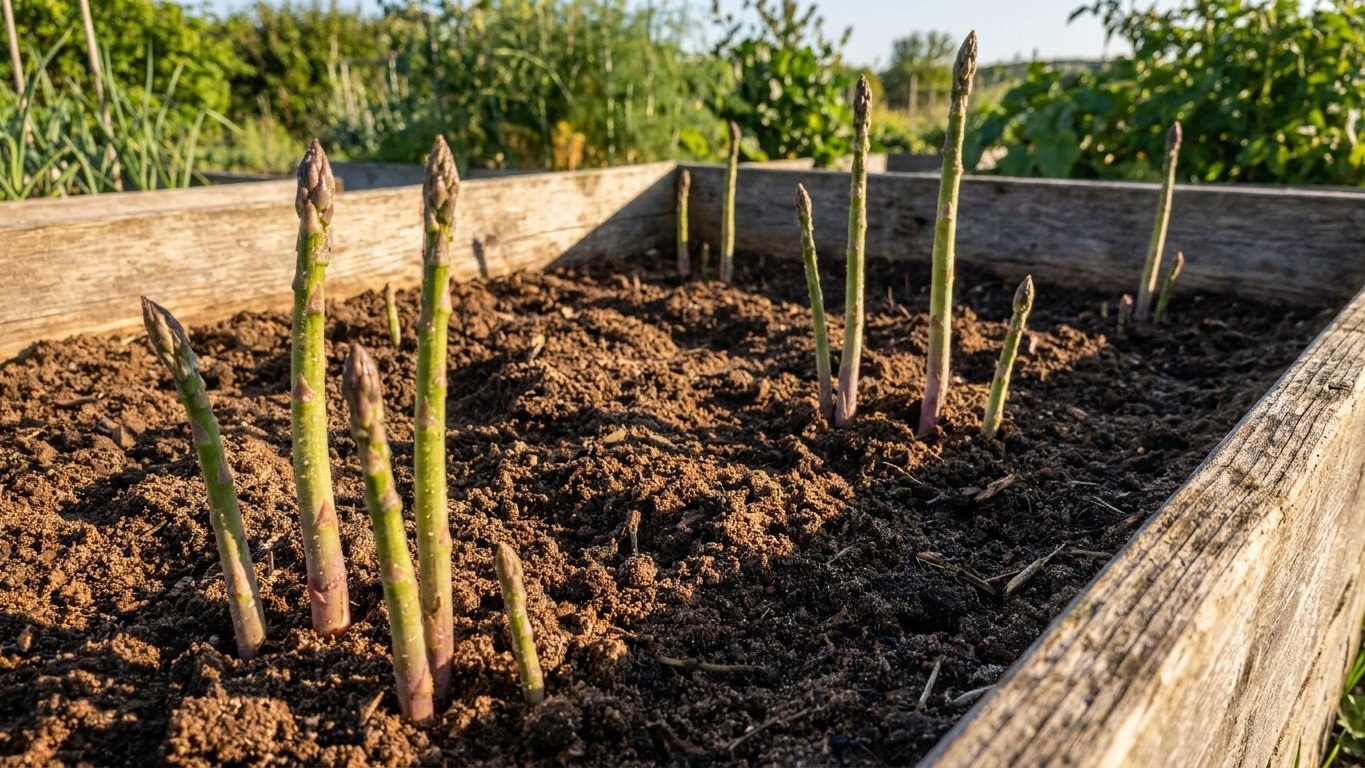

The first thing that eats a New Hampshire asparagus bed is you, and not before the third year. A verified pest calendar isn’t published in the sources behind this page, so you won’t find beetle dates here, and none have been made up to fill the gap. What the sources do hold is what decides whether a bed survives long enough to be eaten at all: drainage, water, and planting time.
The short answer
An asparagus bed is a fifteen-year decision. Per Utah State University Extension, crowns go into 8-inch furrows in early spring, nothing is harvested until year 3, and the bed then produces for 10 to 15 years. The same source says most soils will do, provided they are well drained. That is the only soil requirement it names. Everywhere else in a garden, a bad soil is a yearly nuisance you amend and move on from. Here it’s a mistake you live with until the bed is dug out.
So does New Hampshire’s ground drain well enough? The soil USDA lists as representative of the state is the Marlow series, a Spodosol, which is a sandy, acid, strongly leached soil typically found under conifers. The representative surface texture is loam to silt, at 57 percent sand, 5 percent clay and 38 percent silt, and USDA classes it as well drained. With so little clay to hold water, the answer for this soil is yes. Standing water is not what the Marlow tends to produce.
Two of the other numbers need a warning label. Organic matter for the mapped surface comes in at about 85.0 percent, which means the layer USDA sampled is natural forest litter, not anything a cultivated bed will ever look like. The surface pH is about 3.5, strongly acid, but that describes the mapped forest floor, not your plot. The Utah State source is silent on soil pH, so this page can’t tell you what number your bed should hit. A soil test on your own ground gives you your own figure.
A state holds hundreds of soil series, and the representative one is only a starting point. River bottoms, hill country, and any lot a builder has scraped or filled can behave nothing like the Marlow. Fill and compacted subsoil are the usual culprits for water that lingers.
Check before you dig the furrows. Dig a test hole where the bed would go, fill it with water, and watch how it leaves. If the water is still sitting there well after a rain, that spot will keep a crown wet for years. The choices then are a different spot, or a bed raised above the surrounding ground. That raised-bed fix is common-sense gardening, not something the source spells out. Planting into a wet spot and hoping is the one option to rule out. For a longer look at how this plays out across the state, see Will New Hampshire Soil Hold an Asparagus Bed for Fifteen Years?
Will the summer here water it for you?
The bed wants 1 to 2 inches of water every other week for its first two years, then every three weeks after that. The reference station in New Hampshire averages about 10.7 inches of rain across June, July and August, out of 40.4 inches for the whole year. By month, June brings 4.04 inches, July 3.3 and August 3.35. July is the driest of the three.
Spread evenly, that is roughly 1.5 inches per two-week stretch in July, which sits inside the bed’s range on paper. Summer rain never arrives evenly, though. One thunderstorm can deliver most of a fortnight’s share and mostly run off. Hot days pull moisture out of the ground faster, and sandy soil like the Marlow lets rain through within the day. A wet-looking summer on sand can still leave roots dry. These are normals for one reference station, not a forecast and not your yard, so a slope or a rain shadow changes the picture.
Here is a practical way to work out how much you need to add:
- Set a rain gauge on your own plot, in the open and away from eaves, so you are measuring what actually lands where the crowns are.
- Add up what fell over the last two weeks. During the first two years, the target is 1 to 2 inches in that span.
- If the gauge reads short, water to make up the difference. A dry fortnight in July may mean supplying the whole 1 to 2 inches yourself, while a stormy one may mean nothing.
- Check the soil, not just the gauge. If rain came in one hard burst on sandy ground, count it as less than it measured.
- After the second year, stretch the interval to every three weeks and run the same count over that longer window.
On average the sky covers most of the bill in a New Hampshire summer. The gap you fill is whatever the dry stretches leave behind, and only the gauge on your own plot can tell you how big that gap is.
When to put the crowns in
Crowns go in during early spring. The reference airport station puts the last spring frost at around April 16 to April 27, based on 32°F freeze probabilities in the 30 to 70 percent band. That is the reference-city figure, not a statewide guarantee. Suburban and rural gardens often see the last spring frost one to two weeks later, and more than that at elevation. Treat the dates as a starting range, and check your own county before you commit.
The planting itself is slow and deliberate. Crowns sit in furrows 8 inches deep. You don’t fill the furrow in right away. It is backfilled gradually across the year, 2 inches every other month, so the growing spears keep reaching up through fresh soil. Filling it all at once is a common mistake and defeats the point of the deep trench.
After that comes the long wait. Nothing is harvested until year 3. Then the first harvest runs 4 weeks, the next year 6, and after that 8. This is not a “take a few spears and see” crop in the early years. The end-of-season rule is a thing you can look at, not a date on a calendar: stop cutting when most of the spears coming up are thinner than a pencil.
The alternative to crowns is growing from seed. The sources here don’t give seed-starting dates, so no calendar is offered for that route. The logic is simple, though: you would be growing the crown yourself before it ever goes into the furrow, which pushes the entire timeline back. Gardeners who want the standard route can read When to Plant Asparagus Crowns in New Hampshire, and the broader overview is at Growing Asparagus in New Hampshire.
Common questions
Can I cut a few spears the first year?
No. Nothing is harvested until year 3. After that the season runs 4 weeks, then 6, then 8. Stop each season when most of the spears are thinner than a pencil.
Which variety should I choose?
Four are named in the source, and only their sex is published. Jersey Giant and Jersey Knight are all-male. UC 157 F1 and Purple Passion are male and female. No flavor, yield, or reason to prefer one is published, so any claim that one tastes better or produces more would be unsupported here.
How do I keep cut spears fresh?
The target is 32 to 35°F with near-saturated air, 95 to 100 percent humidity, per UC Davis Postharvest. Above 50°F spears toughen quickly, and at about 30.9°F or lower they freeze and go soft when thawed. In a home fridge, standing the cut ends in water or wrapping them damp is the practical way to hold that humidity, since spears lose water fastest through the cut end.
Which pests should I watch for, and when?
The sources behind this page publish no pest list or timing, so none is given. Your local extension office is the place to ask about what is active in your county. What the sources do establish is that a well-drained spot, steady watering for the first two years, and patience through the third year give the bed its best footing before any pest question comes up.