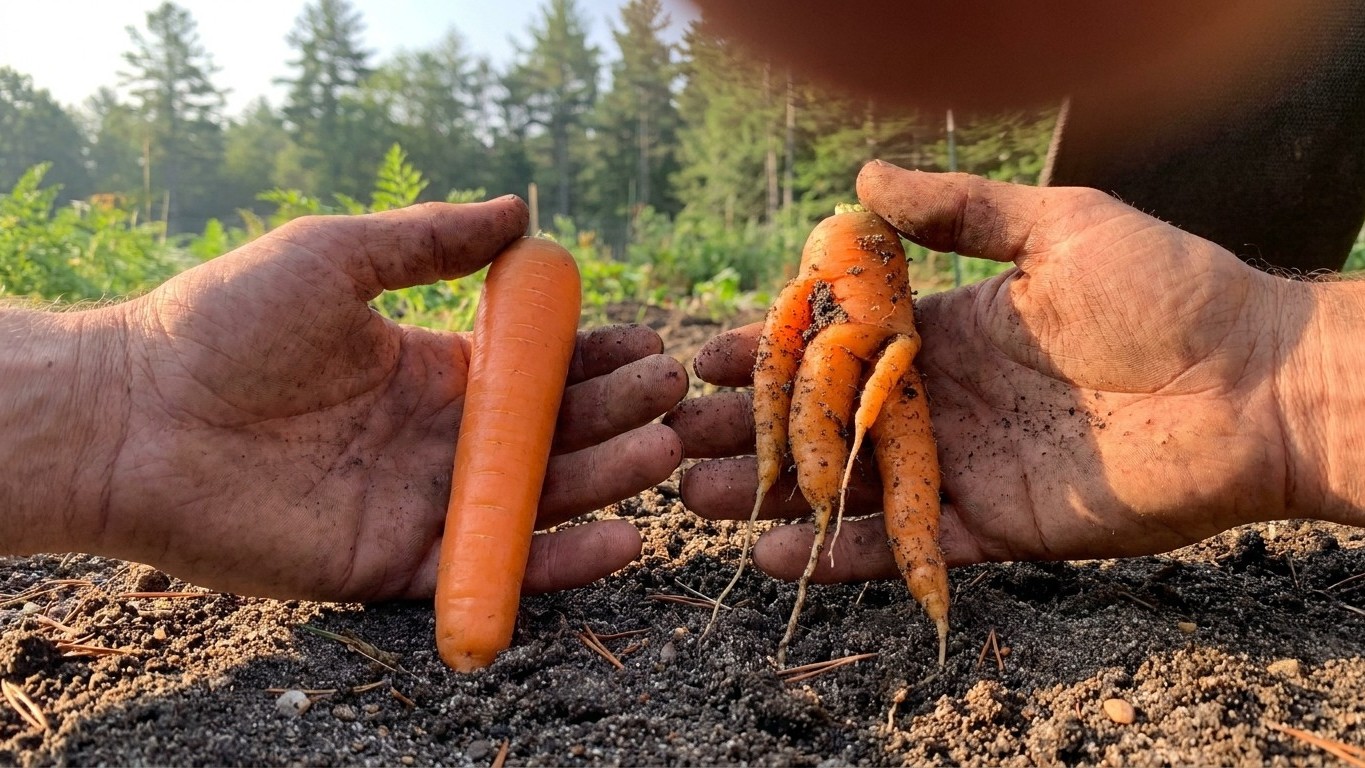

New Hampshire’s benchmark soil runs sandy and sharply acid, the kind of ground that drains fast but starves a carrot of the loose, deep root run it needs. Whether your own bed forks or fills out clean depends less on the state average and more on what’s actually under your boots, and that’s a five-minute dig away from knowing.
The short answer
The soil USDA lists as representative of New Hampshire is the Marlow series, a Spodosol, the acid, sandy, strongly leached soil type you’d expect to find under a stand of conifers. Its surface horizon runs 57 percent sand, 5 percent clay and 38 percent silt, with a surface pH around 3.5, which is strongly acid, and it’s classed as well drained. That texture, heavy on sand and light on clay, sounds like good news for a root crop that hates compaction.
But the organic matter figure attached to this series sits around 85 percent, and that number belongs to a natural forest floor, not a worked garden bed. A reading that high means the surface layer USDA sampled is peat, muck or accumulated forest litter, the kind of duff you’d rake off before you ever put a seed in the ground. A cultivated vegetable bed, turned and amended over seasons, won’t carry anything close to that organic-matter percentage, and the strongly acid pH is a property of that same undisturbed surface horizon, not a number you should assume belongs to your own dirt. So Will Carrots Fork in New Hampshire Soil? The answer depends on what’s actually under that duff layer, not on the raw survey numbers.
Set the organic-matter and pH oddities aside and the texture still tells a real story. Sandy, well-drained ground of this kind rarely forks a carrot on its own, according to Utah State University Extension’s guidance on carrot growing, which points to heavy or rocky soil as the usual cause of forked roots. Carrots want soil that’s deep, loose, sandy and well drained; forking shows up when a taproot meets clay, compaction or stones and splits around the obstruction instead of pushing straight down.
If your patch of New Hampshire ground actually resembles the Marlow profile, sandy and free-draining, you’re closer to what a carrot wants than a gardener working heavy clay elsewhere in New England. If it doesn’t, and plenty of New Hampshire dooryards sit over glacial till, ledge, or compacted fill rather than native forest soil, the fix Utah State names is straightforward: work in plenty of compost and double dig the bed to break up any hardpan, or skip the argument with your subsoil entirely and grow in a raised bed filled with loose, amended mix.
None of this is a diagnosis of your yard. New Hampshire spans hundreds of mapped soil series, from river-bottom silt to shallow, rocky hillside ground, and the Marlow profile is a statewide reference point, not a survey of every backyard in the state. Treat it as a starting assumption to test, not a verdict.
The test that settles it in your own garden
- Dig a hole at least a foot deep where you plan to sow. Carrots need that much clear, loose depth to grow straight; if you hit dense, hard-packed soil, a rock layer, or a ledge shelf well before a foot down, that’s your obstacle, and it’s the same kind of obstacle that makes a root fork.
- Look at what came out of the hole. Count the stones and note their size. Frequent rocks or a hard clay layer close to the surface are exactly the conditions Utah State University Extension flags as the cause of forked roots, and they tell you a raised bed or a double-dug, stone-cleared bed is worth the effort.
- Feel the texture between your fingers. Rub a moist handful of soil. Gritty and loose that falls apart easily leans sandy, which drains well but may need added organic matter to hold moisture. Sticky, smooth soil that molds like clay and holds its shape signals the heavy, compacted ground carrots struggle in.
- Watch how water drains. Fill your test hole with water and see how long it takes to disappear. Water that lingers for hours points to poor drainage and a soil dense enough to deform a taproot. Water that vanishes quickly suggests the loose, well-drained profile carrots prefer.
None of these steps will hand you a lab-grade percentage for your own sand, silt and clay content, and this page won’t invent one for you. What they will do is tell you, in plain terms, whether your bed behaves like the sandy, well-drained Marlow reference or like the heavy, rocky ground that forks a carrot, and that’s the only distinction that actually changes what you do next.
When to sow here
- Start from your last spring frost. For the reference weather station used in New Hampshire climate normals, the last spring freeze falls somewhere between April 16 and April 27, based on NOAA’s 1991-2020 climate normals. That’s a station reading, not a promise for every county, and gardens outside town centers, especially at elevation or in low-lying frost pockets, often see their last frost run one to two weeks later.
- Count backward two to three weeks. Carrots are sown directly in the ground, never transplanted, and they tolerate cool soil better than many vegetables. That means the sowing window opens roughly two to three weeks before your last expected frost date, putting a rough starting point somewhere in late March to mid-April for gardens close to the reference station, earlier or later depending on how your own site compares.
- Check the soil temperature before you sow. Carrot seed needs soil at a minimum of 40 degrees Fahrenheit to germinate at all. A soil thermometer pushed a couple inches down tells you more than the calendar does; cold, wet soil in early spring can sit at 40 degrees for a while even after the air has warmed.
- Aim for the germination sweet spot. Carrots germinate best when soil temperature sits between 55 and 65 degrees Fahrenheit. Sowing at the 40-degree minimum will work, but slowly; waiting until soil reaches the 55-to-65 range speeds germination and gives you a more even stand.
- Count your maturity window from seeding, not from any transplant date. Carrots have no transplant stage, so the 70 to 100 days most varieties need to mature are counted from the day seed goes in the ground. Sow toward the early end of your window and you buy yourself margin against a cool, slow start.
What goes wrong here
- Forked roots in heavy or rocky ground. When a taproot meets compacted clay or a stone, it splits or bends around the obstruction instead of growing straight. Utah State University Extension’s remedy is to work in generous compost and double dig the bed to loosen and clear it, or to bypass the problem with a raised bed filled with a loose, sandy mix.
- Poor or patchy germination during a hot spell. Carrot seed germinates best between 55 and 65 degrees Fahrenheit, and soil that spikes well above that range during a warm stretch can slow germination or thin your stand. Sowing early enough to land in that window, and keeping the seedbed consistently moist during germination, keeps a hot snap from wrecking a planting.
- Split roots from uneven watering. Carrots that dry out and then get soaked, whether by a missed week of watering followed by heavy rain or an inconsistent irrigation schedule, tend to crack along the root as it swells unevenly. Steady, even moisture through the growing season, rather than feast-or-famine watering, is the straightforward fix.
- Slow starts in sandy soil that’s too lean. Sandy ground like the Marlow reference profile drains fast, which carrots like, but sand alone can run short on the organic matter and moisture-holding capacity roots need to size up well. Working compost into a sandy bed before sowing addresses both the nutrition and the moisture retention at once.
Checking this against your own county
Everything above starts from one representative soil series and one reference weather station, and New Hampshire’s actual ground and frost timing vary a good deal by county and by elevation. Before you commit a season to a planting plan, it’s worth checking both against local numbers.
UNH Extension, the University of New Hampshire’s land-grant extension service, is the resource built for exactly this, and can point you toward local soil testing, county-specific frost guidance, and planting calendars tuned to your part of the state rather than a single reference point. You can find them at extension.unh.edu.
Common questions
Do I need to test my garden’s pH before growing carrots in New Hampshire?
The strongly acid pH tied to the state’s representative Marlow soil series describes an undisturbed forest surface, not a cultivated vegetable bed, so it shouldn’t be treated as your own soil’s pH. A proper soil test through your local extension office will give you an actual reading for your bed rather than a statewide estimate.
Can I sow carrots earlier than two to three weeks before the last frost?
Carrot seed needs soil at a minimum of 40 degrees Fahrenheit to germinate, so sowing much earlier than that window usually just means the seed sits in cold, wet ground without sprouting. Checking soil temperature directly with a thermometer is a more reliable guide than counting days on a calendar.
What causes carrots to fork even in loose soil?
Forking traces back to something the taproot meets on its way down, most often a stone, a pocket of compacted clay, or fresh manure that hasn’t broken down. Even soil that feels loose at the surface can hide a harder layer a few inches under, which is why digging a test hole a foot deep matters more than a surface impression.
How long does it take carrots to mature after sowing in New Hampshire?
Most carrot varieties need 70 to 100 days counted from the day seed goes into the ground, since carrots are direct-sown and never transplanted. Sowing toward the earlier end of the recommended window gives a longer runway before fall frost shortens the growing season.