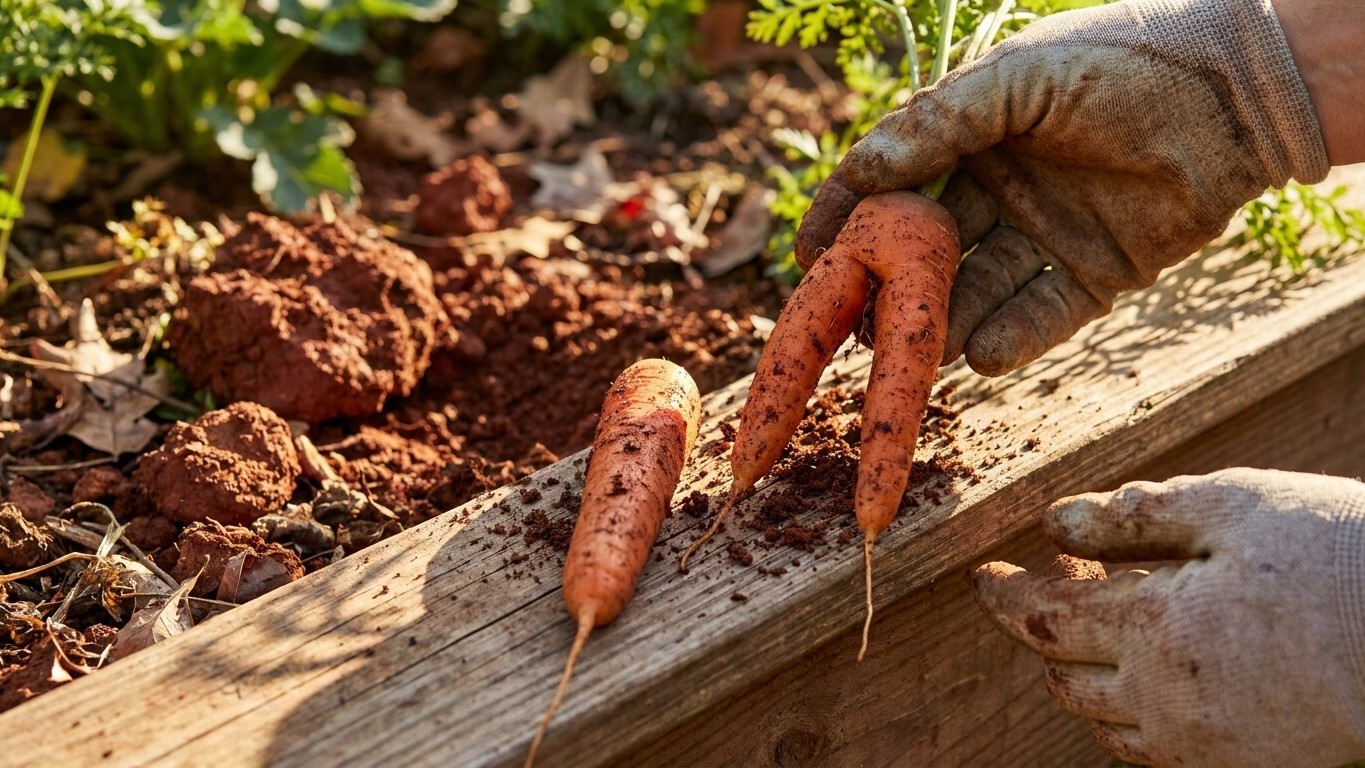

New Hampshire’s representative soil, the Marlow series, runs sandy and well drained: 57 percent sand, only 5 percent clay. On texture alone, that’s good carrot ground and forking from heavy clay is not the state’s default risk. But this soil is also strongly acid at the surface and formed under forest, which changes what a gardener actually has to fix before roots grow straight.
The short answer
The soil USDA lists as representative of New Hampshire is the Marlow series, a Spodosol, the kind of soil that typically forms under conifers in cool, humid climates. USDA’s Soil Data Access records for the surface horizon of this series (averaged across 215 mapped components) put the texture at 57 percent sand, 38 percent silt, and 5 percent clay, a loam to silt loam. Drainage is classed as well drained. Surface pH runs about 3.5, which is strongly acid. Organic matter at the surface averages around 85 percent.
That last figure needs a flag before anyone reads too much into it. An organic-matter reading above roughly 20 percent doesn’t describe topsoil in the way a gardener thinks of it. It describes a natural surface layer of peat, muck, or undecomposed forest litter, the duff you’d find under a stand of pine and hemlock, not a bed that’s been tilled, planted, and harvested for years. A worked garden plot won’t carry that number. So take the texture and drainage class as the useful part of this profile, and set the organic-matter figure aside as a description of undisturbed forest floor, not a promise about your raised bed.
With that caveat, what does 5 percent clay and well-drained loam mean for a carrot? Utah State University Extension is direct on the mechanism: carrots want deep, sandy, well-drained soil rich in organic matter, and it’s heavy or rocky ground that makes the taproot fork, splitting around an obstruction instead of growing straight down. A soil built like the Marlow series, low clay, well drained, sits on the favorable side of that line. Forking driven by clay content and poor drainage is not what this representative profile predicts.
The acidity is the piece that still needs attention. A pH near 3.5 is well outside the range most vegetable crops tolerate, and a gardener working ground like this would need to test and correct pH before anything else, regardless of how good the sand and drainage numbers look. Compost addition, worked into the top 12 inches or so, does double duty here: it buffers acidity over time and adds the organic matter that a natural forest surface, once disturbed and farmed, won’t hold onto on its own.
None of this is a verdict on any one backyard. New Hampshire spans hundreds of mapped soil series, and the Marlow series is simply the one USDA names as representative of the state as a whole. A garden in a river valley, a yard built on fill dirt, or a plot half a mile away on a different hillside can carry a completely different texture, drainage class, and pH. This section is a starting point for what the region’s ground tends to do, not a diagnosis of the dirt under your own carrots.
The test that settles it in your own garden
State soil surveys describe the county. They don’t describe the 4-by-8 bed you’re about to plant. The only way to know what your carrots will actually meet underground is to dig into it yourself, and it takes about twenty minutes.
- Dig a hole at least a foot deep. Carrots need loose ground to that depth or more, depending on the variety, so this is the minimum test hole, not an optional extra.
- Look at what comes out. Note where the soil changes color or texture as you go down, and flag any layer of hardpan, rock, or dense clay that would stop a taproot cold.
- Count the stones. Rocky ground is one of the two things Utah State University Extension names as a direct cause of forked roots. If you’re pulling out fist-sized stones every few inches, that’s your answer before you plant a single seed.
- Feel the texture. Grab a handful of moist soil and squeeze it. Soil that forms a slick, sticky ribbon is high in clay. Soil that falls apart and won’t hold any shape at all is mostly sand. Something in between that holds together loosely is closer to a loam, which is what carrots want.
- Watch how water moves through it. Pour a bucket of water into your test hole and time how long it takes to drain. Water that sits for hours signals the poor drainage that, alongside heavy texture, pushes carrots to fork around resistance instead of growing straight.
- Send a sample for a lab pH and nutrient test. A squeeze test tells you texture, not chemistry. If you want an actual pH number for your bed rather than a state-level figure, a soil test through your local extension office is the way to get one.
What goes wrong here
Even where the regional soil profile leans favorable, a handful of predictable problems still show up in carrot beds. Each one traces back to the same handful of soil and weather conditions, and each has a fix that doesn’t require starting over.
- Forking in heavy or compacted ground. Wherever a garden’s actual soil runs heavier in clay or carries buried rock and root debris (which will vary from the sandy, low-clay profile the state’s representative soil suggests), the taproot splits trying to work around the obstruction. Utah State University Extension’s remedy is to work in generous compost and double dig the bed, loosening soil well beyond the top few inches so roots meet no resistance on the way down.
- Poor germination during a hot, dry stretch. Carrot seed is small and sits near the surface, so it dries out fast once the topsoil crusts over in warm weather. Keeping the seedbed consistently moist until germination, rather than letting it dry and rewetting on and off, is what gets a full stand up rather than a patchy one.
- Splitting from uneven watering. A root that grows through a dry spell and then gets hit with a heavy soak can split along its length as the interior expands faster than the skin. Steady, even watering through the growing season, rather than a stretch of neglect followed by a drenching, keeps roots intact.
- Stunted or twisted roots in shallow, unimproved beds. Even in ground that isn’t especially heavy, a shallow topsoil layer over a harder subsoil forces the taproot to bend or stop early. A raised bed, built up with loosened, amended soil to a full 12 inches or more, sidesteps whatever the native subsoil is doing underneath.
Common questions
Does New Hampshire’s state soil mean my carrots won’t fork?
It means the texture USDA records for the Marlow series, sandy with only 5 percent clay and well drained, sits on the favorable side of what Utah State University Extension identifies as the forking risk (heavy or rocky soil). But that’s a state-representative figure across hundreds of mapped series, not a reading of your specific bed. Dig your own test hole before assuming anything.
Should I worry about the strongly acid pH listed for this soil?
The surface pH recorded for the Marlow series is about 3.5, strongly acid, and that number describes the natural, undisturbed profile USDA mapped, not necessarily a cultivated garden bed nearby. If you want to know your own soil’s pH, a lab test through your local extension office gives you an actual number to work from rather than a state-level average.
Does the high organic-matter figure for this soil mean I don’t need compost?
No. That figure, around 85 percent, describes a natural surface layer of forest litter or peat as it exists unfarmed, not the organic content of a worked vegetable bed. A cultivated garden plot won’t carry anything close to that number and still benefits from compost added at planting time, both for carrots’ preference for rich, loose soil and as a buffer against acidity.
How many days do carrots take from seed in this soil?
Carrots are sown directly in the ground, not transplanted, so every day counts from the seeding date rather than from a transplant date. Utah State University Extension doesn’t attach a specific day count to New Hampshire’s soil conditions in this profile; check seed packaging or your local extension office for a timeline suited to your planting date and variety.