
Alberta’s farmland soil runs loam to silt, roughly 37 percent sand, 21 percent clay and 42 percent silt, with organic matter near 5.2 percent and good drainage. That combination sits in a fairly forgiving middle ground for carrots: not the sandy dream soil growers chase, but not the heavy clay that guarantees forked roots either. Sowing timing matters just as much, and it starts from an average last frost around May 21.
The short answer
The most common soil across mapped Alberta farmland is a Chernozem, the dark, organic-rich prairie soil that covers about 40 percent of the province’s surveyed surface, with Luvisolic soils coming in second. Pulled from measurements on 2,154 mapped soil components by Agriculture and Agri-Food Canada’s Canadian Soil Information Service, the median surface reading comes out to about 6.5 pH (slightly acid), a texture of 37 percent sand, 21 percent clay and 42 percent silt, roughly 5.2 percent organic matter, and a well-drained classification.
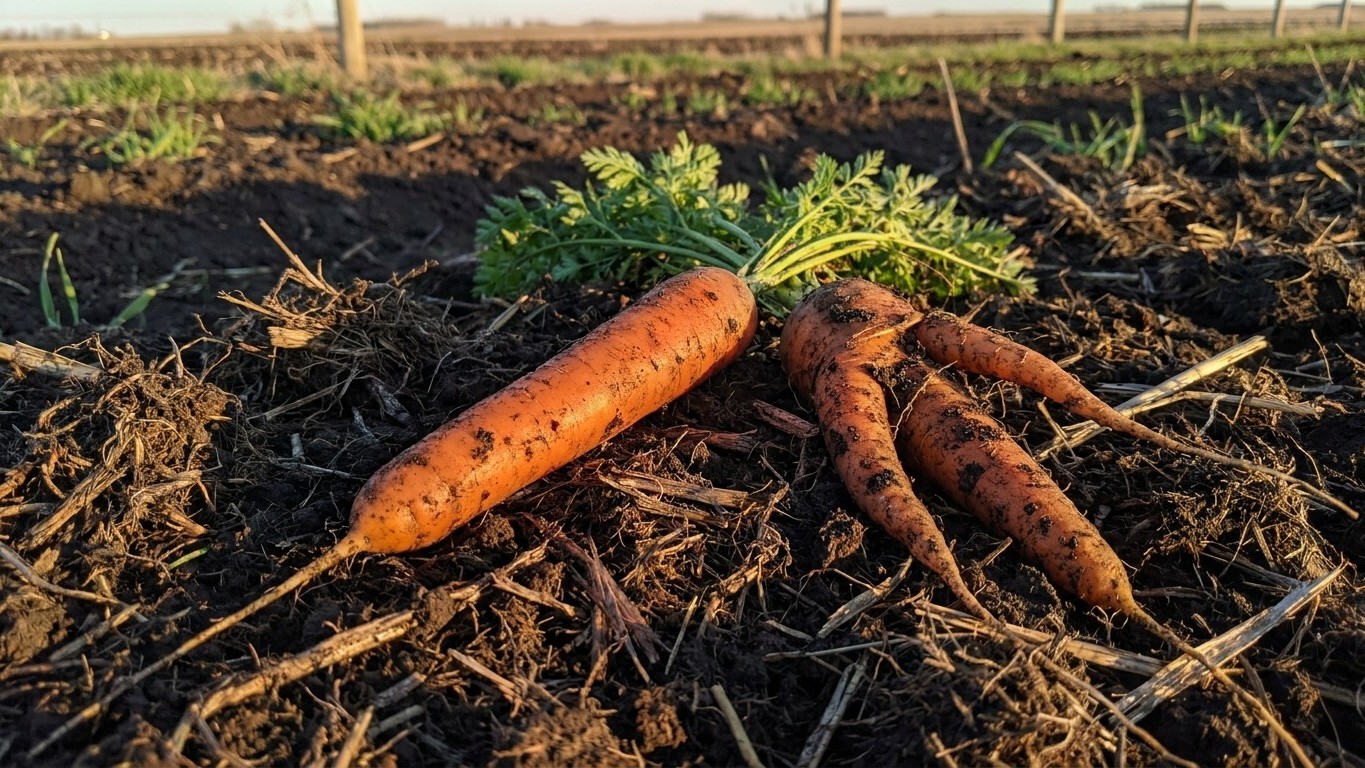
For carrots, that’s a mixed but workable starting point. Utah State University Extension is blunt about what carrots need: deep, sandy, well-drained ground rich in organic matter. Heavy or rocky soil is what makes a carrot root fork, splitting around a stone or a dense clay lens instead of driving straight down. Alberta’s typical 21 percent clay isn’t extreme, and the well-drained rating and 5.2 percent organic matter both work in the carrot’s favor. But that texture leans toward silt more than sand, which means a garden bed sitting on the heavier end of the province’s range can still cause forking, especially if it’s been compacted by foot traffic or heavy equipment.
The fix, per that same Utah State guidance, is either working in generous compost and double digging the bed to break up density below the surface, or skipping the fight altogether with a raised bed filled with a lighter, sandier mix. Double digging means turning the soil a full spade deeper than usual and mixing organic matter through both layers, not just the top few inches. A raised bed sidesteps the question completely by giving the taproot loose, uniform ground with no native clay to push through.
None of this is a diagnosis for any one garden. Alberta spans hundreds of individual soil series, and the survey behind these numbers covers the province’s agricultural belt, not the far north, which isn’t represented in the mapped data at all. A number pulled from 2,154 components is a median, not a promise, and river-bottom ground, old muskeg, or any yard where a builder scraped and refilled the topsoil can sit nowhere near it. Treat the Chernozem profile as a reasonable guess about what the region’s ground tends to do, then confirm it with the dirt actually in the bed.
The test that settles it in your own garden
A provincial median can’t tell you what’s under your own carrot bed. The only way to know is to look, and it takes about twenty minutes with a shovel.
- Dig a hole at least a foot deep in the bed you plan to plant. Note how far down you get before you hit dense clay, rock, or a hardpan layer that resists the shovel. Carrots need that depth clear, since a forked root is often just a taproot that ran into resistance and split around it.
- Check for stones and buried debris in the soil you just turned. Anything larger than a pebble sitting in the root zone is a likely forking point, and it’s easier to sift it out now than to explain a twisted carrot at harvest.
- Grab a handful of moist soil from that hole and rub it between your fingers. Gritty and loose suggests sand-heavy ground, closer to what carrots want. Slick, sticky, and able to roll into a ribbon suggests clay-heavy ground, which raises the odds of forking and points toward compost and double digging or a raised bed instead.
- Watch how the hole itself behaves after a rain or a deep watering. Water that disappears within a few hours suggests decent drainage. Water that sits and pools for a day or more signals a drainage problem worth addressing before you invest in seed, since carrots sulk in soil that stays soggy.
- Repeat the dig-and-feel check in more than one spot if the bed is more than a few feet wide. Soil texture can shift noticeably within the same yard, particularly on lots where fill dirt was added during construction.
When to sow here
Carrots go into the ground as seed, straight into their final bed. There’s no transplanting step to count from, so every date here runs from the day you sow, not from any seedling stage.
- Start with the average last spring frost for the region. Environment and Climate Change Canada’s Climate Normals for the Calgary International Airport station, covering the 1981 to 2010 period, put that average at May 21. That’s a mean date, not a guarantee: in roughly half of all years, the frost lands later than that, so treat it as the midpoint of a window rather than a green light.
- Count back two to three weeks from that average date. Subtracting two to three weeks from May 21 lands sowing somewhere in the last days of April through the first days of May, depending on how the current season is running and how far your own property sits from the Calgary reference station.
- Before trusting the calendar, check the soil itself. Carrot seed needs the ground at a minimum of about 40 degrees Fahrenheit to germinate at all, and a soil thermometer pushed a couple of inches down tells you more than any date on a chart.
- Aim for the sweet spot rather than the minimum. Germination runs best when soil temperatures sit between 55 and 65 degrees Fahrenheit, and seed sown into soil that’s merely thawed but still cold will sit and rot before it sprouts.
- Remember the frost date comes from one station. Alberta is not one climate zone, and northern districts or higher-elevation land will run behind the Calgary average by days or weeks, so adjust the whole sequence later if that describes your area.
What goes wrong here
- Forked roots in heavier pockets of ground. Alberta’s typical soil sits at 21 percent clay, which is moderate, but any bed running heavier than that, or compacted by traffic, will split a taproot around the resistance. Work compost through the full depth of the bed and double dig it, or plant in a raised bed with looser, sandier soil.
- Poor germination during a hot spell. Once soil temperature climbs well past the 55 to 65 degree Fahrenheit range that suits carrot seed, germination slows and gaps show up in the row. Sowing on the early side of the window, and keeping the seedbed shaded and evenly moist during a warm stretch, keeps more seed viable.
- Splitting from uneven watering. Carrots that dry out and then get soaked, whether from an irregular hose schedule or a heavy rain after a dry week, tend to crack along the root. A steady watering routine matters more than the total amount of water applied.
- Stunted or misshapen roots from buried stones and debris. A quick sift through the top foot of soil before sowing catches most of these before they become a harvest surprise.
Checking this against your own county
The Chernozem profile and the Calgary frost average both describe patterns across a wide stretch of the province, not any single yard. For soil testing services and up-to-date planting guidance specific to your part of Alberta, the province’s agriculture office at Alberta Agriculture and Irrigation is the place to start. A local test result, paired with the dig-and-feel check from your own bed, will tell you far more than any provincial median ever could.
Common questions
Does Alberta’s soil naturally suit carrots?
It’s a mixed picture. The typical loam-to-silt texture and well-drained rating help, but the 21 percent clay median means some gardens will still see forking without added compost or a raised bed.
How do I know if my soil is too heavy for carrots?
Rub a moist handful between your fingers. If it feels sticky and rolls into a ribbon rather than falling apart, it’s on the clay-heavy side, and forking becomes more likely without amendment.
Is May 21 a safe date to sow carrots in Alberta?
No. It’s the average last frost from Environment and Climate Change Canada’s Calgary station data, meaning frost arrives later than that in roughly half of all years. Use it as a general marker, not a guarantee.
What soil temperature do carrot seeds need to germinate?
A minimum of about 40 degrees Fahrenheit, with the best germination happening between 55 and 65 degrees. A soil thermometer gives a more reliable answer than the calendar alone.