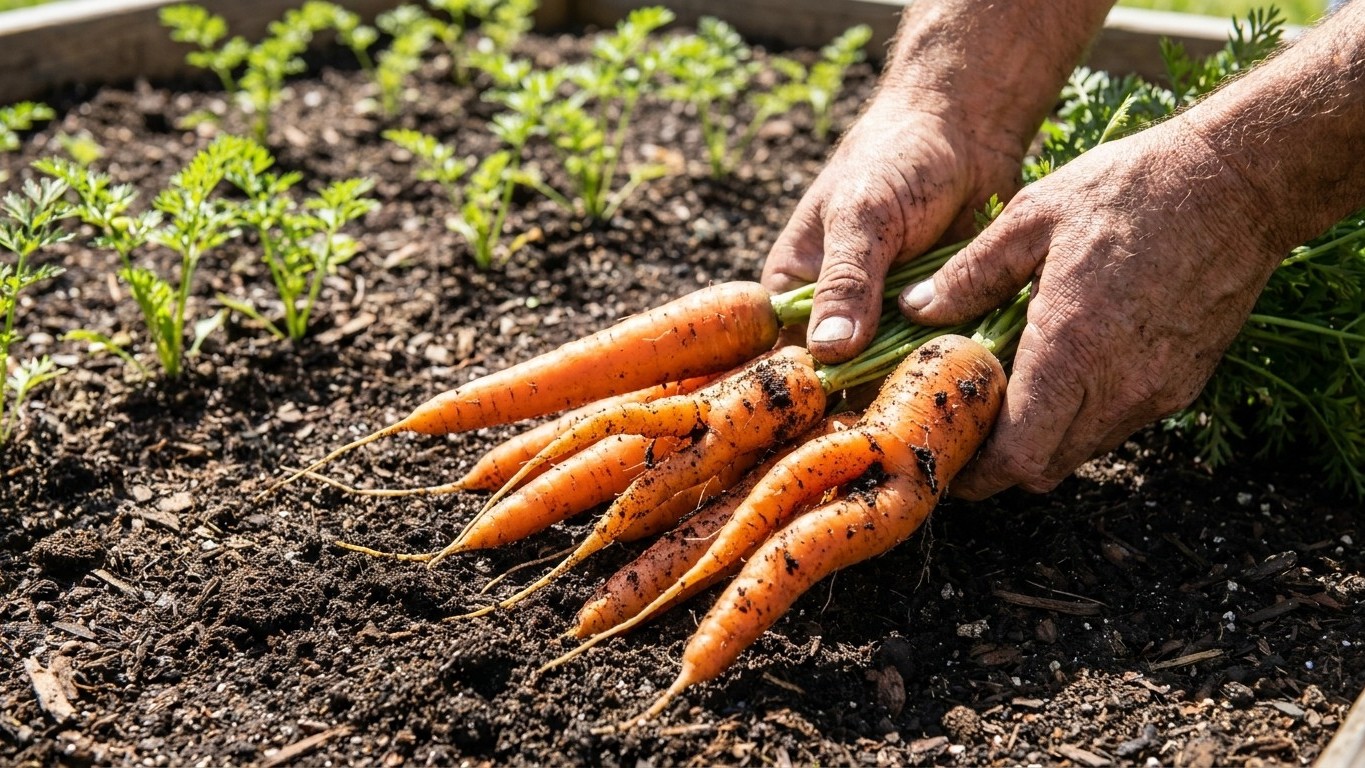

The short answer: Sow Carrots in New Hampshire by counting back from your local last-frost date, since carrots go straight into the ground with no transplanting involved. But that date is only half the equation. The other half is the ground itself, and New Hampshire’s representative soil carries traits that change how that seed performs long before frost ever enters the picture.
The short answer
New Hampshire’s state soil is the Marlow series, a Spodosol, the kind of soil that forms under conifer forests after centuries of rain washing minerals downward. The surface horizon runs 57 percent sand, 5 percent clay and 38 percent silt, and it drains well. On paper, that texture leans in a carrot’s favor: carrots want deep, sandy, well-drained soil rich in organic matter, according to Utah State University Extension, and heavy or rocky ground is what makes a root fork instead of growing straight.
Marlow’s surface pH sits around 3.5, which is strongly acid. That’s a striking number to see attached to any garden soil, and it comes with a catch worth flagging: the organic matter content for this series runs about 85 percent at the surface. A figure that high signals a natural organic layer, forest litter or duff sitting on top of mineral soil, not the kind of worked, amended bed most home gardeners are digging into. A cultivated vegetable bed simply won’t carry that much raw organic material once it’s been tilled, limed and planted for a season or two.
So what does this mean for a carrot going into New Hampshire ground? The texture itself, sandy with only 5 percent clay, is close to what carrots prefer. Compaction and forking are less likely here than in a heavier clay-belt soil. The acidity, though, is the flag to watch. Strongly acid ground straight out of the forest floor is not the same as a garden bed that’s been limed and cropped for years, and it’s the kind of thing a soil test will catch far better than any guess based on a state-level series.
None of this is a diagnosis of your yard. New Hampshire spans hundreds of mapped soil series, from river-bottom silt in the Connecticut Valley to glacial till on hillsides to whatever a builder dumped and graded when your house went up. The Marlow series is simply the one USDA lists as representative of the state under its State Soils program, a starting point for understanding regional tendencies, not a stand-in for the dirt under your own carrot bed.
If your own ground turns out to be heavier than that, the fix Utah State names is straightforward: work in plenty of compost and double-dig the bed before sowing, loosening and enriching to a depth carrot roots can actually push through. Where native soil is shallow, rocky, or simply too far from that sandy ideal to fix by digging, a raised bed filled with a loose, sandy mix sidesteps the problem entirely, and it’s often the faster route for anyone dealing with New England’s glacial stone.
The test that settles it in your own garden
- Pick the spot where the carrot bed will actually go, not a random corner of the yard, and dig a hole about a foot deep with a shovel or garden fork.
- Look at what comes out. Note how deep you got before hitting rock, hardpan, or a distinct color change, since that depth is roughly how far a carrot root can travel before it hits resistance and forks.
- Count the stones. A shovelful riddled with pebbles and cobbles is a strong sign that raised beds or heavy screening will serve you better than digging in place.
- Grab a handful of moist soil from that hole and squeeze it. Sand falls apart and feels grainy. Clay balls up, holds its shape, and feels slick or sticky. Silt sits somewhere between, smooth but not sticky. This tells you where your ground sits relative to the sandy, low-clay texture carrots favor.
- Fill the hole with water and time how long it takes to drain. Water that lingers for hours points to poor drainage and a soil more prone to the splitting and disease that come with waterlogged roots; water that vanishes almost immediately suggests a soil so light it may need extra organic matter just to hold moisture evenly.
- Send a sample to your state’s Cooperative Extension soil-testing lab if you want an actual pH and nutrient reading, since a squeeze test tells you texture, not chemistry.
Do this once, in the actual bed, and you’ll know more about what your carrots are dealing with than any state-wide figure can tell you.
What goes wrong here
- Forking in heavy ground. Even in a state whose representative soil runs sandy, plenty of individual yards sit on denser, clay-rich pockets, especially in low-lying or previously graded areas. Roots meet resistance, split around a stone or a compacted layer, and fork instead of growing straight. The remedy is the one Utah State University Extension gives directly: work in generous compost and double-dig the bed before sowing, breaking up compaction to the full depth a mature carrot root will need.
- Poor germination during a hot spell. Carrot seed is slow and finicky to begin with, and a stretch of hot, dry weather right after sowing can dry out the top half-inch of soil before the seed ever cracks. Keep the seedbed consistently moist, watering lightly and often rather than deeply and rarely, until seedlings are up and rooted.
- Splitting from uneven water. A dry spell followed by a heavy soak, common in a New England summer that swings between drought and downpour, makes roots grow in fits and starts. The outer tissue can’t keep pace with a sudden growth spurt, and the root splits open. Even, consistent watering through the growing season is the fix, not a variety change or a different sowing date.
- Slow starts in acid, unamended ground. Where garden soil still carries some of that strongly acid character typical of the region’s forested background, root development and nutrient uptake can lag. A soil test that flags low pH is worth acting on with lime before the next sowing, rather than guessing at a fix mid-season.
Common questions
Do I need to transplant carrot seedlings in New Hampshire?
No. Carrots are sown directly in the ground where they’ll grow to maturity. There’s no transplanting step, so the 70 to 100 days to harvest that carrots typically need are counted from the day you sow the seed, not from any later transplant date.
What’s the exact last-frost date for my part of New Hampshire?
That specific figure isn’t published here. Last-frost dates vary sharply across the state, from the milder Seacoast to the colder North Country and mountain valleys, and the right approach is to check the recorded average for your own county before counting backward to a sowing date.
Is New Hampshire’s soil naturally good for carrots?
The state’s representative soil, the Marlow series, is sandy and well-drained at the surface, both traits carrots favor, according to Utah State University Extension’s growing guidance. But its surface pH runs strongly acid, and that natural forest-floor profile is a starting reference, not a substitute for testing your own bed.
My soil is heavy and rocky. Should I just plant a different vegetable?
Not necessarily. Heavy or rocky ground is exactly what causes carrots to fork, but the fix is amending the bed, not abandoning the crop. Working in plenty of compost and double-digging the soil loosens it enough for straight roots, and a raised bed filled with a loose, sandy mix solves the problem outright where the native ground is too shallow or stony to dig through.