
The honest answer for New Hampshire in January is that almost nothing goes into open ground this month. Soil across the state sits frozen solid, sometimes two feet down or more, and the last spring frost at the reference station doesn’t arrive until April 16 to April 27. What’s left is indoor seed starting, dormant-season jobs outside, and stored crops that need watching before they turn.
What goes in the ground in January

No outdoor bed in New Hampshire is ready for a seed or a transplant this month. The state spans USDA Hardiness Zones 3b to 6a, and even in the milder pockets near the coast or the Merrimack Valley, ground frozen at this depth won’t take a shovel, let alone a root. Trying to dig anyway just tears up soil structure for no benefit.
That doesn’t mean the garden goes untouched. A handful of things still make sense.
- Garlic and shallots, but only if you missed the fall planting window and happen to hit a rare stretch where the ground has thawed enough to work. In most winters that window is already closed by January, so treat this as a long shot, not a plan.
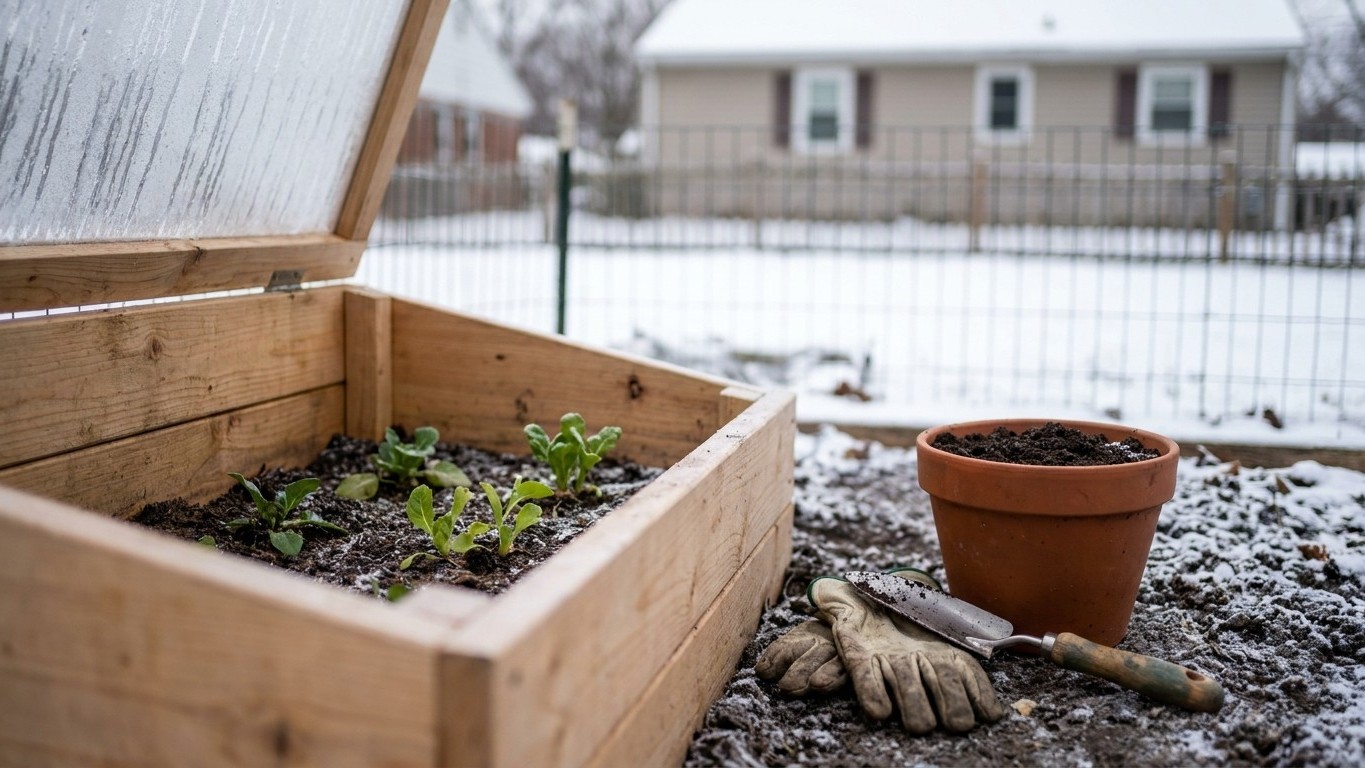
- Cold frames and low tunnels holding cool-season greens that were tucked in back in fall. They aren’t growing much, but they’re surviving, and that’s the point in the dead of winter.
- Bare-root and dormant plantings of fruit trees and shrubs, if and only if a thaw leaves the soil workable. This is weather-dependent and unreliable in a New Hampshire January, so most gardeners wait until the ground opens up for good.
- Forcing rhubarb or chicory indoors, which sidesteps the frozen ground entirely. Dug rhubarb crowns or chicory roots, kept in the dark and warm, will push tender new growth in a matter of weeks.
Everything else on a seed packet, from lettuce to peas to onions sown direct, waits. Planting them into frozen or waterlogged soil doesn’t just fail, it can rot the seed before it ever has a chance to germinate.
What to start under cover
Indoors is where January actually earns its keep. The math starts from the last frost window, April 16 to April 27 at the reference station, and works backward. Crops with the longest lead time get sown first, and January is exactly when that clock starts for a few of them.
Onions, leeks, and celery or celeriac from seed all need 10 to 12 weeks under lights before they’re ready to go outside. Counting back from mid to late April puts the sowing date for these slow starters right around late January, which makes this the true kickoff month for anyone growing onions or leeks from seed rather than sets or transplants. Add heat and steady moisture, since these seeds are slow to germinate in cool rooms.
Peppers and eggplant need 8 to 10 weeks, which usually points to February rather than January in most of the state, so resist the urge to jump the gun on those. That’s the first failure mode: starting warm-season crops too early. A pepper seedling started in January will be leggy, rootbound, and stressed by the time it’s safe to plant outside in late May or June, long after the container it started in has run out of room.
The second failure mode runs the other way. Skip the long-lead crops entirely and start everything in March, and onions and leeks simply won’t size up before the season runs out. Bulbing onions in particular need that early head start to form a decent bulb before summer daylight triggers them to stop growing.
What is ready to pick
Little comes out of a New Hampshire garden outdoors in January, and no amount of optimism changes that. But the pantry and the cold frame still have something to offer.
Kale and leeks left in the ground under mulch or snow cover often survive and can be dug when the soil isn’t frozen solid at the surface, though that’s inconsistent this deep into winter. Cold frames holding spinach, mâche, or claytonia planted back in fall will yield small, steady harvests of tender greens even when the air outside is well below freezing, since the frame traps just enough heat to keep them alive.
Indoors, sprouts and microgreens fill the gap. A tray of pea shoots or sunflower sprouts on a windowsill takes a week or two and needs no outdoor conditions at all.
Storage crops need a check-in now. Squash should feel firm, with no soft spots or that faint sweet smell that signals rot starting from the inside. Potatoes kept too warm will sprout early and should be moved somewhere cooler and darker. Onions with any give near the neck, or a whiff of that sharp odor, are on their way out and should be used first, not left to spoil the rest of the batch.
The jobs that matter this month
January carries its own workload, and skipping it costs real ground come spring.
Pruning and tool care
Dormant pruning of apple and pear trees, and of raspberry and blackberry canes, is best done now while the plants are fully asleep and the structure is easy to see without leaves in the way. Cuts made in dormancy heal faster and cause less stress than pruning once sap starts moving. This is also the slow season for sharpening pruners and loppers, oiling wooden handles, and scraping rust off anything that sat outside too long.
Ordering, planning, and soil
Seed catalogs move fast. Popular onion, tomato, and pepper varieties can sell out weeks before anyone else is thinking about planting, so ordering now avoids a spring scramble for a substitute variety. This is also the natural point to sketch out crop rotation for the coming season, since nothing is competing for attention in the beds yet.
A soil test taken now, through a lab or a state extension service, gives enough lead time to amend pH or nutrient levels before planting season arrives. Compost piles benefit from a turn even in cold weather, since it keeps the pile from going anaerobic and speeds decomposition once temperatures rise. Raised beds, fencing, and trellis hardware are easier to repair without a garden full of plants in the way, and it’s worth walking the whole property to spot what winter weather has already loosened or cracked.
What not to do in January
The most common mistake this month is judging soil readiness by the air, not the ground. A stretch of 50-degree days can feel like spring, but the soil several inches down is often still frozen or saturated, and any seed or transplant put into it will simply fail. Trust a soil thermometer over a jacket you didn’t need that afternoon.
A close second is uncovering cold frames or row covers too early after a mild spell. New Hampshire’s winter thaws are almost never the last cold snap of the season, and greens exposed too soon can be hit hard when temperatures drop back down, sometimes within days.
Feeding nitrogen to dormant trees, shrubs, or perennial beds is also a wasted, sometimes harmful, move right now. Plants aren’t taking up nutrients while dormant, and nitrogen applied to soil that then freezes and thaws repeatedly is more likely to leach away or, in a late warm spurt, push soft new growth that a hard freeze then kills. Save the feeding for when active growth actually starts.
One more: don’t till or dig wet, cold soil just because the calendar says it’s time to get started. Working soil that’s still saturated compacts it, and that damage can take a full season to undo.
Checking this against your own county
A statewide frost window is a starting point, not a promise. The April 16 to April 27 last-frost range and the October 13 to October 26 first-frost range both come from a single reference weather station, and gardens away from that station, especially at higher elevation or in low-lying frost pockets, often see frost linger later in spring and arrive earlier in fall, sometimes by a week or two. The gap between northern New Hampshire’s higher country and the milder Seacoast region is real and worth respecting.
Before locking in a planting date, check current conditions and local guidance through the UNH Cooperative Extension, which tracks frost risk and planting timing at the county level.
Common questions
Can I plant garlic in New Hampshire in January?
Only if the ground somehow remains workable, which is uncommon this deep into winter. Garlic planted in fall, roughly six weeks before the ground freezes, is the reliable route. A missed fall window usually means waiting for spring planting instead of forcing it into frozen soil.
Is it too early to start seeds indoors in January?
For onions, leeks, and celery, it’s close to the right time, since these need 10 to 12 weeks before the last frost window of April 16 to April 27. For peppers, tomatoes, and other warm-season crops, January is too early and risks leggy, rootbound seedlings by planting time.
What can I harvest from a New Hampshire garden in January?
Outdoors, options are limited to overwintered kale or leeks if the ground allows digging, and cold-frame greens like spinach or mâche. Indoors, sprouts and microgreens fill the gap, and stored squash, potatoes, and onions should be checked regularly for soft spots or sprouting.
Do frost dates in New Hampshire vary much by region?
Yes. The published April 16 to April 27 and October 13 to October 26 windows come from one reference station, and elevation, valley cold pockets, and the north-south divide across the state can shift those dates by a week or two in either direction. Local extension guidance is the way to narrow that down for a specific county.