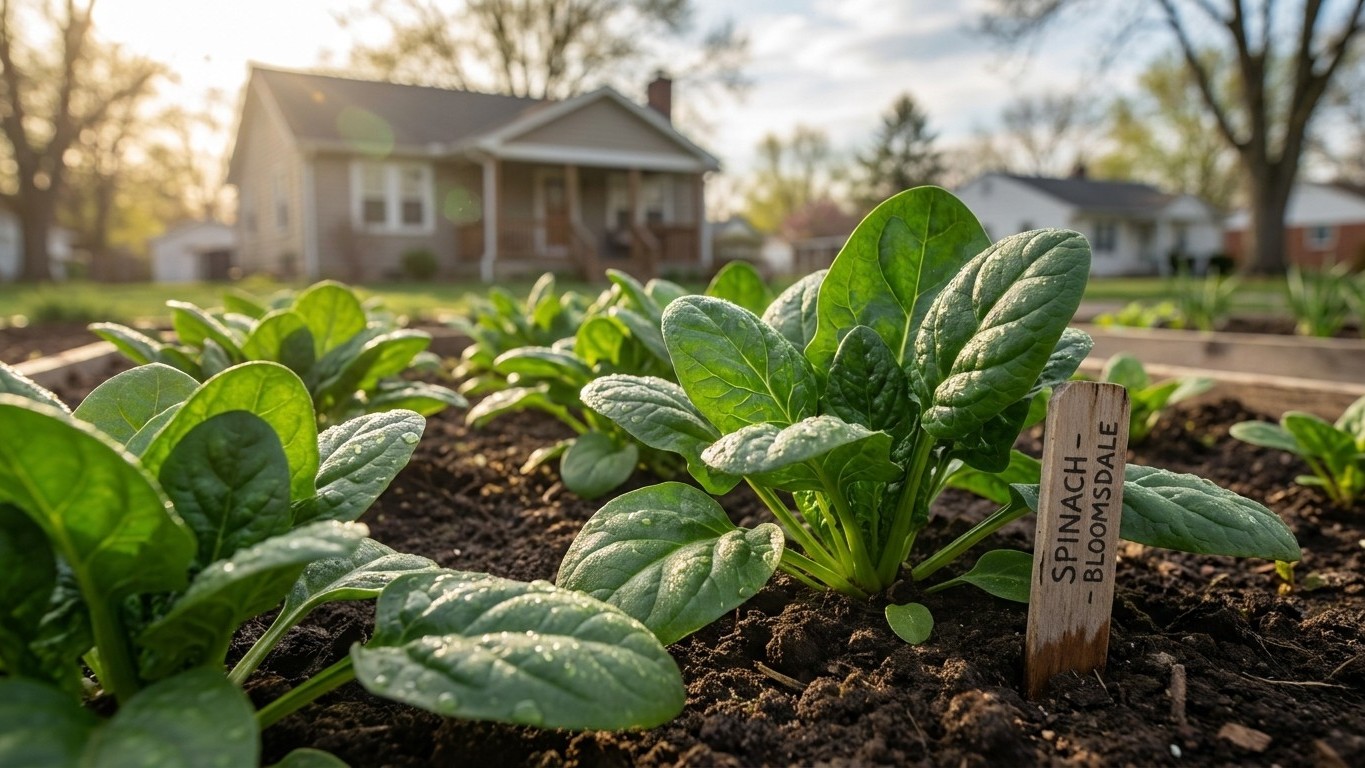

In Wisconsin, spinach bolts fast once the calendar rolls into late May or June, long before the state’s heat ever gets serious. Will Spinach Bolt Early in Wisconsin? The trigger is day length, not the mercury. With roughly 7 days a year above 90 F at the reference station, Wisconsin summers rarely punish spinach with heat the way southern states do. The plant still flowers on schedule because the days grow too long to stop it.
The short answer
On the longest day of the year, Wisconsin gets 15 hours and 10 minutes of daylight. That’s a lot of light, and for spinach, light is the enemy. Long days push the plant toward flowering (bolting) whether or not the weather cooperates. A cool, cloudy Wisconsin summer doesn’t change the sun’s schedule, and the sun’s schedule is what spinach responds to. So a mild June in Green Bay or Eau Claire buys nothing extra. The plant bolts on the same calendar as it would in a scorching summer, because the day length crossing happens regardless of temperature.
This is worth sitting with for a second, because it runs against instinct. Gardeners assume that if the thermometer stays friendly, a cool-season crop should just keep growing. Spinach doesn’t work that way. It reads photoperiod the way onions do, except in the opposite direction: long days make onions bulb up, useful growth. Long days make spinach flower and turn bitter, the end of usefulness. Same mechanism, opposite outcome, and it’s easy to carry the wrong lesson from one crop to the other.
Heat still plays a role, just a smaller one here than in warmer states. Utah State University Extension notes that spinach grows best where temperatures stay under 75 F, and that same 75 F line marks where the leaves start turning bitter. With only about 7 days a year crossing 90 F, Wisconsin doesn’t spend much of the growing season above that ceiling. Most days in a Wisconsin spring or early summer sit comfortably below 75 F. Which means the limiting factor here is overwhelmingly day length, not heat. Even in a year with a mild June, the spinach will bolt roughly on time, because the days got long enough regardless of how the thermometer behaved.
So the practical answer: expect bolting somewhere around late May into June for a spring crop, driven by the approach of the June solstice and its 15-hour-plus days. Heat can accelerate things in a hot stretch, but it isn’t required. The days alone will do the job. That short spring window is exactly why many Wisconsin gardeners shift their focus to a second crop; see When to Sow Autumn Spinach in Wisconsin for timing that avoids the bolting problem entirely.
How long the spring window really is
- Wisconsin’s average last spring frost falls between April 16 and April 29, depending on location, with the lakeshore running later than inland areas.
- Spinach seed goes into the ground 2 to 3 weeks before that last frost date, since the crop tolerates cold soil far better than heat. That puts sowing somewhere around late March to early April for most of the state.
- From that sowing date, the plant has a stretch of cool, short-enough days to put on leaf growth without bolting pressure. This stretch typically runs through April and into May.
- Day length climbs steadily toward the June solstice, and somewhere in that climb, usually late May to early June, the photoperiod crosses the point where spinach starts bolting regardless of temperature.
- Heat rarely intervenes first in Wisconsin. With growth staying good only below 75 F, and the state averaging just 7 days a year above 90 F, the 75 F ceiling gets crossed occasionally on a warm afternoon, but it isn’t the dominant force ending the crop.
- Add it up and the usable spring window runs roughly eight to nine weeks, from a late March or early April sowing to a bolt-driven finish in late May or early June, closing well before Wisconsin’s midsummer heat ever becomes relevant.
That’s a tighter window than gardeners moving from a warmer state might expect, but it’s also a more forgiving one in a different sense. The crop doesn’t get cooked out by heat here. It simply runs out of short days.
The autumn crop, and when the soil lets you sow
A fall planting gets around the day-length problem, since days are shortening rather than lengthening after the solstice. The obstacles shift to two different limits: soil that’s still too warm to germinate seed well, and the frost that eventually shuts the season down.
Soil too warm to germinate
Utah State University Extension notes that spinach seed germination drops off once soil temperatures climb above 80 F. In Wisconsin, that’s mainly a late-July and early-August problem, when soil has absorbed a summer’s worth of heat even though air temperatures rarely spike as high as they do farther south. There’s no published soil-temperature data for Wisconsin specifically here, but given the state’s modest heat load, soil should cool enough for reliable germination by mid to late August in most years. Gardeners in a particularly hot, dry stretch might want to wait it out a bit longer rather than fight poor germination.
The frost that ends the season
Wisconsin’s first fall frost lands between October 17 and October 29, again later near Lake Michigan and earlier inland and to the north. The source gives no fixed days-to-maturity number for spinach, only a planting guideline: sow 50 to 75 days before the date you want to harvest. Counting back from an October 17 harvest target, that puts sowing between roughly August 3 and August 28. Counting back from the later October 29 date near the lakeshore stretches that window into early September at the earliest edge. Either way, the practical sowing target for most of Wisconsin sits in the first three to four weeks of August, a window that lines up well with when soil temperatures should have dropped back under that 80 F germination ceiling.
Checking this against your own county
Frost dates and soil warming vary enough across Wisconsin that a statewide range only gets you so far. Lake Michigan pushes both the last spring frost and the first fall frost later along the shoreline, while inland southern counties typically see their first fall freeze in early October, and the far north considerably earlier than that. Before locking in a sowing date, check current conditions and local frost records with the University of Wisconsin-Madison Division of Extension, which maintains county-level offices with growing information specific to your soil and microclimate.
If you’re near the lake, lean toward the later end of both the spring and fall windows described above. If you’re inland or in the north, plan for frost sooner and adjust your fall sowing date earlier to stay inside that 50-to-75-day range.
Common questions
Can spinach handle a light frost in Wisconsin? Spinach tolerates cold far better than heat, which is why it goes in the ground 2 to 3 weeks before the last spring frost rather than after it. A frost that would kill tomatoes generally leaves spinach undamaged.
What varieties should Wisconsin gardeners consider? Bloomsdale, Melody, Teton, and Olympia are commonly named spinach varieties, but no performance or maturity data for any of them appears in the sources behind this article, so no claims about speed, bolt resistance, or yield are made here.
Does mulching or shade delay bolting? That’s not addressed by the sources used for this article. What is established is that bolting follows day length and warmth together, so anything that meaningfully changes the light or heat the plant experiences would, in principle, interact with those two factors.
Is a summer spinach crop possible in Wisconsin at all? Given that Wisconsin’s summer days reach 15 hours and 10 minutes at their longest, and that long days alone push spinach toward flowering, a summer sowing runs straight into the bolting trigger with no way around it. The spring and fall windows exist specifically because they sit outside that long-day stretch.