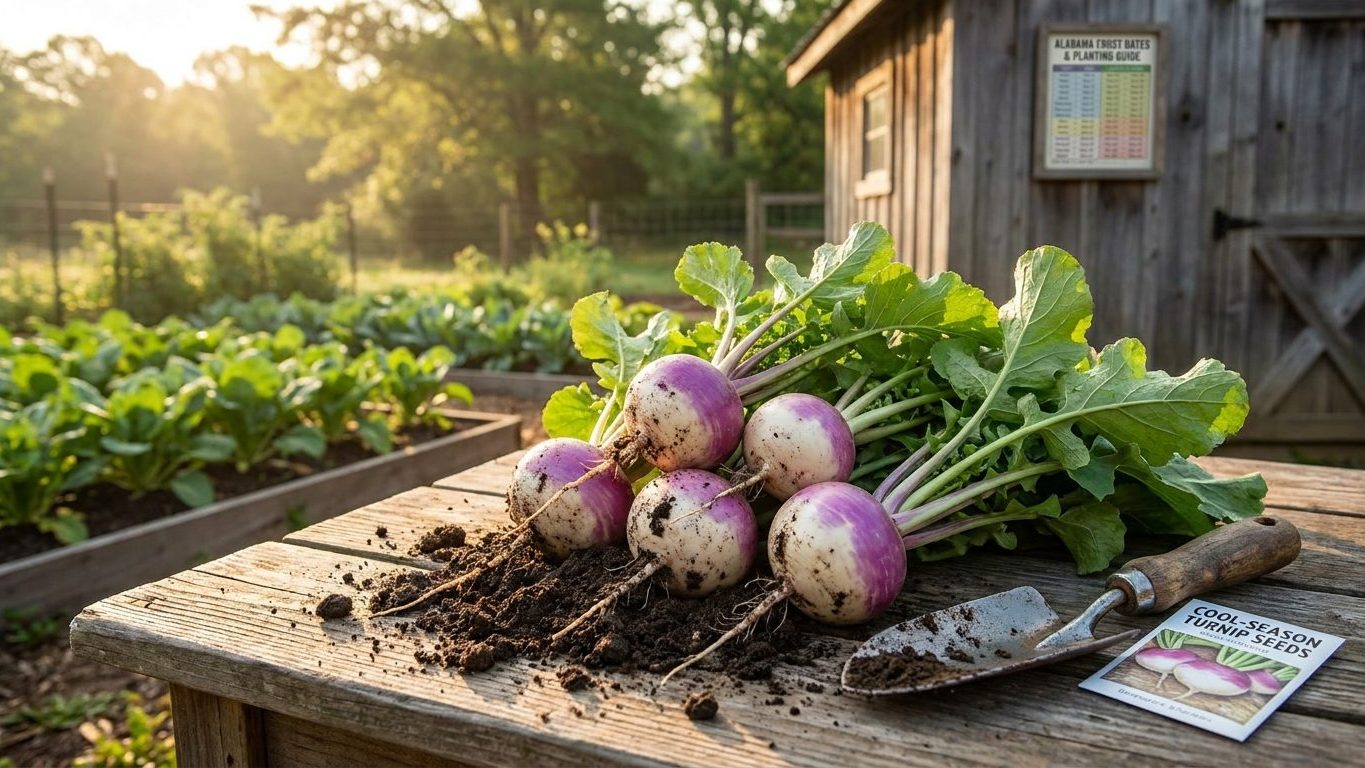

Sow turnips for baby roots and greens in late March to early April, then sow the main storage crop between mid-July and early August for a fall harvest. Both windows are built around New Hampshire’s frost dates, not a fixed date on a seed packet, and both shift depending on where in the state a garden sits.
The short answer for New Hampshire
The frost dates behind this calendar aren’t guarantees, they’re probabilities. NOAA’s 1991-2020 climate normals for the Manchester station put the last spring freeze between April 16 and April 27, meaning there’s a 30 to 70 percent chance a 32°F freeze lands somewhere in that stretch, not a switch that flips on April 27 and never freezes again. The first fall freeze at the same station runs the same odds in reverse, landing between October 13 and October 26.
Spring sowing window
Turnip seed germinates in soil as cool as 40°F, and young plants shrug off a light frost, so there’s little reason to wait for the calendar date once the freeze risk actually starts dropping. Direct-sow as soon as the ground crumbles rather than clumps in a fist, typically two to three weeks ahead of that April 16-27 window. For most Manchester-area gardens that lands in late March to early April, timed for baby turnips and salad greens rather than storage roots.
Fall sowing window
The better crop is the fall planting. Turnips sweeten after a light frost and hold in storage far better than anything pulled during June heat. Standard varieties need roughly 40 to 60 days to reach a pullable size. Counting back from the earlier end of the fall freeze window, October 13, sets a sowing target of mid-July through the first days of August. Push later than that and a hard freeze can arrive before the roots have sized up.
| Window | Sow by | Days to maturity | Harvest goal |
|---|---|---|---|
| Spring (greens/baby roots) | Late March-early April | 30-45 | Before summer heat triggers bolting |
| Fall (main storage crop) | Mid-July-early August | 40-60 | After a light frost, before a hard freeze |
What will not work here

Rutabaga’s longer clock
Rutabaga gets bundled with turnips in seed catalogs and on seed racks, but the two crops don’t share a calendar, and treating them the same is the most common mistake gardeners make with this planting. Rutabaga needs 90 to 100 days to bulk up, more than double a fast turnip variety. Counted back from the same October 13-26 fall freeze window, that pushes the sowing deadline to early June, not the mid-July date that works fine for turnip. A rutabaga seed dropped in the ground in July on a turnip schedule is still a thin, unfinished root when the first hard freeze shows up.
Cold, bolting, and dry spells
A second failure point sits at the other end of the season. New Hampshire’s coldest month averages a nightly low of 17.1°F, cold enough to turn an unmulched, unharvested turnip into frozen mush if it’s left in the ground past the first hard freeze rather than the first light one. A single light frost sweetens the root; several nights near 17°F splits and ruins it. Roots need to come out, or get buried under several inches of loose mulch, before the ground locks up for the season.
Spring sowing runs into its own dead end. Turnips are a long-day brassica, and warming soil plus lengthening daylight through May and June push a spring-sown root toward flowering instead of bulking. That’s why the spring window is scoped to greens and baby roots, not storage turnips: a gardener chasing full-size storage roots from an April sowing usually ends up with a woody root and a seed stalk instead. Skipping water during a dry stretch in the two weeks after either sowing date fails just as reliably, since turnip seed sits close to the surface and dries out fast without light watering every few days until it germinates.
What changes across New Hampshire
The USDA Plant Hardiness Zone Map, built on one variable, the average annual extreme minimum temperature, places New Hampshire across a wide spread: from zone 3b in the far north down to zone 6a near the Seacoast and lower Merrimack Valley. That’s a substantial gap in expected winter minimums between one end of the state and the other, and it maps almost directly onto how long the growing season runs.
A garden in the North Country works with a season that starts later and closes sooner than the Manchester numbers above suggest, sometimes by three to four weeks total. That argues for pulling the fall sowing deadline earlier, closer to the end of June rather than mid-July, to leave room for a first frost that regularly arrives ahead of Manchester’s October 13. Gardens near the coast or in the lower river valleys often carry a longer buffer instead, and can push the fall sowing date toward early August without much added risk.
None of this is a reason to guess. The right move is to check the USDA hardiness zone map for the exact county and elevation in question, since that 3b-to-6a range is a state-wide spread, not a single answer, and it’s a far better starting point than assuming the Manchester dates apply everywhere as written.
Where to check this for your own county
Every date on this page comes from one weather station and one statewide hardiness range, a reasonable first pass but no substitute for a local recommendation. The University of New Hampshire’s Cooperative Extension, at https://extension.unh.edu/, publishes county-level guidance that folds in local frost patterns, soil types, and the varieties that have actually held up in trials nearby.
Two things are worth hunting down there. First, a county or regional planting calendar that adjusts these frost-based windows to local conditions rather than a single airport station 20 or more miles from any given garden. Second, any vegetable variety trial results specific to turnip or rutabaga, since extension trials often flag which varieties bolt less, store longer, or resist splitting under New Hampshire’s particular mix of humidity and cold snaps, details a national seed catalog has no reason to track.
A county-level recommendation from the extension office beats this page every time, because it’s built from local observation across multiple seasons rather than one weather station and a statewide zone range. Treat this article as the state-wide starting point, and the extension office, along with any local Master Gardener program it runs, as the correction for the specific soil, slope, and microclimate of an individual garden.
Checking this against your own garden
No planting calendar beats what’s actually happening in the bed. Three signs tell a gardener more about their own microclimate than any frost-date table ever will.
- Soil that crumbles instead of clumps when squeezed in a fist means it’s dry and warm enough to sow; soil that holds a wet ball shape is still too cold and too heavy, regardless of what the calendar says.
- The first true leaves, the second set to appear after the small rounded seed leaves, usually show up seven to ten days after sowing in warm soil and can take twice that long in a cool spring. A slow first set is a sign that particular spot runs cooler than the state average, even if the rest of the yard is on schedule.
- An early flower stalk pushing up from the center of a young plant signals bolting, not a healthy root filling out, and it’s the clearest local sign that a spring sowing went in later, or hit heat sooner, than that garden’s own timing can handle.
Tracking these three things instead of a fixed date makes next year’s sowing more accurate, because the information comes from the same patch of ground rather than a weather station miles away with its own soil, drainage, and exposure.
The Moon calendar is a separate, older custom: see when to plant turnips by the moon, written as tradition rather than fact.