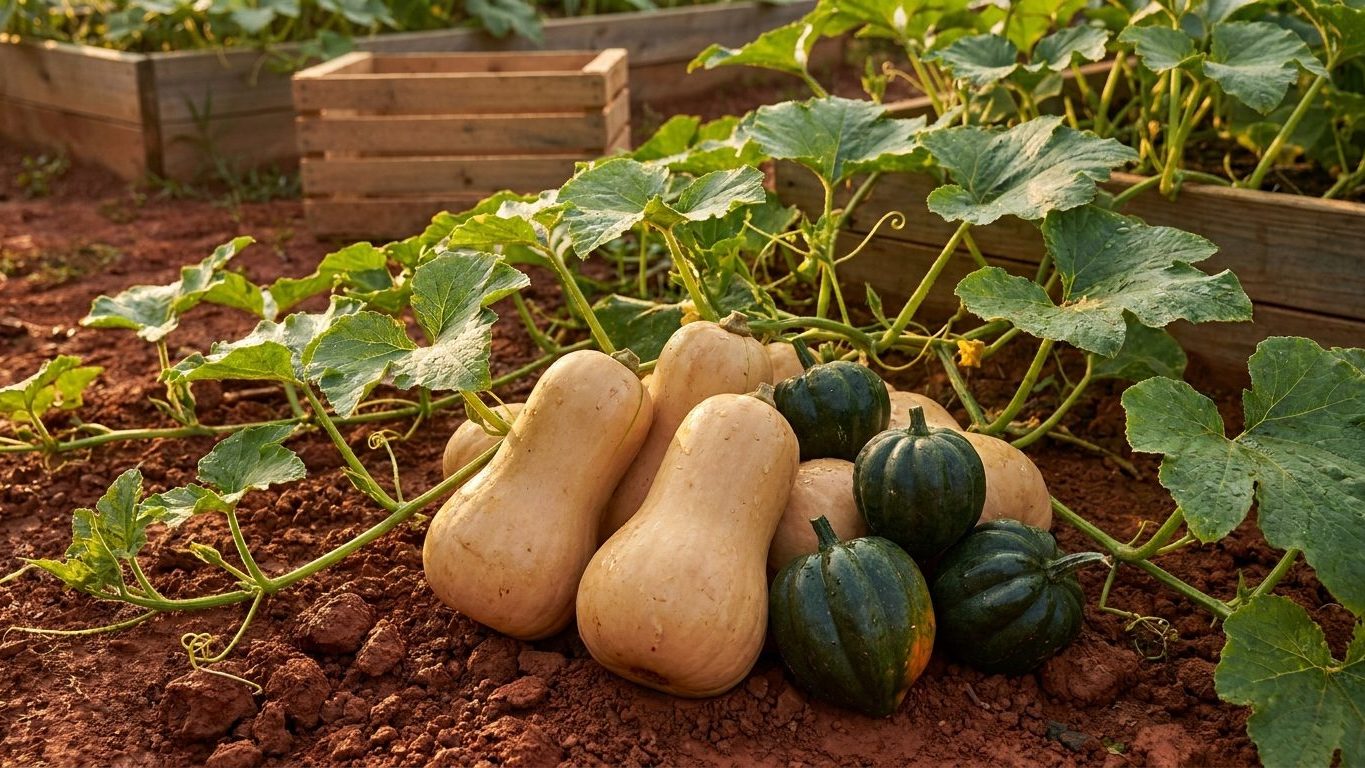

Short-season squash win in New Hampshire, full stop. Acorn, delicata, and buttercup types mature in the window this state actually offers. Long-season storage squash like Hubbard or big-vined butternuts are a gamble outside the warmest valleys, because the growing season here rarely stretches far enough to finish them reliably.
The short answer for New Hampshire
The frost dates set the boundaries, and they’re not generous everywhere in the state. At the reference weather station in Manchester, the last spring frost typically falls between April 16 and April 27, and the first fall frost arrives between October 13 and October 26. That’s a frost-free window of roughly 170 to 190 days at that one station, and it’s the best-case scenario for the state. Away from the airport tarmac, in the suburban and rural gardens most people actually plant, that window shrinks by one to two weeks on each end, sometimes more at elevation. So the real number most New Hampshire gardeners are working with is closer to 150 to 170 frost-free days.
That’s the ceiling for winter squash. Anything that needs more days to maturity than that ceiling allows is fighting the calendar before the seed even goes in the ground. Here’s how the common winter squash types line up against it.
| Type | Typical days to maturity | Fit for New Hampshire |
|---|---|---|
| Acorn (Table Ace, Tuffy) | 75-85 | Comfortable fit, even in shorter-season pockets |
| Delicata | 95-100 | Fits well in most of the state |
| Buttercup / Kabocha | 95-110 | Fits in an average year; needs a warm start |
| Butternut (short-season cultivars) | 100-110 | Workable, but pick a shorter-days cultivar and start indoors |
| Standard butternut / large Hubbard | 110-120+ | Tight to risky outside the warmest valleys |
Heat matters as much as calendar days here, and this is where New Hampshire’s numbers really steer the decision. The reference station logs an average of just 10.9 days a year at or above 90F. That’s a modest heat load. Winter squash bred for long, hot summers, the kind grown across the mid-Atlantic or the Southeast, often stall in a cooler season even when the frost-free window technically allows enough time on paper, because they’re waiting on heat units that never quite arrive. The types that top the table above aren’t just short-season, they’re also bred to size up and cure under moderate heat, which matches what this state actually delivers most summers.
What will not work here
The biggest mismatch in New Hampshire gardens is planting a squash bred for a longer, hotter climate and expecting it to finish on time. Large Hubbard types and full-season Cucurbita maxima varieties that need 120 days or more of warmth are working against both ends of the season: a late spring start pushed back by frost, and a fall frost that can arrive as early as October 13 in a cooler pocket. Add the modest heat load, under 11 days a year above 90F, and you get vines that are still sizing fruit when the first hard frost blackens the leaves. This isn’t a soil problem or a fertilizer problem. It’s a mismatch between the variety’s clock and the state’s calendar.
What won’t fail here, interestingly, is thirst. Summer rainfall averages about 10.7 inches across June, July and August, with July, the driest month, still bringing in 3.3 inches. That’s a humid regime, not an arid one, and it changes what actually threatens a squash planting. In a hot, dry state, the failure mode is a vine wilting between waterings. In New Hampshire, the failure mode running the other direction is disease pressure from too much moisture sitting on the leaves and soil: powdery mildew, downy mildew, and fruit rot where a squash sits on damp ground. Wide spacing and good airflow matter more here than a watering schedule, because the rain is already showing up on its own most weeks.
Close spacing is the specific mistake worth naming. A gardener who plants squash hills tight together, following advice written for a drier climate where crowding isn’t a disease risk, is setting up exactly the humid, still-air conditions that mildew needs. Given 10.9 days of real heat stress a year, New Hampshire squash rarely need extra water discipline. They need room to breathe.
What changes across New Hampshire
New Hampshire is not one climate, and the USDA Plant Hardiness Zone Map makes that plain: the state spans zone 3b up through zone 6a. That’s a wide spread for a state this size, built on the map’s one variable, the average annual extreme minimum winter temperature. It doesn’t measure summer heat or frost timing directly, but it’s a reliable stand-in for how much shorter and cooler a growing season runs as you move north or up in elevation.
A gardener near the coast or in the Merrimack Valley, closer to the warmer end of that range, is working with something closer to the Manchester reference figures: a frost-free window that can approach 170 to 190 days in a good year. A gardener in the North Country or up in the White Mountains, closer to zone 3b or 4a, is working with a season that can run several weeks shorter on both ends. For that reader, the safe move is to lean hard on the acorn and delicata end of the table above, skip the standard butternut and Hubbard types altogether, and start seed indoors three to four weeks before the last expected frost rather than direct-sowing.
There’s no single answer for “New Hampshire” here, and that’s the point of naming the 3b-6a spread rather than picking one number. A reader shouldn’t try to guess which zone applies to their own yard from a state-level range this wide; the USDA map itself, searchable by ZIP code, is the tool for that.
Where to check this for your own county
New Hampshire as a whole is a blunt instrument for planting decisions. The sharper tool is UNH Cooperative Extension, the university’s land-grant extension service, which works at the county level where the frost dates and heat numbers actually apply to a specific garden rather than an airport weather station.
Two things are worth pulling up there specifically. First, a county-level planting calendar, which will adjust the Manchester frost dates cited above for local conditions, whether that’s a warmer river valley or a colder upland town. Second, variety trial results or recommended-variety lists for winter squash, which tell you which specific cultivars of acorn, delicata, or butternut have actually performed well in trials run in or near that county, rather than relying on a seed catalog’s national averages for days to maturity.
A county recommendation will beat a state-level one every time, for the simple reason that it’s built on data closer to the actual garden. State and regional climate normals answer a question that applies across all of New Hampshire; the extension service exists specifically to narrow that down further. Treat this article as the starting framework, and the county office or its published materials as the correction for local ground truth.
Checking this against your own garden
Frost dates and hardiness zones describe averages built from decades of weather records. They don’t know what’s happening in one particular backyard this particular spring, and that’s exactly what a gardener’s own observation can settle faster than any date on a chart.
Soil warmth by feel is the first check. Winter squash seed germinates poorly in cold soil no matter what the calendar says; if the soil still feels cool and slightly damp to the back of a hand pushed a few inches down, it’s telling you the season is running behind the regional average that year, whatever the last frost date suggested.
The first flush of male flowers on an established squash plant is the second signal. Male flowers typically open before female flowers, sometimes by a week or two, and a strong early flush suggests the plant has settled into warm enough conditions to start reproductive growth in earnest. A long gap before any flowers appear at all, well past the point the variety’s seed packet suggests, points to a cooler local microclimate than the state average.
The first true leaves, the ones that appear after the initial seed leaves and actually look like the plant’s mature foliage, mark the point where a seedling has moved from surviving to actively growing. Slow true-leaf development after a normal-looking germination is often the clearest sign that a particular spot, whether it’s a low frost pocket, a shaded corner, or heavier soil that stays cold longer, runs behind the rest of the yard. That’s information no zone map or frost-date table can hand a gardener directly; it only shows up by watching the actual plants.