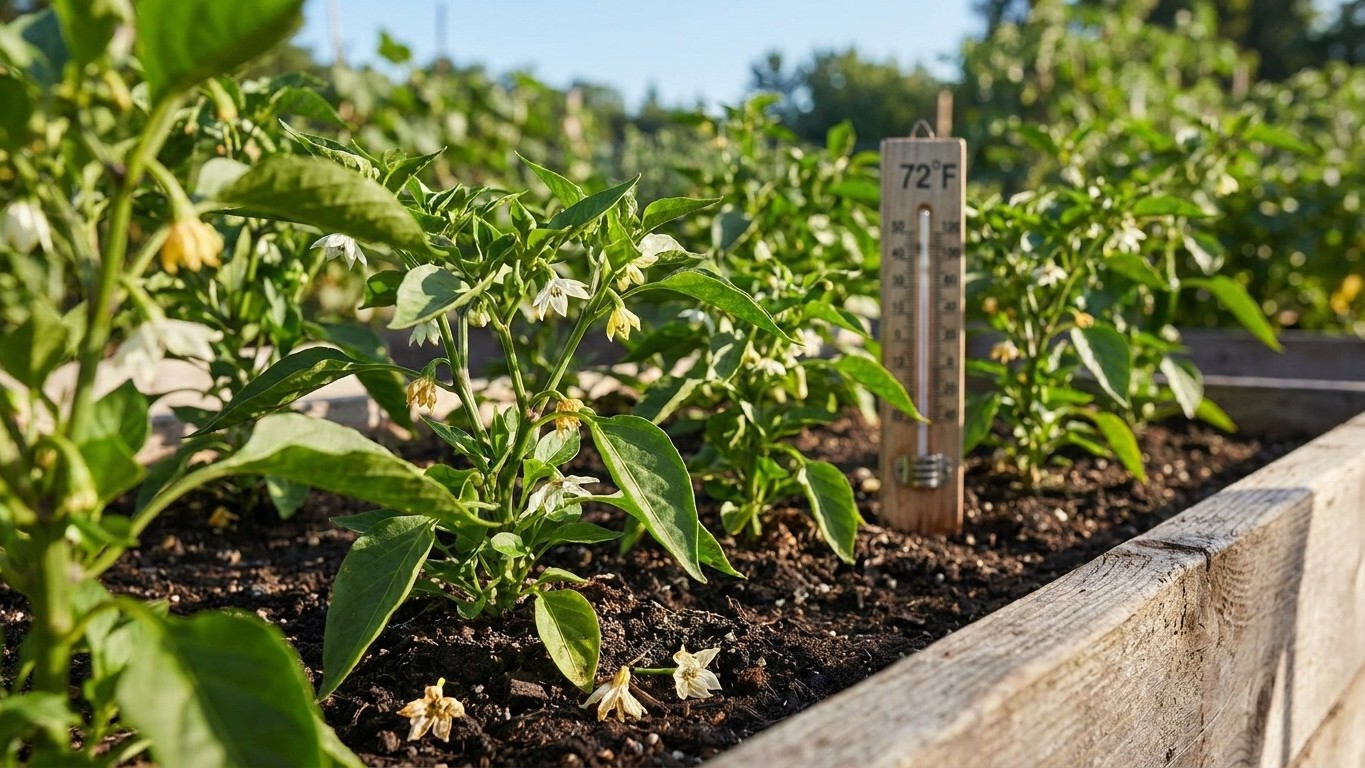

Start pepper seed indoors in New Jersey about 8 to 10 weeks before you plan to move transplants outside, which lands most gardeners somewhere in mid-January through mid-March depending on their county’s frost timing. The reference point is the last spring frost near Newark, March 29 to April 6, plus the wait for soil to warm to 60 F.
The short answer
Newark’s airport station averages 20.8 days a year at or above 90 F, according to NOAA NCEI Climate Normals covering 1991 through 2020. That’s not a rare event here. It’s close to three full weeks of heat stress spread across a typical summer, usually clustered in July and August, and it matters more to pepper growers than most people realize. Pepper fruit set shuts down when daytime highs climb past 90 F, regardless of how healthy the plant looks. Flowers open, but pollen turns sterile or the plant simply drops the bloom rather than commit resources to a fruit it can’t support in that heat. A plant loaded with blossoms in early July can look identical two weeks later, minus the blossoms, and the grower is left wondering what went wrong. Nothing went wrong. The thermometer did what New Jersey summers do.
The other failure point sits at the opposite end of the scale, and it’s just as unforgiving. Nights below 55 F stall fruit set the same way excessive heat does, according to Utah State University Extension. Cool nights are the more common problem early in the season, right after transplant, when a stretch of chilly weather rolls through in May or a wet spring keeps overnight lows depressed. This site tracks daytime heat extremes by county, but it does not carry summer overnight low temperatures for New Jersey locations. That gap matters. A gardener in a low-lying valley or near the Pine Barrens can see cooler nights than someone ten miles away in a more urban or coastal spot, and no statewide average captures that variation reliably. The only dependable move is watching your own thermometer through late spring and again if a late-summer cold snap arrives early.
Put the two thresholds together and the practical target becomes clear: peppers want nights that stay above 55 F and days that stay under 90 F to set fruit consistently. New Jersey’s summer heat load makes the upper threshold a real, recurring obstacle, not a theoretical one. Planning around both ends, rather than just the frost date, is what separates a pepper patch that produces steadily from one that blooms all summer and yields little.
When to start seed here
The math is simple once you have the pieces, and it’s worth doing yourself rather than trusting a generic packet date, because it accounts for your actual transplant window.
- Start with the frost date. Near Newark, the last spring frost typically falls between March 29 and April 6, based on NOAA NCEI’s 1991-2020 freeze probability data. Suburban and rural gardens away from that airport station usually see frost linger one to two additional weeks, sometimes longer at higher elevation, so treat this as a starting reference and check local frost records or a county extension office for your specific area.
- Add the soil-temperature wait. Peppers need soil at 60 F before transplanting, per Utah State University Extension, and soil warms slower than air. In much of New Jersey that pushes the safe transplant window into late April or into May, well past the frost date itself, especially in clay-heavy or shaded soil that holds cold longer.
- Count backward 8 to 10 weeks from that transplant date. If your target transplant date lands in the first half of May, counting back 8 weeks puts your seed-starting date in mid-March; counting back the full 10 weeks moves it to late February. Gardeners aiming for an earlier transplant window in late April should start seed correspondingly earlier, in mid-January to early February.
- Adjust for your own microclimate. A garden that historically sees frost linger into mid-April should shift the whole sequence later by that same margin, rather than starting seed on a fixed calendar date regardless of local conditions.
- Build in a buffer for slow germination. Pepper seed germinates unevenly and can take longer in cool rooms, so starting at the earlier end of the 8-to-10-week range gives more margin if seedlings come up slower than expected.
This backward-counting method works for any New Jersey county. Swap in your own last-frost estimate and soil-warming timeline, and the 8-to-10-week rule still applies without modification.
What goes wrong here
- Blossom drop from a hot spell. When daytime highs push past 90 F, which happens an average of 20.8 days a year near Newark, plants abort flowers rather than set fruit. There’s no fix during the heat itself, but light afternoon shade cloth over the row and consistent watering reduce the stress and help the plant hold onto blooms that open just before or after the hot stretch passes.
- Blossom drop from a cool night. A stretch of nights under 55 F, whether right after transplant in May or during an early cold snap later in the season, causes the same dropped-flower symptom as heat does. Since this site doesn’t track summer night lows for New Jersey, the only reliable defense is watching your own local forecast and delaying transplant, or covering young plants with row cover, when a cool spell is forecast.
- Sunscald on exposed fruit. New Jersey summer sun is strong enough to scald pepper fruit that loses its leaf cover, showing up as pale, papery patches on the side facing direct sun. Avoid heavy pruning of foliage during the hottest weeks, and stake or cage plants so leaf canopy stays intact over developing fruit rather than falling open.
- Blossom-end rot. Irregular watering, common during a dry patch sandwiched between summer thunderstorms, disrupts calcium uptake and produces a sunken, dark spot on the fruit’s blossom end. Even, consistent watering, plus mulch to hold soil moisture steady between rains, addresses the root cause more reliably than adding calcium products after the fact.
Common questions
Can I start pepper seed too early in New Jersey?
Yes. Starting more than 10 weeks before your realistic transplant date, per Utah State University Extension’s guidance, often produces leggy, root-bound seedlings that stall out and transplant poorly. If soil won’t reach 60 F until mid-May in your area, an early-February start already covers the full 10-week window, and going earlier than that mainly adds stress on the seedlings while they wait indoors.
Does the 90 F day count mean I should skip a fall pepper crop?
Not necessarily, but it does mean timing matters. With 20.8 days a year averaging 90 F or hotter near Newark, mostly in July and August, a fall crop needs flowering to happen after that heat load eases, typically once nights start cooling in September. Fruit set failure at the hot end applies to a second planting exactly as it does to the first.
How do I know when my soil actually hits 60 F?
A simple soil thermometer, pushed a few inches into the bed and checked in the morning over several consecutive days, gives a direct reading. Air temperature alone is unreliable since soil lags behind it by days or weeks, particularly in shaded or heavy clay ground common in parts of New Jersey.
What if my county’s last frost is later than the Newark date?
Shift the entire schedule later by the same margin. Since suburban and rural gardens away from the Newark reference station commonly see frost linger one to two weeks longer, or more at elevation, push both the transplant date and the seed-starting date back accordingly rather than relying on the Newark figure as a statewide guarantee.