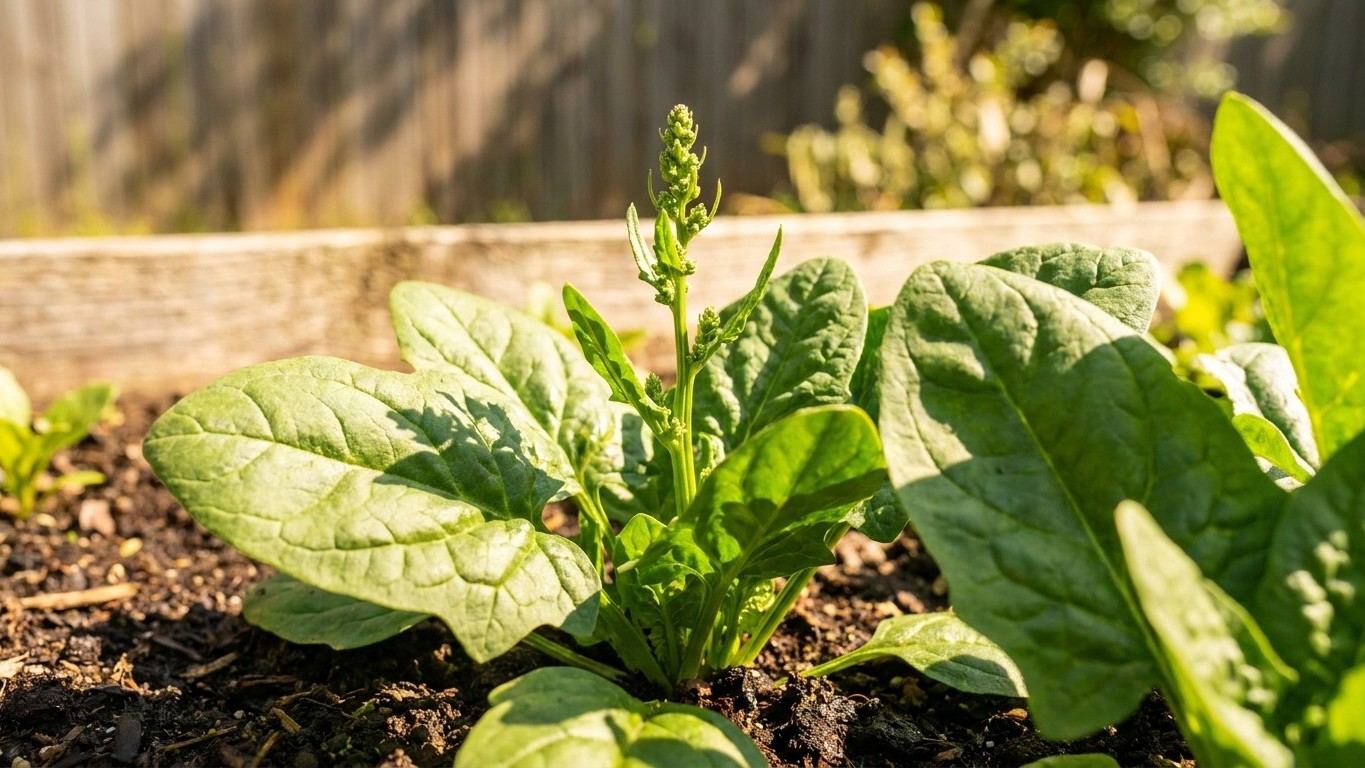

Yes. New Jersey gardens see close to fifteen hours of daylight on the longest day of the year, and that alone is enough to push spinach toward flowering. Heat piles on right behind it, with the region routinely climbing past 90°F for weeks each summer. Between the two, spinach here gets a narrow spring window and an even tighter shot at a fall crop.
The short answer
On the longest day of the year, the reference city near Newark sees about 14 hours and 55 minutes of daylight. That number matters more than most gardeners expect, because spinach doesn’t wait for heat to start flowering. Long daylight hours are one of the two triggers that push the plant to send up a seed stalk, and New Jersey’s early-summer days sit well past the point where that switch flips. A cool, cloudy June wouldn’t undo that. Day length runs on the calendar, not the thermometer, so even a mild spring doesn’t buy extra weeks once the days stretch out toward the solstice.
That would be a bigger problem in the Deep South, where long days show up but summer heat never really lets up either. In New Jersey, heat adds pressure on nearly the same schedule. The reference station near Newark logs an average of 20.8 days a year at 90°F or hotter, most of them clustered from late June through August. Spinach grows best where temperatures stay under 75°F, and above that ceiling growth slows, leaves turn bitter, and the plant is that much closer to bolting anyway. By early summer, New Jersey spinach is caught between two forces pointing the same direction: days long enough to trigger flowering on their own, and heat that makes sure nothing slows the process down.
Coastal counties like Cape May or Monmouth run a few degrees cooler in high summer than inland spots such as Camden or Mercer, and gardeners there sometimes assume that edge stretches the season. It helps a little on the heat side, since afternoons top out lower and the plant spends less time above that 75°F ceiling. But day length is nearly identical across the entire state. A garden in Cape May and a garden in Sussex County see almost the same number of daylight hours in June. The coastal advantage narrows the heat problem without touching the day-length problem at all.
The honest answer is that the limit here is both day length and heat, and they arrive close enough together that separating them barely matters in practice. A shade cloth might buy a few degrees of relief and a few extra days. It won’t change how many hours of daylight fall on the garden, which is the piece worth remembering: Spinach in New Jersey isn’t fighting one rough heat wave. It’s fighting a seasonal clock that ticks the same way every year, cool summer or hot one.
How long the spring window really is
Lay the sowing rule against the reference city’s frost dates and the picture gets specific fast.
- Last frost sets the sowing date. The reference station near Newark shows a last spring freeze between March 29 and April 6. Spinach seed goes in the ground two to three weeks before that date, which lands sowing somewhere in the middle two weeks of March for most of the state.
- Early growth happens under short days. In mid-to-late March, day length is still well under 13 hours, so the plant spends its first few weeks of growth before the long-day trigger becomes a factor. This is the easiest stretch of the whole season.
- The daylight clock starts working against the crop by mid-April. Day length climbs every week on the way to the June solstice, and somewhere in this stretch the plant crosses into hours long enough to start pushing toward a seed stalk.
- Heat arrives on a similar schedule. New Jersey doesn’t usually log its first 90°F days until early summer, but afternoons routinely climb past the 75°F growth ceiling well before that, often by mid-to-late May.
- Both pressures converge by late May or early June. Day length is near its yearly peak and air temperature is already past what spinach tolerates well, which is why most spring plantings in this state bolt within roughly eight to ten weeks of sowing.
That leaves a realistic spring window of about two months: mid-March sowing through a harvest that needs to wrap up before Memorial Day in most years. Gardeners farther inland, in spots like Sussex or Hunterdon counties where frost lingers later, should expect that window to open later and close on roughly the same date, which shortens it further. The source lists several varieties commonly grown for a spring crop, including Bloomsdale, Melody, Teton, and Olympia, but publishes no days-to-maturity figures for any of them. Picking a variety by name won’t stretch the calendar; the daylight and heat triggers apply no matter which packet is in hand.
The autumn crop, and when the soil lets you sow
Fall spinach in New Jersey runs into a different obstacle than the spring crop does. Days are shortening instead of lengthening by August, which removes the day-length trigger from the equation entirely. What’s left is a straightforward race between soil temperature and the calendar.
Soil still too warm to germinate
Spinach seed struggles to germinate once soil temperature climbs above 80°F, and New Jersey soil holds onto summer heat well past the point air temperatures start easing off. With the reference station near Newark averaging 20.8 days a year at 90°F or hotter, mostly bunched into July and the first half of August, soil in full sun commonly stays too warm for reliable germination into late August. Gardeners who sow early, hoping to get a jump on the fall crop, often see poor or spotty germination as a direct result. Waiting for soil to cool, rather than watching the calendar, is the more reliable cue. Mulching the bed or sowing in a partly shaded spot can knock a few degrees off soil temperature and open the window slightly earlier.
The frost that ends the season
The reference station shows a first fall freeze arriving between November 4 and November 16. Working backward from that date using the 50-to-75-day sowing-to-harvest rule leaves a sowing window between roughly August 21 and September 15 for a harvest that lands before or right around the first frost. That window overlaps almost exactly with the point where soil is finally cool enough to germinate reliably, which makes the fall crop workable but tight rather than generous. Gardeners in outlying counties, where frost often arrives a week or two earlier than the reference-city dates suggest, should aim for the earlier end of that sowing window rather than the later one. Missing it by even a week or two either pushes germination back into soil that’s still too warm, or pushes harvest past a killing freeze.
Common questions
Can shade cloth stop New Jersey spinach from bolting?
Shade cloth lowers leaf and soil temperature a few degrees, which eases the heat side of the equation, but it does nothing to shorten the hours of daylight reaching the garden. It buys a little time, not a season.
Does a cooler coastal county change the timeline?
Coastal spots run a few degrees cooler in midsummer, which can keep leaf temperature under the 75°F ceiling a little longer. But day length across New Jersey varies by only minutes from the shore to the northwest corner of the state, so the bolting trigger arrives on nearly the same date statewide.
Is there a heat-tolerant spinach variety that solves the problem?
The published record for the varieties commonly grown here, Bloomsdale, Melody, Teton, and Olympia, doesn’t include bolt-resistance or days-to-maturity data, so no variety on that list can be confirmed to outrun the day-length trigger.
Should backyard growers trust the reference city’s frost dates exactly?
The frost window comes from one airport weather station near Newark. Suburban and rural gardens elsewhere in the state typically see the last spring frost later and the first fall frost earlier, sometimes by one to two weeks and more at elevation, so treat these dates as a starting point and adjust based on your own county’s history.