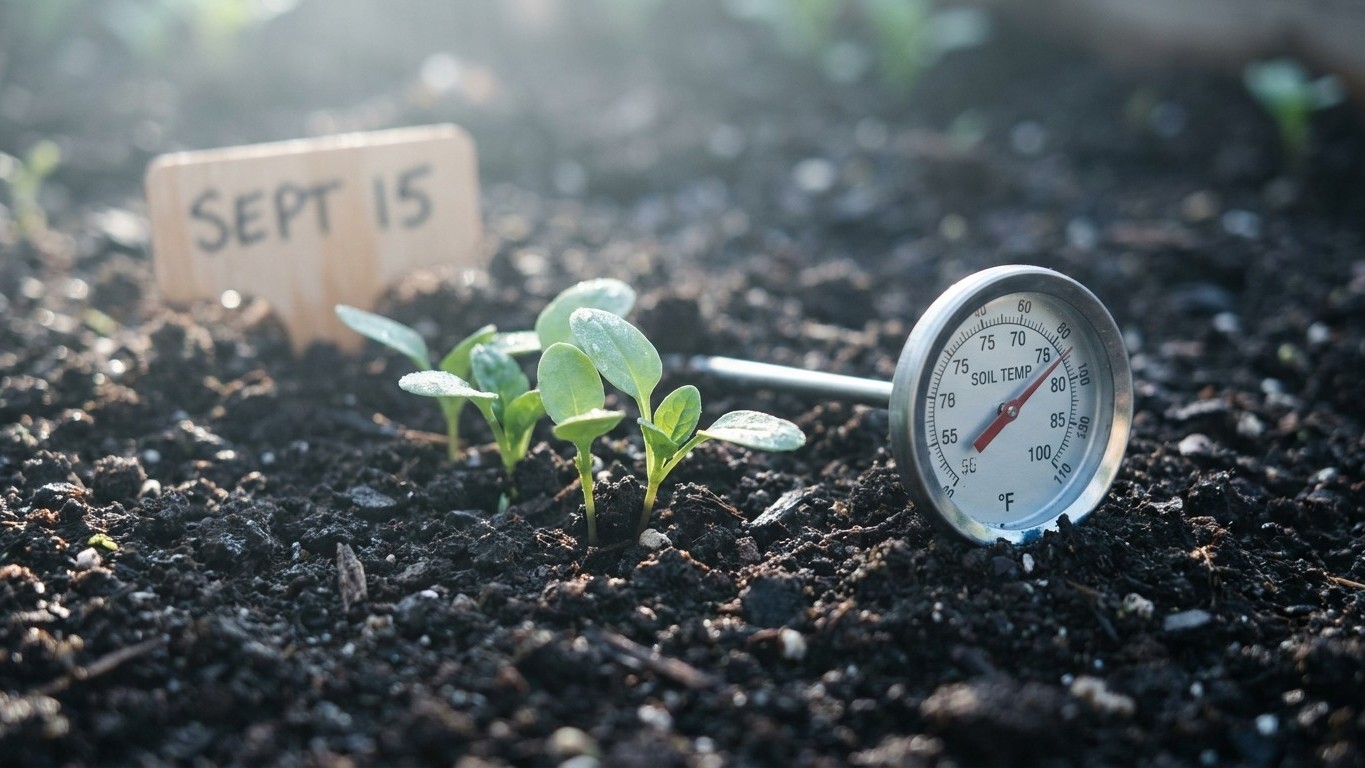

In New Jersey, autumn spinach goes into the ground from mid-August through late September, timed backward from the date you want to harvest and forward from the point when soil finally cools out of summer’s grip. Sow too early and the seed won’t sprout in soil still holding onto August heat; sow too late and plants run out of season before the first hard frost. The right week depends on your county’s frost pattern and how fast your own garden bed sheds heat.
The short answer
On the longest day of the year, daylight at the New Jersey reference weather station (Newark) stretches to 14 hours and 55 minutes. That number matters more than most gardeners realize, because spinach flowers, or bolts, in response to long days as much as it does to warmth. A cool summer doesn’t buy extra weeks here. Even if July stayed unusually mild, the day length alone would still be pushing the plant toward seed stalks rather than leaves.
Heat compounds the problem rather than replacing it. The same reference station averages 20.8 days a year at 90 F or hotter, which means New Jersey summers deliver plenty of afternoons well past the 75 F mark where spinach growth stays good. Above that threshold the plant doesn’t just stall, it turns bitter, since 75 F works as both a growth ceiling and a flavor line. Cross it, and the leaves that do form taste sharper than the ones grown in cooler weeks.
So the honest answer to what limits spinach here is both day length and heat, working together rather than one canceling out the other. Long days arrive on the same calendar as the hot stretch, so there’s no clever timing trick that lets the plant coast through a New Jersey summer on daylight alone or on temperature alone. That’s why spinach in this state is grown as two separate, short crops bracketing the hot season rather than one long run: an early spring planting finished before day length and heat rise together, and a fall planting that waits for the soil to cool back down.
That split is the whole logic behind the rest of this page. The spring crop has a hard ceiling set by rising day length and climbing temperatures. The fall crop has a different obstacle entirely: soil that’s still too warm to let seed germinate, followed by a frost that eventually closes the season. Both windows are narrow, and both are dictated by New Jersey’s own climate normals rather than a generic planting chart.
How long the spring window really is
Spinach seed is sown two to three weeks before the last expected spring frost, not after it, because young plants tolerate a hard freeze far better than they tolerate a late start. At the reference weather station used for these figures, the last spring frost falls between March 29 and April 6, according to NOAA NCEI U.S. Climate Normals for 1991-2020. Working from that single date backward, and then forward against the point where day length and heat catch up, sketches out how much usable spring New Jersey gardeners actually get.
- Start date: Two to three weeks before March 29-April 6 lands sowing in the first half of March, roughly March 8 through March 23 depending on how the season is running.
- Ceiling on quality: Growth stops being good once temperatures climb past 75 F, and that same number marks where flavor turns bitter as the plant edges toward bolting.
- Day length working against the crop: New Jersey’s daylight is already climbing toward its 14-hour-55-minute peak through spring, so the weeks that bring warmer soil also bring longer days, and both pressures land close together.
- Closing point: Between the two, the spring window typically runs only six to eight weeks from sowing before daily highs settle above 75 F and daylight has stretched well past the point spinach tolerates.
- Practical takeaway: A sowing made in mid-March and harvested by early-to-mid May uses the window before day length and heat force the plant into flower.
Suburban and rural gardens tend to see their last frost later than the reference station shows, sometimes by one to two weeks or more at elevation, so treat these dates as a starting point and confirm the pattern for your own county before locking in a sowing date.
The autumn crop, and when the soil lets you sow
For the fall crop, the calendar runs backward from harvest rather than forward from a frost date. Utah State University Extension puts it simply: sow 50 to 75 days before the date you want to pick spinach. At the reference station, first fall frost runs from November 4 to November 16, again from NOAA NCEI’s 1991-2020 normals. Counting back 50 to 75 days from those dates puts likely sowing between roughly September 2 and September 27, with gardeners aiming for an earlier harvest pushing sowing back into mid-to-late August.
Soil still too warm to germinate
The math above assumes the soil cooperates, and through most of August it doesn’t. Soil temperature lags well behind air temperature, and with 20.8 days a year reaching 90 F or hotter, New Jersey’s topsoil often sits above the 80 F mark where spinach germination drops off, according to Utah State University Extension. That means an August sowing can look correct on the calendar and still fail simply because the seed bed hasn’t cooled down yet. Watering the bed the day before sowing, laying a light-colored mulch, and sowing in the cooler part of the day all help, but the only reliable check is a soil thermometer pushed to seed depth rather than a guess based on the air temperature that morning. Seed packets commonly offered for fall planting include Bloomsdale, Melody, Teton, and Olympia, though the source used for these figures publishes no days-to-maturity data for any of them, so match variety to your own harvest goal using the packet rather than a borrowed number.
The frost that ends the season
On the other end of the window, the first fall frost, November 4 to November 16 at the reference station, marks the practical close of the season. Established spinach handles a light frost better than most leafy crops, and cooler weather often sweetens the leaves rather than damaging them. Still, growth slows sharply as day length shortens through October, so the real harvest deadline sits close to the frost date itself rather than well after it. Suburban and rural gardens often see their first frost earlier than the reference station, sometimes by a week or two, so building in that cushion by sowing toward the earlier end of the window is the safer bet if you garden away from a city or coastal heat pocket.
Common questions
Can spinach be grown through the New Jersey summer?
No. Long days push the plant toward flowering regardless of temperature, and 20.8 days a year above 90 F push it past the 75 F ceiling where quality and flavor hold up. That combination is why spinach here is grown as two short crops bracketing summer rather than one continuous planting.
What’s the real difference between the spring and fall spinach windows here?
Spring is limited by rising day length and heat arriving together, giving roughly six to eight weeks starting in early-to-mid March. Fall is limited by soil that stays too warm to germinate seed through much of August, with the practical window opening in September and closing near the first frost in early-to-mid November.
How do I know if my soil is cool enough to sow fall spinach?
Check with a soil thermometer at seed depth rather than relying on air temperature. Utah State University Extension notes germination drops above 80 F soil, and New Jersey topsoil commonly holds heat well into late summer even after the air feels cooler in the morning and evening.
Do the frost dates given here apply to every New Jersey county?
Not exactly. These dates come from one reference weather station, and gardens away from that station, especially suburban, rural, or higher-elevation sites, typically see the last spring frost later and the first fall frost earlier, sometimes by a week or two or more. Use the reference dates as a starting point and adjust based on your own local frost history.