
Winter squash need roughly seven months of frost-free growing time to go from seed to a fully cured, storable fruit, and New Jersey’s growing window comes close to delivering that, provided the planting date respects the region’s cool, damp spring rather than the calendar. The short version: sow after mid-to-late April, expect harvest by mid-October, and pick a type that matches your county’s soil and season length rather than the state average.
When the soil is warm enough in New Jersey

The question every gardener actually wants answered isn’t “when is frost over,” it’s “when can I put seed in the ground without it rotting.” Those are two different dates, and mixing them up is the single most common reason winter squash gets off to a slow start in New Jersey gardens.
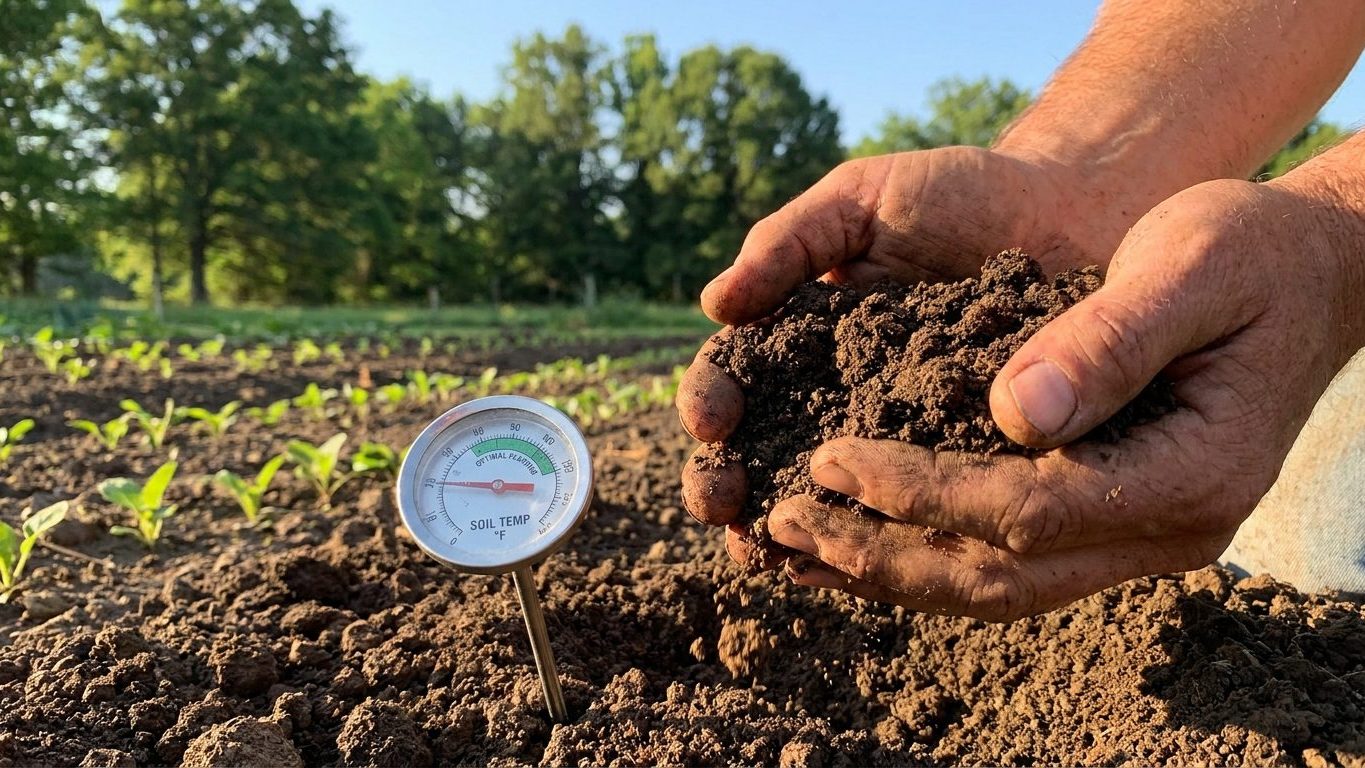
At the reference station used for New Jersey’s climate normals (NOAA NCEI, station USW00014734), the last spring frost falls in the window of March 29 to April 6, based on the 1991-2020 normals and the 30-70% freeze-probability band. That’s the frost date. Soil warming lags behind it by two to three weeks, because bare ground and mulched beds both need sustained air temperatures in the 60s to push soil temperature past the point where squash seed germinates reliably rather than sitting and rotting. Practically, that pushes direct-seeding into late April to mid-May across most of the state, even though the frost risk itself has usually passed by early April.
That frost date is a probability, not a promise, worth saying once and remembering all season. It describes what happened at one airport-adjacent weather station over thirty years, not what will happen in a particular backyard this year. Suburban and rural gardens away from that station, especially those in low-lying areas or at any elevation, typically see a later last frost and an earlier first frost than the reference figures suggest, sometimes by one to two weeks. A garden in a valley in the northwestern part of the state is playing a different game than one on the coastal plain.
New Jersey spans USDA hardiness zones 6a to 7b, based on the 2023 Plant Hardiness Zone Map built from 1991-2020 average extreme minimum temperatures. That range matters less for winter squash than the frost dates do, since hardiness zone measures winter cold survival for perennials, not a warm-season annual’s planting window. But it’s a useful shorthand for how much the state varies: a 7b garden along the shore is working with a meaningfully gentler climate than a 6a garden near the Delaware Water Gap.
Rather than trusting a seed packet’s generic instructions or a date pulled from a gardening forum, check with Rutgers Cooperative Extension for county-specific soil temperature guidance and the direct-seed versus transplant recommendation for your area. Transplanting can buy two to three weeks in short-season pockets, but winter squash resents root disturbance more than most vine crops, so it only makes sense where the extra head start actually changes whether the fruit finishes before frost.
How long the season lasts here
Subtracting the two frost windows gives a real number instead of a guess. Using the later end of the spring frost range (April 6) against the earlier end of the fall frost range (November 4), the safe, full-risk growing window runs about 212 days, a little over seven months. Using the more optimistic ends of each range, March 29 through November 16, stretches that to roughly 232 days. Either way, New Jersey sits comfortably in the range winter squash generally need to mature and cure fully on the vine.
That length changes what’s worth attempting. A 200-plus day window is enough for a single planting of any winter squash type to reach full maturity with room to spare in most years, which is the baseline requirement since an immature squash at frost neither cures properly nor stores well afterward. It’s also enough, in the southern part of the state and in warmer pockets closer to the coast, to consider a second, later sowing of a quick-maturing type if the first planting gets lost to a cutworm attack or a rough June. That second-chance planting isn’t a given in shorter-season northern counties, where the fall frost risk arrives closer to the earlier end of the November range and eats into the safety margin fast.
The seven-month window also settles the transplant-versus-direct-seed question differently depending on where in the state you garden. In a long-window southern county, direct seeding after the soil has warmed is usually simplest and avoids the root check that transplanting winter squash almost always causes. In a shorter-window northern or higher-elevation garden, a two-to-three-week transplant head start (started indoors under lights, moved out carefully to avoid disturbing the taproot) can be the difference between a squash that finishes and one that gets caught green by frost.
For gardeners weighing a second planting or staggering harvest dates, the site’s succession sowing guide walks through how to time a follow-up sowing against a given frost window without gambling the whole crop on a single planting date.
Heat and water in New Jersey

Winter squash is the crop where the season-length math is unforgiving: the fruit has to mature fully on the vine before frost, because there’s no ripening it on a windowsill afterward the way you might with a tomato. That makes New Jersey’s heat and rainfall numbers worth reading as inputs to that math, not as background trivia.
At the Newark reference station, the state averages 20.8 days a year at or above 90°F (1991-2020 normals). That’s a moderate heat load, not a scorching one. It’s enough to push squash through steady vegetative growth and fruit set without the extreme heat stress that shuts down pollination in hotter states, but it also means New Jersey summers, especially in humid, low-lying, or coastal areas, run more risk from mildew and slow ripening in a cool, damp year than from drought stress in a hot one. Powdery and downy mildew on squash foliage are far more often a New Jersey problem than sunscald or heat-stalled fruit set.
Rainfall backs that up. Summer rainfall (June, July, August combined) averages about 13.2 inches, out of 46.6 inches for the year, with August running driest at 4.15 inches against June’s 4.34 and July’s 4.66.
| Month | Average rainfall |
|---|---|
| June | 4.34 inches |
| July | 4.66 inches |
| August | 4.15 inches |
That’s a reasonably wet summer by national standards, and it means New Jersey gardens are less dependent on irrigation to carry squash through fruit fill than a hot, dry western state would be. But the figure never reads alone. It arrives unevenly, often as thunderstorms that run off a compacted clay bed rather than soaking in, while a sandy garden a mile away drains the same storm within a day and still needs supplemental water between rains. With only 20.8 days above 90°F, evaporation demand is modest compared to a true hot-summer climate, but a run of dry weeks in a sandy-soil garden can still stress squash vines enough to affect fruit size, so a rain gauge on your own plot is worth more than the regional average.
Which winter squash suit New Jersey
New Jersey’s numbers point toward type, not brand name. With a roughly seven-month frost-free window in most of the state, earliness isn’t the constraint it would be in a shorter northern growing region, so the choice comes down more to disease pressure and soil moisture than to squeezing in a fast finish.
Given the state’s humid summers and real mildew pressure, disease resistance is the first thing worth checking for, ahead of size or shape. Types bred or selected for stronger tolerance to powdery and downy mildew hold their foliage later into the season, which matters directly for winter squash because leaf loss late in the year cuts short the plant’s ability to keep filling and hardening fruit before frost. In the shorter-season northern and higher-elevation counties, where the safe window runs closer to 212 days than 232, an earlier-maturing type gives more margin against a fall frost that arrives on the early side of the November range.
Good airflow at planting time (wider spacing, trellising where practical, avoiding overhead watering late in the day) does more for a New Jersey squash crop than any single variety choice, because it directly counters the humidity that drives the state’s main disease pressure. In the driest part of the summer, typically August at this reference station, a consistent watering routine at the root zone matters more in sandy-soil gardens than in the state’s heavier clay ground, which holds onto June and July’s rain longer.
This page won’t put a variety name on any of that, and that’s a deliberate choice, not an oversight. Naming a cultivar for “New Jersey” in general glosses over the real differences between a sandy South Jersey garden and a clay-heavy northern one, and it ignores the actual trial data that exists for this state. Rutgers Cooperative Extension runs and publishes variety trials specific to New Jersey conditions, and their county offices can match a squash type to your soil, your disease history, and your particular frost risk in a way a general article never can. That’s the recommendation that actually means something: not a name pulled from a seed catalog, but the type your own extension office has already tested against your own climate.