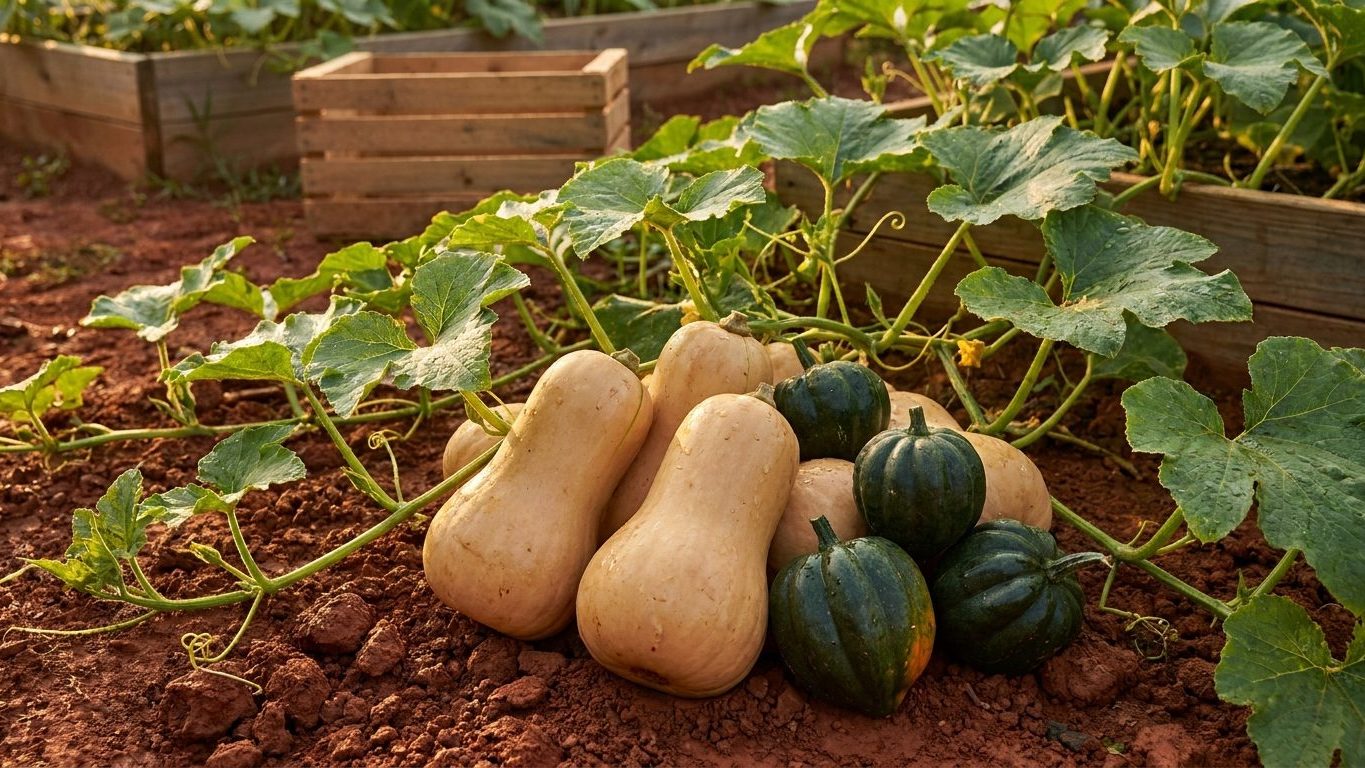

New Jersey’s frost-free window runs long enough, and its summers run hot enough, that most winter squash types mature and cure without trouble here. The variable that actually decides your results is disease pressure from humid summers, not the length of the season.
The short answer for New Jersey
Start with the numbers. At the reference weather station (Newark), the last spring frost falls between March 29 and April 6, and the first fall frost arrives between November 4 and November 16. Stretch those dates out and you get a frost-free window of roughly 212 to 232 days, depending on where in that probability band your particular spring and fall land. That is a long season by any standard, and it changes the calculus for winter squash completely.
Most winter squash types need somewhere between 80 and 120 days from seed to harvest. Acorn squash finishes around 80 days. Butternut and spaghetti squash typically need 90 to 110. Hubbard and kabocha types, the slow ones, can run 100 to 120 days. Even at the tight end of New Jersey’s frost-free window, 212 days, every one of those types has room to mature and still leave weeks to spare for curing on the vine before frost. This is not a state where season length is the deciding factor, the way it is in northern New England or the upper Midwest.
What decides the outcome instead is heat and humidity. The reference station averages 20.8 days a year at or above 90°F, which is a real heat load, and summer rainfall runs about 13.2 inches across June, July and August, arriving mostly as thunderstorms rather than steady soaking rain. That combination, warm nights and humid air, is exactly what fungal diseases like powdery mildew and downy mildew need. So the type decision for New Jersey is less “can this variety finish in time” and more “can this variety’s foliage stay ahead of mildew through a wet, hot August.”
Given that, the types that do best here are the ones with more open, less dense foliage and decent air movement through the plant: butternut, acorn, delicata and spaghetti squash all have a track record of holding up through New Jersey summers when spaced properly. Hubbard and kabocha types can work too, particularly in the warmer, longer-season parts of the state, but they carry more leaf mass and need more attention to spacing and airflow to avoid trouble in a wet year.
What will not work here
Season length is not the trap in New Jersey. The trap is treating a humid Mid-Atlantic summer like a dry one, or treating a long season as an excuse to crowd plants together.
Close spacing is the first failure point. Winter squash vines, especially the bushier Hubbard and kabocha types, put out a lot of leaf surface. Packed tight, that foliage stays wet longer after each thunderstorm and after morning dew, and with 20.8 days a year above 90°F pushing humidity around during the day, that dampness turns into powdery mildew on the leaf surface and downy mildew underneath within a matter of weeks. A garden that would tolerate tight spacing in a drier climate does not get the same pass here. Give every plant the full spacing the seed packet recommends, and lean toward the wider end of that range if you are in a low, poorly drained spot.
Watering on a fixed weekly schedule is the second failure point, and it cuts in a direction gardeners do not expect. Because 13.2 inches over the summer sounds like plenty, some gardeners assume they can skip watering, then get caught off guard when a dry stretch between storms stresses the plants during flowering. Others overcorrect and water on top of already-soaked soil after a storm, which does nothing for the plant and everything for fungal disease. The rain in New Jersey’s summer arrives unevenly, as bursts rather than steady drizzle, and August, the driest summer month at 4.15 inches, is also usually the month curing fruit needs the driest air. Watering by the calendar instead of by the soil ignores that pattern.
The third failure point shows up only in the coolest pockets of the state. A very late-maturing Hubbard or giant kabocha, direct-seeded late in a spring that runs toward the April 6 end of the frost date range, can still be pushing new growth when a cooler microclimate’s first fall frost arrives earlier than the reference station’s November 4. That is not a statewide problem, but it is a real one in specific spots, covered next.
What changes across New Jersey
New Jersey is not one growing zone, and treating it as one is where a lot of advice online goes wrong. The USDA Plant Hardiness Zone Map puts the state across a 6a to 7b range, a spread built on one variable, the average annual extreme minimum winter temperature. That is not the same thing as your frost-free growing season, but the two generally move together: colder winter zones tend to sit alongside shorter, later-starting, earlier-ending growing seasons.
There is no single answer for “New Jersey” here, and that is the point. The northwest of the state, up in the higher elevations of the Highlands and the Kittatinny Ridge area, sits at the cooler 6a end. Coastal South Jersey and the areas closest to the ocean’s moderating effect sit at the milder 7b end. A gardener in a 6a pocket is working with a shorter effective season than the 212-to-232-day range calculated from the Newark reference station, sometimes by two or three weeks on each end once local terrain and elevation are factored in.
What should shift for a reader in a cooler, higher part of the state: lean toward the faster-maturing types, acorn and delicata over Hubbard and kabocha, and consider starting seed indoors three to four weeks before your expected last frost rather than direct-seeding, to buy back the days a slower variety would otherwise lose. A reader in the milder coastal or southern parts of the state has more room to experiment with the slower, larger types and can generally direct-seed with less risk.
None of this tells you which zone your own property sits in. That answer lives on the USDA hardiness zone map itself, checked against your address, not in a state-level article like this one.
Where to check this for your own county
Rutgers Cooperative Extension, the land-grant university extension service for New Jersey, publishes county-level guidance built specifically for New Jersey soils, New Jersey pest pressure and New Jersey’s real microclimates rather than a single reference station. Start at njaes.rutgers.edu and look for two specific things once you get there: the local vegetable planting calendar for your county or region, which will adjust the frost-date window used in this article to your actual location, and any variety trial results for winter squash run by Rutgers or your county’s extension office. Those trials tell you which specific varieties within each type (which butternut, which acorn, which Hubbard) have actually performed well against New Jersey’s real disease pressure in field conditions, not just on paper.
A county recommendation is built closer to your actual garden than a state one ever can be, because it accounts for local soil types, local disease history and local microclimate quirks that a statewide article, including this one, simply cannot capture. Treat what you have read here as the starting framework, the type of squash and the reasoning behind it, and treat your county extension office as the source for the specific variety names and the specific planting date for your address.
Checking this against your own garden
Your own garden will tell you more than either one, and it outranks both.
Soil warmth is the first thing to check, and you do not need a thermometer to do it. Winter squash seed wants soil that feels warm to bare skin at a two-inch depth, not just air that feels warm. Push your hand into the soil where you plan to plant, mid-morning, a few days in a row. If it feels cool and damp rather than warm and dry, the soil has not caught up to the air yet, no matter what the reference frost dates say, and seed sown into it will sit and sulk rather than germinate.
The first flush of male flowers is the second signal. Winter squash plants send out male flowers, the ones with a thin stem and no swelling behind the bloom, before the female flowers that will actually set fruit. A strong early flush of male flowers tells you the plant has settled in and is building toward fruit set. If that flush comes late or thin, something in your specific spot, shade, competition, poor drainage, is slowing the plant down relative to what the calendar suggests it should be doing.
The first true leaves, the ones that show the plant’s actual leaf shape rather than the rounded seed leaves, mark the third checkpoint. How quickly they appear and how big they get tells you whether your soil and your spacing are giving the plant what it needs before the heat and humidity of midsummer arrive and make forgiveness harder to come by.