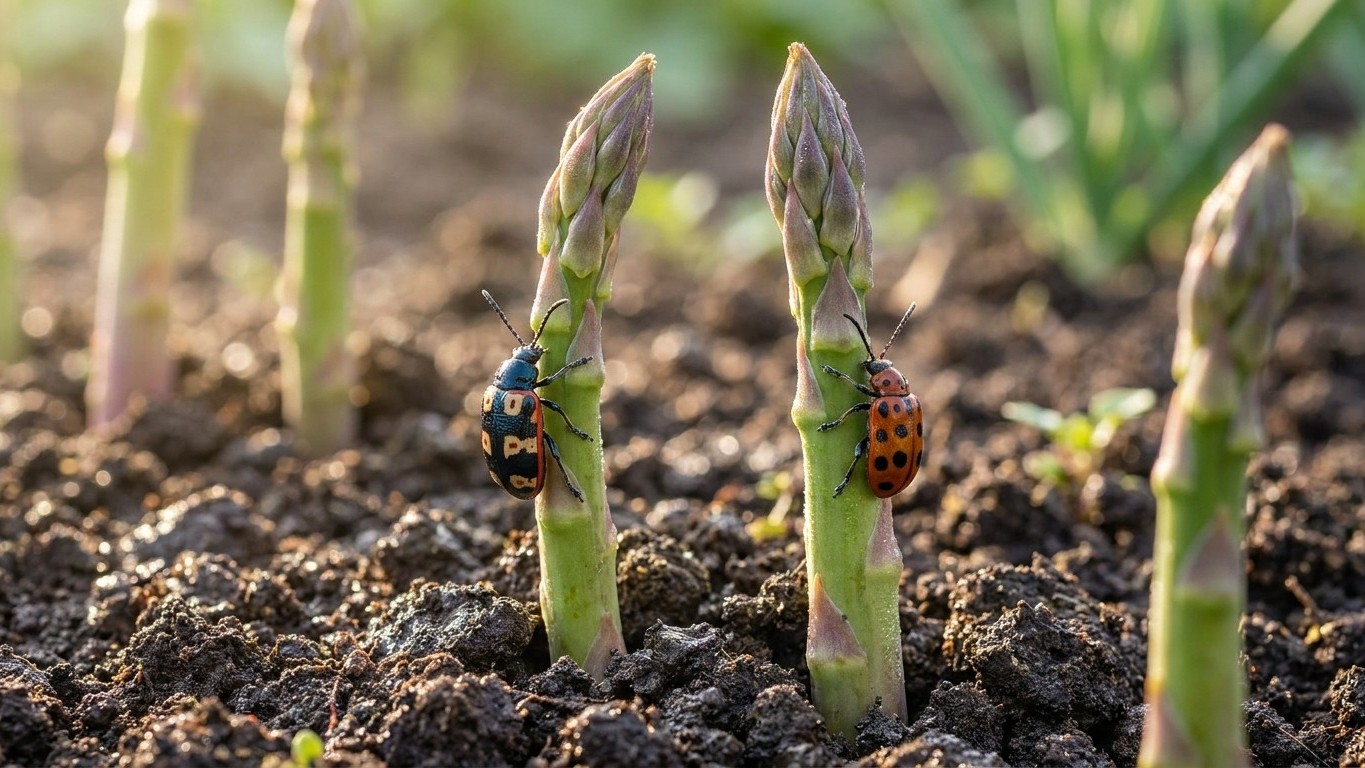

Stop cutting when most of the spears coming up are thinner than a pencil. That is a thing you check by eye, not a week on the calendar. A New Mexico bed also gets no cutting at all until its third year. Once spears are cut, keep them at 32 to 35°F with the cut ends standing in water. Warmth toughens them fast, and a freezing fridge shelf wrecks them.
The short answer
New Mexico’s state soil is the Penistaja series, an Aridisol, which is soil-science shorthand for dry-climate ground. Its representative surface runs about 69 percent sand, 15 percent clay and 16 percent silt, with organic matter around 1.4 percent and a surface pH of about 7.5, which is alkaline. Aridisols often carry salts too. USDA classes the series as well drained.
That matters more for asparagus than for any other crop on this site. A bed is planted as crowns in 8-inch furrows, is not harvested until year 3, and then produces for 10 to 15 years. Utah State University Extension’s only soil requirement is that the ground drains. Most soils will do if they do. A tomato bed that sits in heavy dirt gets amended next season. An asparagus bed in heavy dirt is stuck with the mistake for a decade or more.
So does the dominant soil drain well enough? Yes, comfortably. Sand sheds water. The Penistaja is not the soil that drowns crowns, and for a gardener on ground like it, drainage is the least of the worries. The trouble runs the other way: sandy ground lets water go so fast that the watering schedule becomes the real work, which the next section picks up. A low organic matter figure also means the ground holds little in reserve.
The state soil is a starting point, though, not a diagnosis of your garden. New Mexico spans hundreds of soil series. River bottoms, hill country, and any lot a builder has scraped or filled can look nothing like the Penistaja. Those numbers are USDA’s representative values for the surface layer of mapped ground, not a measurement of a worked bed, and the pH is not yours.
Test before you dig. Fill a hole where the bed would go, let it empty, and fill it again. If water is still standing well after the second fill, that spot is wrong for asparagus. A lab soil test then gives your own numbers, salts included. The Utah State source does not publish a pH target or a winter chilling requirement, so this page supplies neither.
If the spot fails the water test, move the bed. Building it up above grade is a reasonable workaround, though that is practical judgment rather than anything the Utah State source spells out. Will New Mexico Soil Hold an Asparagus Bed for Fifteen Years? goes deeper on that decision.
Will the summer here water it for you?
No. Here is how the numbers stack up.
- What the bed asks for. Utah State’s guidance is 1 to 2 inches of water every other week for the first two years, then every three weeks after that. That is steady, deep watering, not a sprinkle.
- What the summer delivers. The reference station’s 1991-2020 normals show about 3.5 inches of rain across June, July and August combined, out of 8.8 inches for the whole year. June is the driest month at 0.57 inches. July brings 1.64 and August 1.31. All of June together does not equal the low end of a single watering.
- What the soil does with it. On sandy ground like the Penistaja, rain passes through within the day. Summer rain here also tends to arrive as a thunderstorm, and a downpour on dry surface soil mostly runs off instead of soaking in. Hot days speed evaporation on top of that. The 3.5 inches on paper is worth less in the root zone.
- What you add. Across the 13 weeks of summer, an every-other-week schedule means six or seven rounds. Even at one inch each, that outruns the whole season’s rain. In the first two years, count on supplying most of the water yourself. After that, every three weeks works out to four or five rounds, and the gap to the rainfall narrows but does not close.
- How to settle it. These are normals from one reference station, not a forecast, and a slope, a rain shadow or a city lot changes the picture. A cheap rain gauge on your own plot tells you what actually fell. Water to make up the difference, and check how deep the moisture went with a trowel the next day.
When to put the crowns in
Early spring. The reference station’s last spring frost, using the 32°F freeze probabilities in the 1991-2020 NOAA NCEI normals (30 to 70 percent band), falls around March 31 to April 12. Treat that as an average, not a promise. Frost can show up after it in any given year.
That figure comes from an airport station. Suburban and rural gardens typically see the last frost one to two weeks later, and more at elevation. Look up your own county before you commit to a planting day.
Crowns go into furrows 8 inches deep. The furrow is not filled at planting. Backfill it gradually through the year, about 2 inches at a time every other month, so the new shoots are never buried under a full load of soil. Filling it all at once is the common mistake.
Planting day also starts a clock that is easy to underestimate. There is no harvest until year 3. Not a few spears, not a taste. Once cutting begins, it runs about four weeks in the first harvest year, six the following year, then eight. In every one of those seasons, the signal to quit is the same object: most spears coming up thinner than a pencil. The plant is telling you it needs its ferns to feed the crown. Spindly spears can have other causes too, and What Eats Asparagus in New Mexico, and When covers what to rule out. For the full growing picture, start at Growing Asparagus in New Mexico.
Seed is the alternative to crowns. It is the slower route to a working bed, and the Utah State source does not publish a sowing date here, so I will not invent one. Follow the seed packet and your county’s frost date.
Common questions
Can I cut a few spears before year 3?
No. Leave the bed alone until year 3. The first cutting season is short, about four weeks, followed by six and then eight in later years.
How do I know it is time to stop cutting?
Look at the spears. When most are thinner than a pencil, stop and let the ferns grow. There is no week number to count on.
How do I keep cut spears fresh?
The target, per UC Davis Postharvest, is 32 to 35°F (0 to 2°C) with 95 to 100 percent humidity. Both edges bite. Above 50°F, spears toughen within hours. At about 30.9°F or lower, freezing injury leaves them water-soaked and mushy once thawed. At home, stand the butts in an inch or so of water, or wrap the cut ends damp, because the cut end loses water faster than anything else. A fridge thermometer shows whether your shelf is in range.
Which variety should I plant?
Utah State names four. Jersey Giant and Jersey Knight are all male. UC 157 F1 and Purple Passion are male and female. The source publishes only that, with no flavor, yield or reason to prefer one, so any ranking would be guesswork.