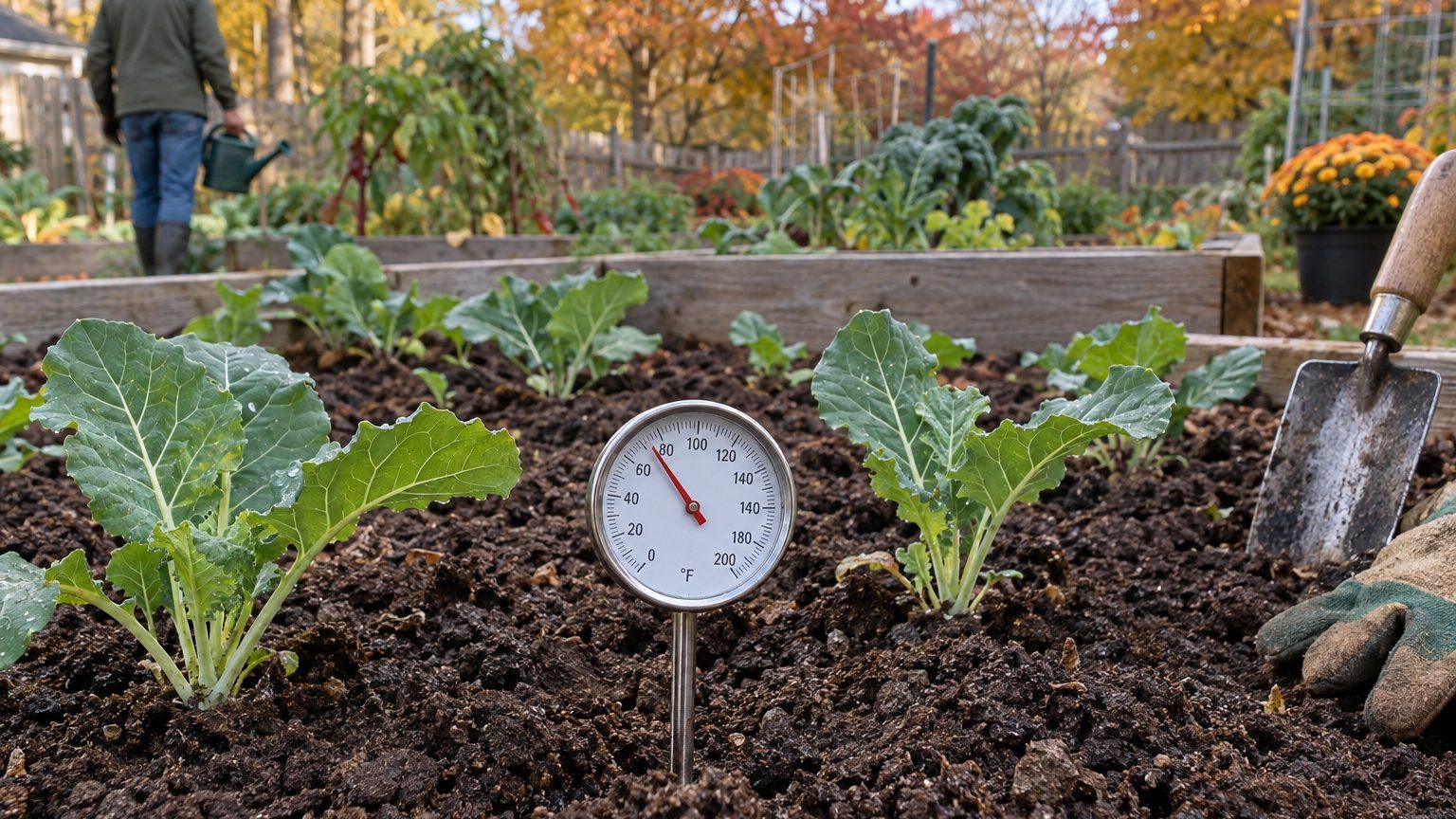

Collards go into New Mexico ground once the soil itself has warmed, not on a calendar date alone. In the Albuquerque area that usually means waiting until mid-April, and because the state’s growing window runs a full frost-free stretch of around 200 days, most gardeners get one strong planting rather than a spring-and-fall split, with the coldest winter month deciding whether the crop stands in the garden or ends at the first hard freeze.
When the soil is warm enough in New Mexico

The frost date gets all the attention, but it’s a stand-in for the number that actually matters: soil temperature. Collard seed germinates poorly in cold ground, and transplants set out too early just sit there, stunted, while the roots wait for warmth they aren’t getting. At the reference station in Albuquerque (NOAA station USW00023050), the last spring frost falls somewhere between March 31 and April 12, based on the 1991-2020 Climate Normals. That’s a 30 to 70 percent probability band, not a guarantee, and it comes from an airport weather station. Gardens in outlying suburbs, river valleys, or at higher elevation typically see their own last frost run one to two weeks later than that station reading, sometimes more. Check your own county before you trust the airport’s number.
Once that frost risk has passed and the soil has had a week or two to catch up, collards can go in as either seed or transplant. Direct-seeding works fine where the season is long enough to let young plants sit exposed a bit longer; transplants buy a head start for gardeners who want leaves sooner. Either way, this page won’t hand you a cultivar name, because the types that actually perform well in a given New Mexico county are the ones your state’s land-grant extension office has trialled there, not the ones a general gardening article assumes. New Mexico State University’s Cooperative Extension Service, at aces.nmsu.edu, publishes county-level variety guidance that this page can’t replace.
One more thing worth flagging before you plant: collards are brassicas, in the same family as cabbage, kale, mustard, turnip, and rutabaga. They share pests and diseases with all of them, which means a bed that grew cabbage last year hasn’t been “rotated” just because you’re calling this year’s crop something different. If you’re planning where to put the bed, work from a rotation plan that treats the whole brassica family as one group, not as separate crops that happen to look different.
How long the season lasts here
Run the two frost dates together and you get the shape of the New Mexico growing year. Using the latest likely spring frost, April 12, and the earliest likely fall frost, October 29 (both from the same NOAA Climate Normals dataset for the Albuquerque station), the frost-free window comes out to roughly 200 days. That’s a long season by national standards, and it changes what’s worth attempting in the garden, not just how long the collards sit in the ground.
A 200-day window is long enough that a single spring sowing isn’t your only option. Collards actually do some of their best work as a cool-season crop, and a long frost-free stretch like this one gives you room to time a second sowing for harvest deeper into fall, when flavor tends to sweeten after a light touch of cold. Whether that second sowing is worth the bed space depends on what else is competing for the space in mid-summer, and on how consistently you can keep new seedlings watered through the hottest weeks. If succession planting interests you, the site’s succession sowing guide walks through spacing a second round of brassica plantings so the harvests don’t all land at once.
The length of the window also affects the transplant-versus-direct-seed decision from the section above. In a short-season territory, transplants matter because every week counts. Here, with 200 days to work with, direct-seeding has more room to catch up, which simplifies things for anyone who’d rather not manage trays indoors.
Heat and water in New Mexico

This page doesn’t have a sourced count of days above 90°F or a summer rainfall figure for New Mexico, so none gets invented here. What the record does give is the number that matters more for planning a collard bed: the mean daily minimum temperature of the coldest month, which at the Albuquerque reference point runs 26.4°F.
That figure is the hinge the whole crop plan turns on. Where a territory’s coldest month stays genuinely mild, collards become a standing crop, picked leaf by leaf from November into March, with new growth replacing what’s harvested. Where the coldest month doesn’t stay mild, collards behave as an autumn crop instead: planted for a fall harvest, picked hard before a real freeze, and finished for the season once that freeze arrives. A mean daily minimum of 26.4°F in the coldest month puts Albuquerque and similar elevations in the second group. Collards tolerate a light frost well, even a brief dip into the mid-20s, but a winter that averages that cold on its minimum side, night after night, isn’t the mild standing-crop winter that lets the plant just keep going. Plan the bed as an autumn crop, harvest it down before the hard freeze locks in, and treat anything that survives past that as a bonus, not the plan.
New Mexico’s hardiness range spans zone 4b to 9a under the USDA Plant Hardiness Zone Map (built on the 1991-2020 normals), which is a wide spread for one state. That range is exactly why the Albuquerque figures here should be read as a reference point, not a statewide promise. Southern counties at lower elevation run warmer through winter than the Albuquerque station does, and a gardener there may get closer to that standing-crop pattern than someone at higher elevation in the north. There’s no summer-rainfall or heat-day dataset attached to this page to lean on for the other half of the picture, so the honest answer is that New Mexico’s summer growing conditions vary by elevation and irrigation access more than any single figure could capture, and watering consistency, not a specific rainfall total, is what keeps a summer-sown bed from bolting or drying out between sowings.
Which collards suit New Mexico
None of this page’s reasoning points to a specific variety, and that’s deliberate. What the local facts do support is a description of the type that fits: something on the earlier-maturing side, since even a 200-day window works better when the plant isn’t racing a fall freeze at the finish; something that handles dry heat reasonably during establishment, since summer sowings here are working against evaporation more than against humidity; and, because New Mexico’s dry climate keeps humidity-driven disease pressure lower than it would be in the Southeast, disease resistance matters less here as a first filter than consistent watering and airflow around the leaves.
That’s as far as a general page can responsibly go. The varieties that have actually been trialled and recommended for New Mexico gardens, county by county, live with New Mexico State University’s Cooperative Extension Service, not with a national gardening article. Check aces.nmsu.edu for the variety list for your county before you buy seed, because the extension office has data this page doesn’t: which types held up through an actual Albuquerque or Las Cruces or Farmington winter, not just a theoretical one built from frost-date probabilities.
Refusing to name a cultivar here isn’t a gap in the research. It’s the correct answer for a page working from climate normals and frost probabilities rather than from local trial results, and it’s worth saying plainly rather than filling the space with a name that sounds authoritative but isn’t backed by anything grown in New Mexico soil.