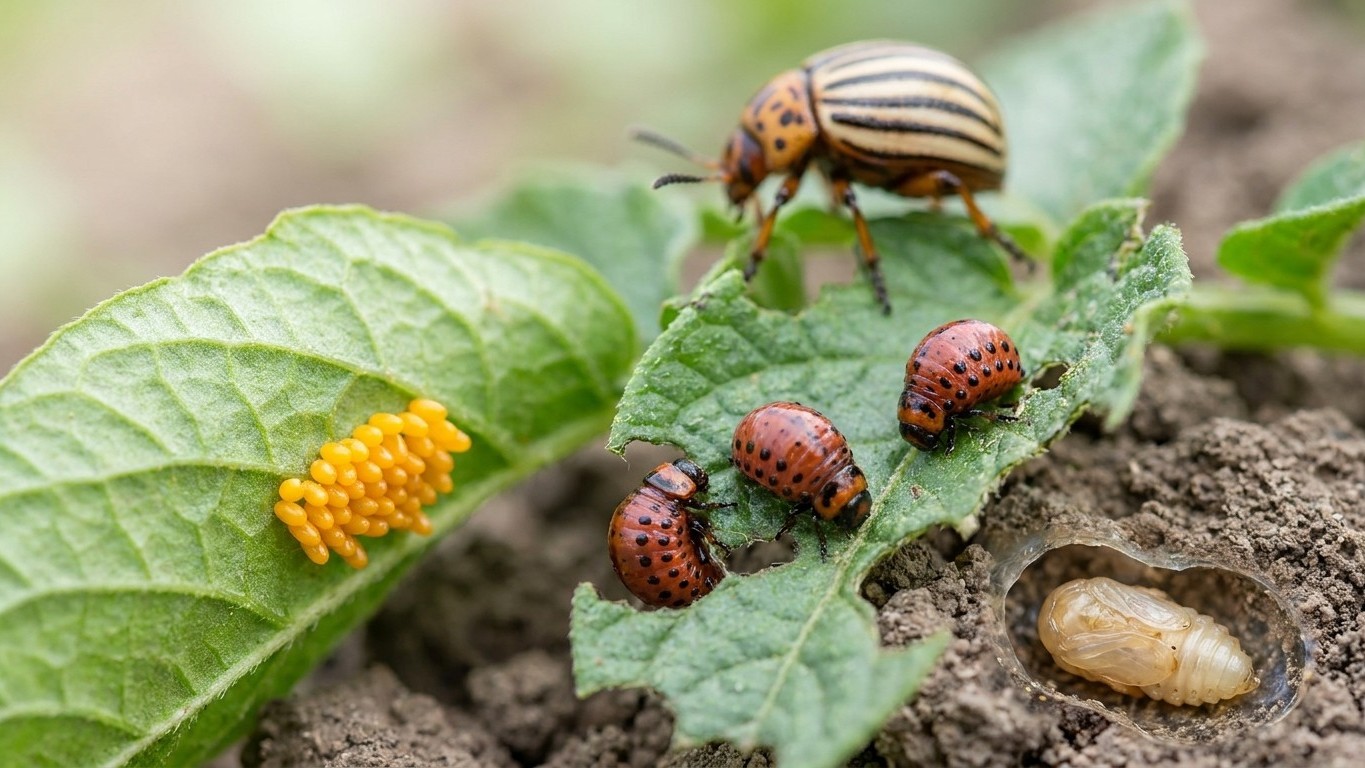

New Mexico State University Extension documents ten insect and mite pests across vegetable crops statewide, but only a handful of those actually feed on potato foliage or tubers. The rest belong to squash, corn, or mustard-family crops and show up on a potato bed only by accident, if they show up at all. Knowing which name applies to your plant, and which doesn’t, saves a lot of wasted spraying.
Which pests attack potato in New Mexico
New Mexico State University Extension lists ten species it documents on vegetable crops in the state: Aphids, Bagrada bug (Bagrada hilaris), Beet leafhopper (Circulifer tenellus), Corn earworm, Grasshoppers, Lygus bugs, Spotted cucumber beetle, Squash bug, Striped cucumber beetle, and Thrips. That’s the full documented list for this territory, no more, no fewer.
Not every name on that list belongs on a potato plant. Bagrada bug is a mustard-family specialist, it targets cabbage, broccoli, and their relatives, and it has no reason to settle on a potato leaf. Corn earworm feeds inside corn ears and tomato fruit, it isn’t built to bore into a potato tuber underground, and it rarely lands on the crop at all. Spotted cucumber beetle, striped cucumber beetle, and squash bug are cucurbit feeders through and through, they want squash, melon, and cucumber vines, and a potato row usually gets ignored while those three insects work the neighboring bed.
That leaves five species with a real reason to be on a potato plant in New Mexico: aphids, beet leafhopper, grasshoppers, lygus bugs, and thrips. Aphids cluster on the undersides of leaves and pull sap while also spreading viruses between plants. Beet leafhopper does the same kind of damage but carries a specific threat, curly top virus, which it can move from weedy hosts into a potato patch fast. Grasshoppers are generalists, they’ll strip foliage from almost anything green when their numbers build up in a dry year, and potato leaves are no exception. Lygus bugs pierce plant tissue with a needle-like mouthpart and can distort new growth. Thrips scrape at leaf surfaces and leave a silvery, stippled look behind.
The one decision that matters here is scouting before naming: a bug found crawling near squash vines that has wandered onto a potato leaf isn’t a potato pest just because it’s in the row. Match the insect to what NMSU Extension actually documents feeding on this crop before treating anything.
When each one shows up, and what it does first
New Mexico’s frost-free planting window, based on the reference weather station used by NOAA NCEI, runs with a last spring freeze probability landing between March 31 and April 12. That’s the anchor point for a potato calendar here, not a named month, because seed potatoes go in the ground relative to that freeze risk, and everything that eats the crop afterward follows the plant’s own growth stages rather than the calendar page.
Aphids tend to arrive as soon as the canopy fills in, riding wind currents from weedy areas or neighboring plantings. The first sign is rarely the insect itself, it’s a sticky residue on leaves (honeydew) or leaves that look faintly curled and undersized.
Beet leafhopper moves in early too, often right behind emergence, because it’s chasing the newest, tenderest foliage. What a gardener notices first isn’t the leafhopper hopping away when disturbed, it’s the plant itself: stunted new growth and leaves that roll upward, both signs of curly top virus transmission rather than direct feeding damage.
Grasshoppers build their populations through the warm, dry stretch of the growing season and become most damaging as their numbers peak later in summer, when rangeland vegetation dries out and they move into irrigated gardens looking for green material. Ragged, chewed leaf edges, sometimes whole leaflets gone overnight, is the calling card.
Lygus bugs and thrips both show up once foliage is well established, feeding on the newest leaves and stems. Lygus damage looks like small dark flecks or slightly deformed new leaves. Thrips leave a papery, silvered sheen on the leaf surface, often first noticed on the top few leaves of the plant. Neither insect announces itself until you flip a leaf over and check.
Telling the damage apart from everything else
Not every discolored or chewed potato leaf means an insect is at work. New Mexico’s dry heat and alkaline soils produce their own set of symptoms that mimic pest feeding, and mixing them up leads to treating a plant that doesn’t need it.
The detail that separates insect feeding from everything else is where the damage sits and whether it moves: pest damage tends to appear on specific leaves or in a spreading pattern from an edge of the row, while nutrient and water stress usually shows up evenly across the whole plant at once.
| Symptom | Likely cause | What tells them apart |
|---|---|---|
| Sticky residue, curled leaves | Aphid feeding | Check leaf undersides for clusters of small, soft-bodied insects |
| Stunted growth, upward-rolled leaves | Beet leafhopper / curly top virus | Whole plant looks dwarfed rather than just a few leaves; virus symptoms don’t clear up with water |
| Ragged, chewed leaf margins | Grasshoppers | Chewing is coarse and irregular, unlike the fine stippling of thrips |
| Silvery, papery sheen on leaves | Thrips | Sheen concentrates on youngest leaves first, feels dry rather than wet |
| Yellowing between leaf veins | Nutrient deficiency | Pattern follows veins evenly across older leaves, no chewing or residue present |
| Wilting despite moist soil | Disease or root issue | Soil is wet but plant droops anyway; insect feeding doesn’t cause this pattern |
| Torn or bruised leaves in one area | Mechanical or wind damage | Damage clusters on the side facing prevailing wind, not scattered through the plant |
None of these signs are a substitute for someone looking at the actual plant. If a symptom doesn’t match cleanly to one row in that table, that’s the point to bring a sample or a clear photo to a local extension office rather than guess.
What actually works here, and what is a waste of time
Timing beats product choice on a short growing season. A floating row cover put in place at planting, before the frost-free window fully opens between March 31 and April 12, keeps beet leafhopper and early aphids off young plants during the weeks they’re most vulnerable, and it costs nothing in ongoing labor once it’s set. Covers come off once the plant needs pollinator access or once the canopy outgrows the cover’s height.
Weed control around the garden matters more than most gardeners expect. Beet leafhopper builds its populations on weedy hosts before moving into cultivated plants, so removing weedy borders near a potato patch reduces the source population before it ever reaches the crop. Rotating potatoes away from the same bed year to year also limits how many overwintering pests are already waiting in the soil when new plants emerge.
Handpicking grasshoppers in small gardens, while tedious, actually works when populations are still low, before they migrate in from dried rangeland later in the season. Once numbers spike, physical removal stops being practical, and that’s a sign to call the local extension office rather than try to outpace the population by hand.
What wastes time: spraying on a fixed schedule regardless of whether pests are present, since none of the five species covered here stay active constantly through the season. Broad, repeated treatments also knock back the natural predators that would otherwise keep aphids and lygus bugs in check, often making the next generation worse. New Mexico State University Extension is the source for what’s actually labeled for use on potato in this state, and that’s the office to call before buying any treatment, since this page doesn’t recommend specific products or active ingredients.
Where to check this for your own county
New Mexico State University Extension documents these pests at the state level, but presence and pressure shift a lot within the state itself. A garden in a high, cooler county won’t see grasshopper pressure the same way a low-desert county does, and beet leafhopper activity tracks closely with nearby weedy or rangeland habitat that varies block to block, let alone county to county.
The next move is contacting the county extension office directly, since that’s the level where someone can confirm what’s actually active in a specific garden right now, not just what’s been recorded somewhere in the state at some point. County agents also know local planting timing relative to the frost-free window, which shifts with elevation more than the reference station figures suggest.
A state-wide list is a starting point for narrowing down a symptom, not a diagnosis. Bringing a leaf sample, a photo, or a clear description of when the damage appeared to a county office turns a guess into an answer, and it’s the only way to know for certain which of the five relevant species is actually behind what’s happening in a particular garden.
Common questions
Do all ten pests NMSU Extension lists actually feed on potato?
No. Only aphids, beet leafhopper, grasshoppers, lygus bugs, and thrips have a documented reason to feed on potato. Bagrada bug, corn earworm, spotted cucumber beetle, squash bug, and striped cucumber beetle target other crops and rarely cause meaningful potato damage.
When should row covers go on a potato bed in New Mexico?
Set covers at planting, timed around the frost-free window that runs between March 31 and April 12 based on the reference station data from NOAA NCEI. Remove them once the plant’s canopy needs more room or pollinators need access.
NOAA NCEI 1991-2020 U.S. Climate Normals data is the source for that frost window figure.
Why does my potato plant look damaged but I can’t find any insects?
Nutrient deficiency, drought stress, disease, or mechanical wind damage can all mimic pest feeding without any insect present. Check whether the symptom is even across the whole plant (more likely stress or deficiency) or concentrated on specific leaves (more likely feeding), and bring an unclear case to a county extension office.
Is beet leafhopper worse than the other four pests on this list?
It carries a specific added risk: curly top virus, which it transmits while feeding. Aphids can also spread viruses, but grasshoppers, lygus bugs, and thrips cause direct feeding damage without the same virus-transmission concern documented for this territory.