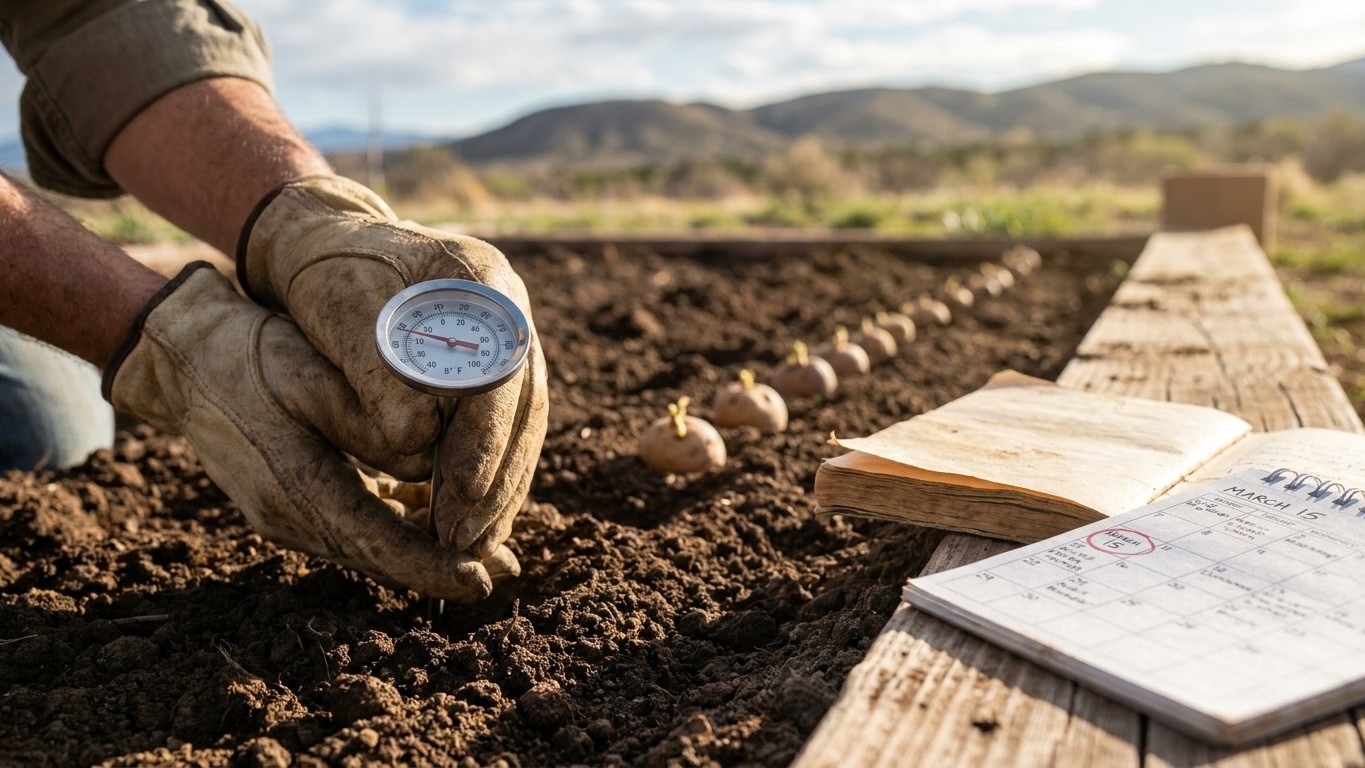

For Albuquerque, the reference city behind New Mexico’s federal climate data, the math lands somewhere in the second half of March. NOAA’s climate normals put the last spring frost there between March 31 and April 12, and potatoes go into the ground 14 to 21 days before that date, once the soil itself reaches 50 F. Do the subtraction and you get a window, not a single day. Your own yard, especially outside city limits or higher up a foothill, will likely run later.
The short answer
The figure that matters comes from two different places, and neither one is a calendar date you can just circle. NOAA’s National Centers for Environmental Information tracked freeze probabilities at the Albuquerque airport station across the 1991-2020 period and found the 30 to 70 percent band for a 32 F freeze falling between March 31 and April 12. That’s the frost bracket. The planting bracket comes from a separate source: Utah State University Extension’s potato fact sheet and the University of Maine Cooperative Extension’s Bulletin #2077 both describe potatoes going into the ground 14 to 21 days before the last frost date, timed to when soil temperature hits 50 F.
Stack those two figures and the arithmetic does the rest. Subtract 21 days from the earliest frost date, March 31, and you land near March 10. Subtract 14 days from the latest frost date, April 12, and you land near March 29. That gives an Albuquerque-area planting window running roughly from early to late March, with the exact day depending on how quickly the soil actually warms that season, not on what the calendar says it should be doing.
This is where a lot of planting advice goes wrong. It treats “count back from frost” as if it produces one date, when it actually produces a window bounded by two independent variables: how variable your local frost timing is, and how fast your particular soil, in your particular yard, climbs to 50 F. A gravelly south-facing bed in Albuquerque’s North Valley might hit that mark a full week before a heavy clay plot in a shaded backyard three miles away, even though both sit under the same regional frost data.
None of this is New Mexico-specific arithmetic, either. The 14-to-21-day rule and the 50 F threshold are the same numbers Utah State and Maine publish for their own states. What changes state to state, and county to county within New Mexico, is the frost date itself and how many days a given location spends above the heat ceiling once summer arrives. That second number is the more decisive one for anyone gardening south of Santa Fe, and it’s covered in the next section.
What actually decides it
Two thresholds run this whole operation, and they pull in opposite directions. One tells you when you’re allowed to start. The other tells you how much time you actually have before the crop gives up on you. Understanding both means you can work out a planting date for a county this page never mentions, using nothing but a local frost date and a soil thermometer.
The 50 F soil trigger
Air temperature is not the gatekeeper here. Soil is. Utah State University Extension and the University of Maine Cooperative Extension both tie potato planting to soil reaching 50 F, not to a date on a seed packet. Soil warms slower than air, and it warms unevenly depending on soil type, moisture, and how much direct sun a bed gets. A sandy plot with good drainage in Las Cruces will cross 50 F noticeably earlier than a heavy, wet clay bed at the same elevation. That’s why the frost-date countback (14 to 21 days before last frost) functions as an estimate, a placeholder for the real trigger, which is a thermometer reading taken a few inches down at planting depth. In a season that runs unusually cold, the countback date can arrive before the soil actually qualifies, and the smarter move is to wait for the reading, not the calendar.
The 90 F heat ceiling
The other threshold works from the top down. Utah State’s fact sheet is direct about this: soils above 90 F inhibit tuber set and fill. That’s not a slowdown gardeners can water their way out of. Once the soil crosses that line, the plant stops sizing tubers regardless of irrigation. In lower-elevation New Mexico, where summer soil temperatures climb fast and stay high for weeks, this ceiling arrives well before the growing season would otherwise wind down. That reshapes the whole strategy. Instead of treating potatoes as a full-summer crop, the useful approach in a hot, low-desert county is to plant as early as the 50 F trigger allows and dig a spring crop before the heat ceiling shuts tuber development down, rather than trying to nurse the same planting through July and August.
How to do it
- Find your own county’s last spring frost timing rather than borrowing Albuquerque’s March 31 to April 12 window outright; a local extension office or a nearby weather station reading will get you closer than a statewide guess.
- Count back 14 to 21 days from that local frost date to get a target window, understanding it’s a planning estimate, not a fixed day.
- Buy certified seed potatoes rather than saving grocery-store tubers or last season’s leftovers; uncertified seed carries virus that a home garden has no way to screen for.
- A few days before your target window, check soil temperature directly at planting depth with a soil thermometer, not an air thermometer.
- Cut larger seed potatoes into pieces with at least one eye each, and let the cut surfaces callus for a day or two before planting, reducing rot risk in the ground.
- Plant once the soil reads 50 F, even if that date runs a few days earlier or later than your original countback estimate.
- In lower-elevation or hot-summer counties, choose an early or mid-season variety class so the crop can size up and finish before soil temperatures climb past the 90 F ceiling.
- Track soil temperature again as summer approaches; once it’s clearly trending toward 90 F, plan the harvest around finishing before that point rather than extending the season.
What goes wrong
- Using one statewide frost date for the whole state. New Mexico’s elevation and terrain vary enough that a date built from an Albuquerque airport station won’t match a county at higher elevation or further north. Check local data instead of applying the reference-city window as a guarantee.
- Planting by the calendar instead of the thermometer. The 14-to-21-day countback is a placeholder for when soil should reach 50 F, not a promise that it has. In a cold, slow spring, planting on the countback date can mean planting into soil that hasn’t warmed enough for growth to actually start, gaining nothing over waiting a few more days.
- Using uncertified seed potatoes. Grocery-store potatoes or saved tubers from a prior harvest can carry virus with no visible symptoms. Certified seed potato, sourced as such, is the one safeguard both Utah State and Maine treat as non-negotiable.
- Planting a late-season variety class in a hot, low-elevation county. If soil temperatures reliably cross 90 F for weeks at a time before a late variety would finish sizing, tuber fill stalls out regardless of care. An early or mid-season class gives the crop a real chance to finish inside the cooler window.
- Trying to push a second, summer planting after the spring harvest. Once regional soil temperatures are running above 90 F, a new planting faces the same ceiling immediately. In hot counties, the workable plan is one well-timed spring crop, not a spring-and-summer succession.
Common questions
Can I plant a second potato crop later in the summer in New Mexico?
In counties where soil temperatures climb past 90 F for extended stretches, a summer planting runs straight into the same ceiling that limits a late spring crop, so tuber set and fill stall out. The more workable approach in those areas is one spring planting, timed early, rather than a second attempt once summer heat sets in.
My county sits at a higher elevation than Albuquerque. Does the March 31 to April 12 frost window still apply?
Not directly. That window comes from a single airport station’s climate normals, and higher elevation typically pushes the last frost later. Treat the Albuquerque figure as a reference point and check data specific to your own county or a nearby station before setting a planting date.
Do all potato varieties handle heat and finish timing the same way?
No. Utah State and Maine both classify varieties by season length, early, mid-season, or late, rather than publishing a fixed days-to-maturity number. In counties with a short window before soil crosses the 90 F ceiling, an early or mid-season class has a better shot at finishing tuber fill before growth stalls.
Is it safe to Plant Potatoes bought from a grocery store instead of buying seed potatoes?
Both university sources treat certified seed potato as the baseline, not an optional upgrade. Grocery-store or home-saved tubers can carry virus without any visible sign of it, and there’s no way to screen for that at home. Certified seed is the one safeguard that actually protects the crop before it’s even in the ground.