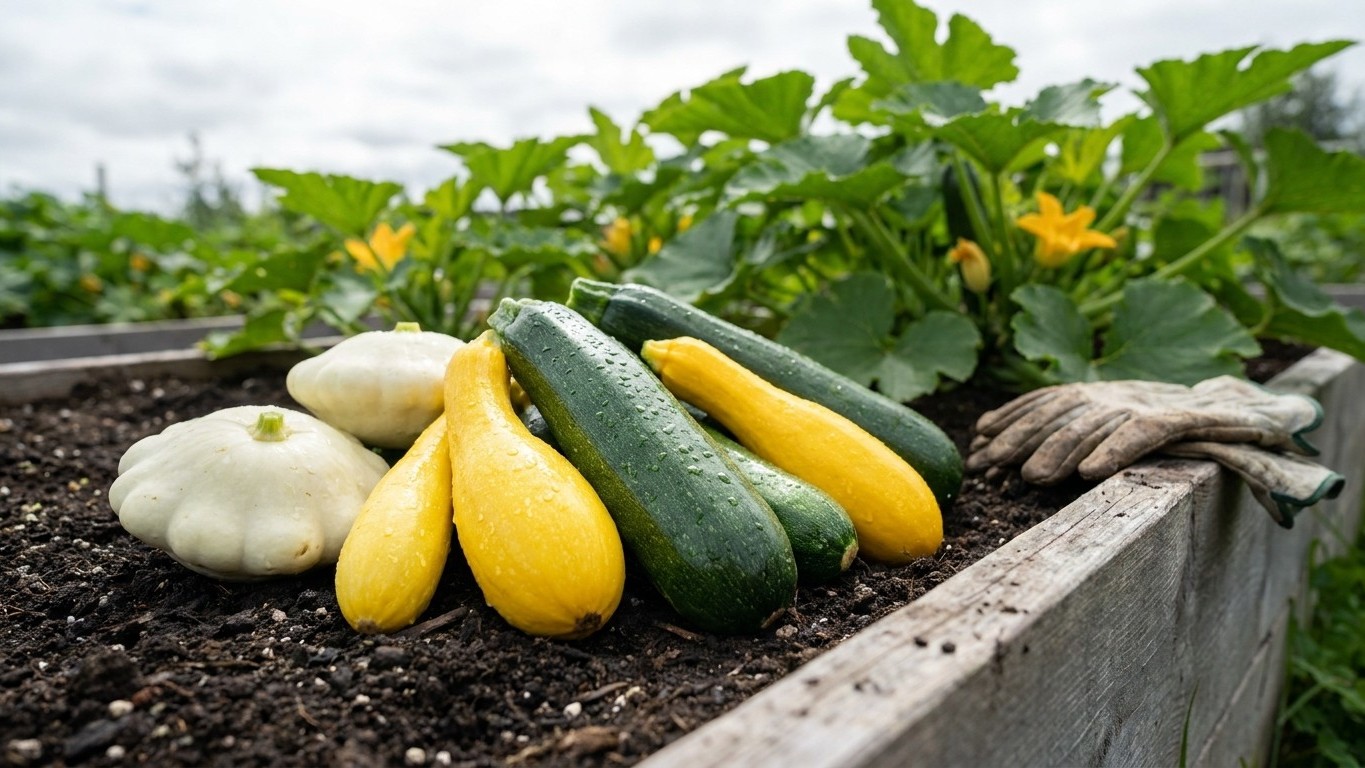

Given the long frost-free window near the state’s reference weather station and the sharp heat load that comes with it, the varieties that do best in New Mexico are fast, compact bush types, yellow straightneck, zucchini, and scallop or pattypan squash, grown under drip irrigation rather than left to rely on summer rain. Sprawling, water-hungry vines are the harder bet here.
The short answer for New Mexico
Start with the calendar. At the reference station, the last spring freeze falls somewhere between March 31 and April 12, and the first fall freeze arrives between October 29 and November 9. Stretch those two windows out and the frost-free season runs roughly 200 to 223 days, well over six months. That is more than enough time to run almost any summer squash type to maturity, since even the slower cultivars finish in 55 to 65 days. Season length, is not what narrows the field here.
What narrows it is heat and dryness. The reference station averages 42.5 days a year at or above 90F, a heat load concentrated right in the middle of the growing season, and summer rainfall totals only about 3.5 inches across June, July and August, with June, the month most gardeners are direct-seeding squash, delivering just 0.57 inches. That combination punishes anything that needs steady, even soil moisture over a wide root run.
That is why bush-type summer squash pulls ahead of sprawling vine types in this state. A compact zucchini or yellow straightneck plant occupies a tight, predictable footprint that a single drip line can cover evenly, and it fruits in 45 to 55 days, fast enough to get a full harvest in before the worst heat stalls fruit set and fast enough to allow a second sowing in early to mid-July for a fall crop that still beats the late-October freeze. Pattypan and scallop types behave the same way and fit the same watering pattern.
Sprawling vining squash, the kind that spreads eight or ten feet and pulls moisture from a wide, shallow root zone, asks for more total water delivered more often, precisely what a summer with 0.57 inches of rain in its driest month cannot supply on its own. None of this rules vining types out if a gardener is set up with reliable irrigation, but for most yards here, the bush habit is the lower-risk choice.
What will not work here
The clearest failure mode in New Mexico is treating a summer squash bed like it would be treated in a wetter state, watering once a week and expecting the plant to coast. With 42.5 days a year above 90F driving evaporation and only about 3.5 inches of rain across the entire summer, a once-weekly soak dries out long before the next one, and summer squash respond to that stress with blossom drop and stunted, misshapen fruit rather than steady production. Anyone growing squash here needs a watering rhythm built around the heat, not around a generic weekly schedule.
Varieties bred and marketed mainly for humid-region disease pressure, heavy powdery mildew resistance packages aimed at the Southeast or the mid-Atlantic, bring little advantage in this dry air, and choosing a cultivar for that trait alone means passing over one better suited to heat tolerance and fruit set under stress, which is the actual local problem.
Heat itself has a direct effect on fruit set. Once daytime temperatures push past roughly 90 to 95F for stretches, summer squash flowers commonly abort or fail to pollinate properly, and with more than six weeks of the year crossing that 90F line at the reference station, a gardener who plants only heat-sensitive cultivars and expects continuous output through July is planting for disappointment. The fix is less about variety alone and more about timing plantings to dodge the hottest weeks, but some cultivars hold fruit set better under heat stress than others, and that trait is worth checking for at planting time.
At the coldest end of the state’s hardiness range, the slowest-maturing summer squash types run into a different problem. A cultivar that needs 60 to 65 days to first harvest cuts it close where the frost-free window is far shorter than the 200-plus days seen near the reference station, and a late spring or an early fall cold snap at higher ground can end the season before a slow variety ever produces a full crop.
What changes across New Mexico
New Mexico’s USDA hardiness zone range, 4b to 9a under the USDA Plant Hardiness Zone Map, is one of the widest spans of any state’s cluster page in this series, and that spread alone means there is no single squash calendar or variety list that fits the whole state. Zone 4b sits at the cold end, the kind of reading associated with high mountain country, where hard frosts arrive earlier in fall and linger later in spring than anything the reference station records. Zone 9a sits at the warm end, associated with the lower, warmer river valleys, where the frost-free window runs longer and the heat load is heavier still than the 42.5 days above 90F averaged at the reference station.
A gardener working land toward the colder, higher end of that range should treat the reference station’s dates as optimistic, not as a guarantee, since higher elevation typically pushes the last spring frost later and the first fall frost earlier than the airport figures used here. The practical shift is toward the fastest-maturing bush varieties available, tighter succession windows, and a readiness to use row cover or cloches to buy a couple of extra weeks on either end of the season.
A gardener toward the warmer, lower end of the range can generally plant earlier in spring and push later into fall, but should expect more days above 90F than the reference station’s average, which raises the bar on irrigation consistency and makes heat-tolerant fruit set an even bigger factor in variety choice than it is statewide.
Because the state spans that much climatic ground, the honest answer to “which zone am I in” is not something this page can settle. That call depends on local elevation and terrain, and belongs on the USDA Plant Hardiness Zone Map rather than in a general guess here.
Where to check this for your own county
New Mexico State University’s Cooperative Extension Service is the source built to close the gap, the difference between a statewide range and what actually happens in one county’s soil and microclimate. Two things are worth looking for specifically once there.
First, the local planting calendar for the county in question, which will reflect actual frost records for that area rather than the single reference station cited throughout this page. A county at elevation, or one in a river valley with its own cold-air drainage pattern, can run noticeably earlier or later than the reference dates given here, and the county-level calendar is where that correction lives.
Second, the list of summer squash varieties that extension agents have actually trialled or recommended for that county, which accounts for local pest pressure, local soil type and local water availability in a way a statewide list cannot. A county that leans sandy and hot will get different variety guidance than one at higher, cooler ground, even within the same state.
This page works at the scale of a state, useful for understanding the general pattern of heat, dryness and season length across New Mexico, but a county recommendation from NMSU Extension will always be more specific and more reliable for an individual garden than anything written at this scale. Treat this page as the starting framework and the extension office as the source that adjusts it to one particular piece of ground.
Checking this against your own garden
No planting date on this page beats what the ground itself is doing, and three simple observations settle more than any calendar figure.
Soil warmth, checked by hand a couple of inches down in the bed, is the first tell. Summer squash seed sits and sulks in cold soil no matter what the calendar says, and a gardener who feels the soil is still cool to the touch in early spring is better off waiting, even if the date on this page suggests planting is underway elsewhere in the state.
The first flush of male flowers, the ones on thin stems that appear before any fruit-bearing female flowers show up, signals that the plant has settled in and is building toward production. A long gap before female flowers follow often points to heat or moisture stress worth adjusting for immediately, rather than waiting out.
The first true leaves, the ones that appear after the initial seed leaves and actually look like squash foliage, mark the point where the plant has moved past its most fragile stage. Slow, pale true leaves usually mean the soil is cooler or less fertile than the plant wants, a sign specific to that garden’s own conditions rather than to New Mexico as a whole.