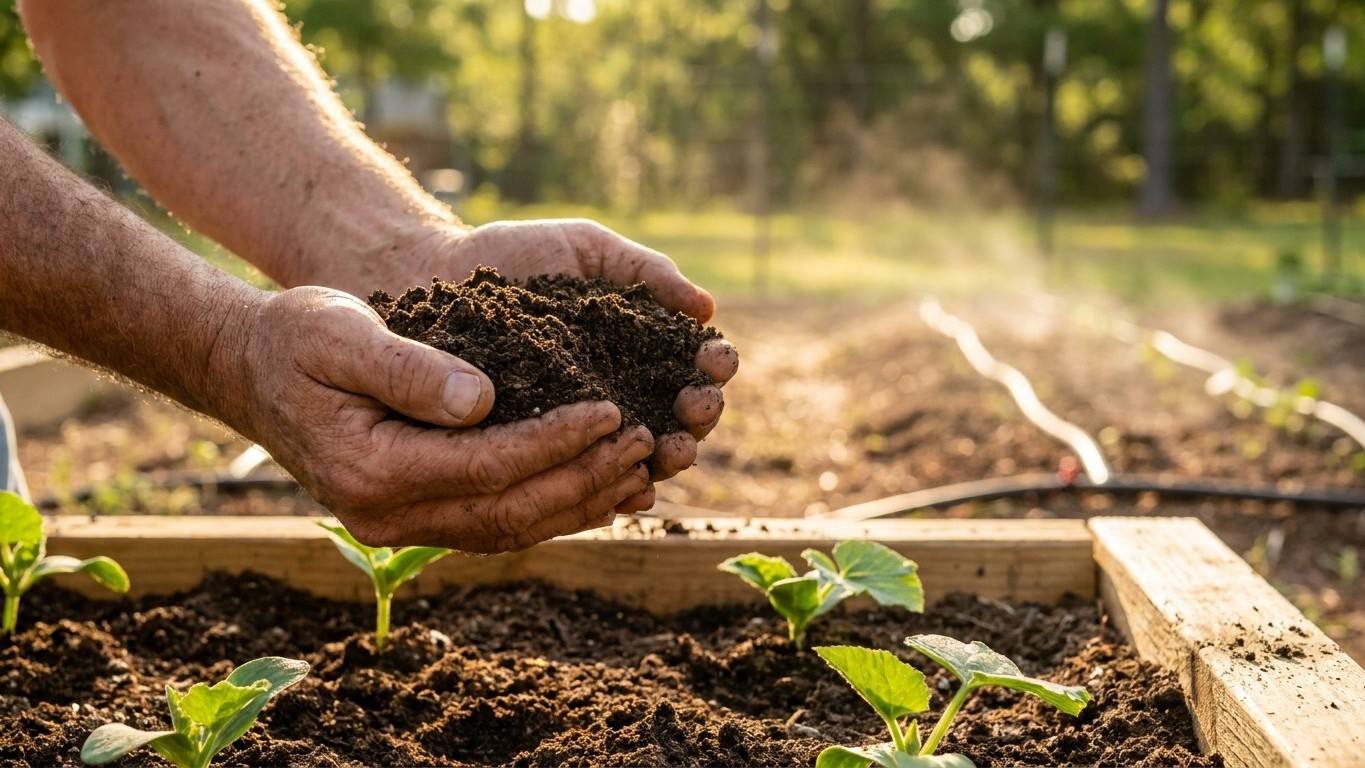

Summer squash can go into New Mexico ground once the soil itself has warmed, not simply once the calendar clears the last frost date. At the reference station near Albuquerque, that means waiting until mid-to-late April in most years, then watching soil temperature and local microclimate rather than the date alone before setting out plants.
When the soil is warm enough in New Mexico
The NOAA NCEI 1991-2020 Climate Normals put the last spring frost at the reference station (USW00023050) somewhere between March 31 and April 12, based on the 30-70% probability band for a 32F freeze. That’s a useful anchor, but it’s a proxy for something else entirely: summer squash doesn’t care about frost risk directly, it cares about soil temperature. Seeds and transplants need soil warm enough to keep the roots active, and soil typically lags a week or two behind the last frost date before it reaches that point.
Treat the frost date as a probability, not a promise. A 30-70% band means frost is still plausible on either side of it, and one bad cold snap in early April can undo an eager planting. Gardeners in the Rio Grande valley near the reference station usually see conditions closest to this window; those farther out, at higher elevation or in outlying counties, should expect the real last frost later, sometimes by one to two weeks or more.
Elevation changes the math
New Mexico spans USDA Hardiness Zone 4b through 9a, a range wide enough to cover mountain valleys and low desert basins in the same state. That spread comes from the USDA Plant Hardiness Zone Map’s single variable, average annual extreme minimum temperature, and it means the reference-city frost dates above apply best to conditions similar to Albuquerque’s elevation and exposure. A garden a few thousand feet higher, or tucked into a cold-air drainage, can run a noticeably later spring and earlier fall than the numbers cited here.
Because of that spread, the smart move is to treat these dates as a starting estimate and confirm them against local knowledge. New Mexico State University’s Cooperative Extension Service keeps county-level guidance and locally trialled variety recommendations that this page simply can’t replicate. Ask there before locking in a planting date, and don’t reach for a named cultivar based on a general climate page like this one, since the varieties that actually perform well in a given New Mexico county are the extension office’s business, not a generic recommendation.
How long the season lasts here
Pairing the last spring frost window (March 31 to April 12) with the first fall frost window (October 29 to November 9) gives a frost-free season at the reference station running from roughly 200 days, in the tightest pairing (last frost April 12, first frost October 29), up to about 224 days in the most generous pairing (last frost March 31, first frost November 9). Either way, that’s a long window by national standards, well over six months of frost-free growing.
A season that long changes what’s worth attempting with summer squash. Where a short window forces a single sowing and makes every week of delay costly, 200-plus days leaves room for a first planting in late spring and a second one in mid-summer, timed so the second crop matures as the first starts to decline from squash bugs, powdery mildew, or simple exhaustion. Succession sowing like this also sidesteps a common failure mode: a single planting that peaks all at once, then collapses under heat stress in July with nothing behind it.
The length of the window also affects whether transplanting makes sense versus direct seeding. With a shorter season, transplants buy valuable weeks; with New Mexico’s roomier frost-free stretch, direct seeding after the soil has genuinely warmed is often simpler and avoids the root disturbance summer squash dislikes. For the mechanics of staggering plantings through a season this long, the succession sowing guide on this site walks through spacing out sowings so the harvest doesn’t stall or crash all at once.
Heat and water in New Mexico
The reference station averages 42.5 days a year at or above 90F, according to the NOAA NCEI 1991-2020 Climate Normals for Albuquerque. That’s not a description of an occasional hot spell, it’s a summer’s worth of days where pollen loses viability fast and fruit set drops off. Summer squash flowers are only receptive for a few hours each morning, and heat much above the high 90s can leave female flowers unpollinated even when the plant looks healthy and is covered in blooms.
Rainfall does little to offset that heat load. Summer rain across June, July, and August totals about 3.5 inches, out of roughly 8.8 inches for the whole year, meaning most of what falls, falls outside the growing season. June is the driest of the three, at just 0.57 inches, with July picking up slightly to 1.64 inches and August at 1.31 inches.
What the numbers mean at the plant
| Month | Average rainfall |
|---|---|
| June | 0.57 inches |
| July | 1.64 inches |
| August | 1.31 inches |
Summer squash carries broad, thin leaves that lose water quickly, especially under 42-plus days of 90-degree heat, and its roots sit shallow rather than reaching deep for reserves. When rain does come in New Mexico, it often arrives as a monsoon thunderstorm, dumping water fast enough that much of it runs off rather than soaking into the root zone, particularly on compacted or clay soil. Sandy soil drains too fast in the other direction, so either way, a New Mexico garden usually can’t rely on summer rainfall alone. This is a territory where irrigation scheduling and some afternoon shade during the hottest stretch of the day do more to protect a squash crop than any other single decision, and a rain gauge on the actual plot is the only way to know how much of that 3.5 inches is really reaching the roots.
Which summer squash suit New Mexico
New Mexico’s climate profile points toward specific traits rather than specific names. With a frost-free window running 200 days or more, timing isn’t the constraint it would be in a shorter-season state, so there’s little reason to chase the earliest-maturing types just to beat a closing window. Heat is the real filter here: types that hold up to sustained days above 90F, and that tolerate a bit of afternoon shade over the root zone during the worst heat, will outperform ones bred for cooler, cloudier climates.
Because summer rainfall is light and often arrives as fast-draining thunderstorms, disease pressure from constant leaf wetness is less of an issue in New Mexico than it would be in a humid state, but dust, spider mites, and squash bugs thrive in the same hot, dry stretches that stress the plant. Airflow around the plant and consistent irrigation matter more here than fungicide-focused disease resistance, though resistance to powdery mildew still helps once late-summer humidity ticks up during monsoon season.
None of that adds up to a single named variety this page can responsibly hand over. The types trialled and recommended for New Mexico conditions, tested against its heat, its elevation range, and its particular monsoon pattern, are exactly what New Mexico State University’s Cooperative Extension Service tracks. A generic climate page naming a cultivar would be guessing; the extension service, working with local trial data, isn’t. That distinction is worth taking seriously, since a squash variety that performs well in a humid coastal state can underperform badly once it’s facing 42 days above 90F and barely half an inch of June rain.