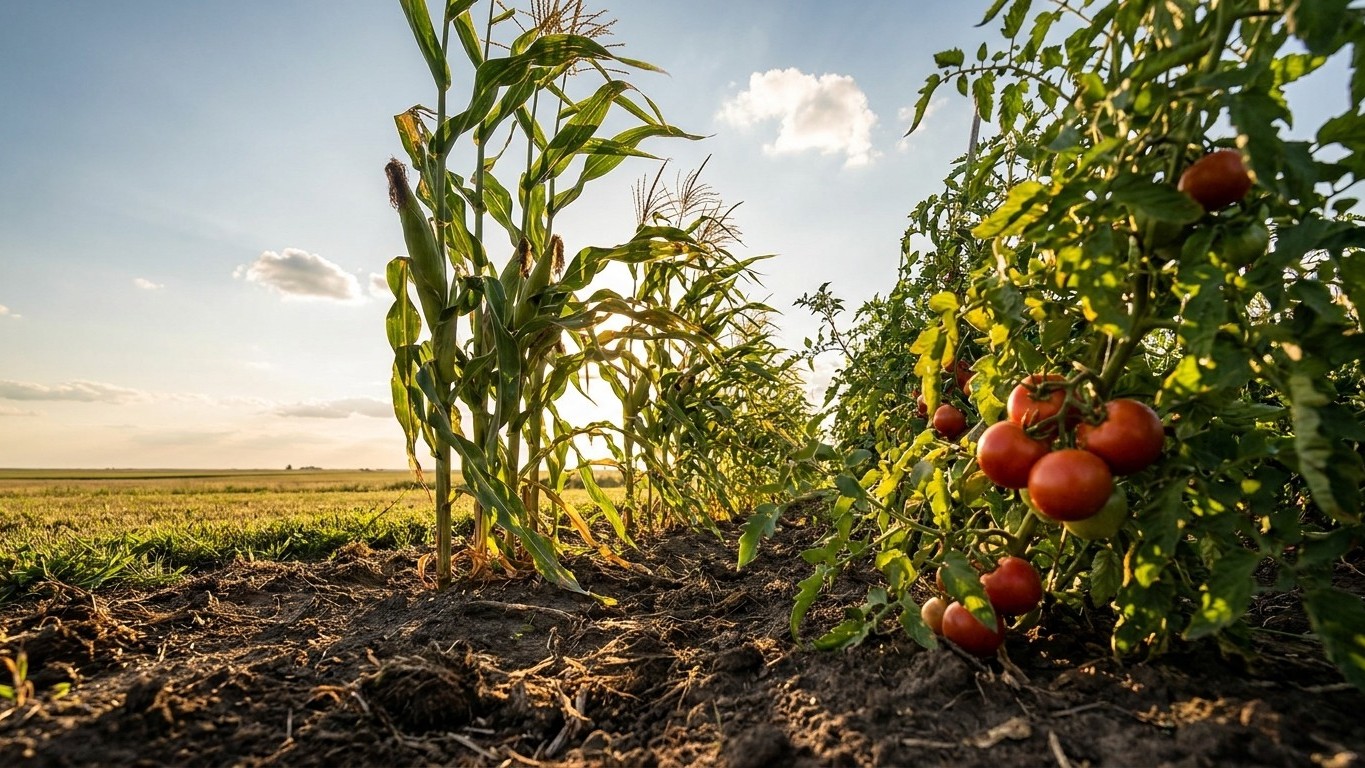

Sweet corn from a spring planting around Albuquerque comes ripe from roughly late June into August, depending on planting date, variety and elevation. The best stretch for each planting is short, and the sweetness starts draining the moment an ear leaves the plant. Heat makes it drain faster. What follows covers how to read the plant, how long picked ears stay sweet, and which spot in a New Mexico house comes closest to a good place to keep them.
When sweet corn are ready in New Mexico
Sweet corn is ready when the silks at the tip of the ear have dried to brown, the husks are still green and moist, and a punctured kernel runs milky. Look for all three together. For a spring planting at Albuquerque’s elevation, that usually falls somewhere between late June and August, and the ears are worth checking once the silks have dried and the husks are still moist and green. Higher ground runs later.
Frost dates frame the season at both ends. At the Albuquerque airport weather station, the NOAA NCEI U.S. Climate Normals put the last spring freeze between March 31 and April 12 and the first fall freeze between October 29 and November 9 (the 30 to 70 percent probability band for 32 F, station data here). Those are reference-city figures. Suburban and rural gardens usually see the last spring frost later and the first fall frost earlier, often by one to two weeks, and by more at elevation. Your county extension office can tell you where your own ground falls.
The last frost is not the planting day. Utah State University Extension says sweet corn needs soil above 60 F, and soil gets there well after the final freeze. Clemson Cooperative Extension gives the reading depth that makes the number usable: “Do not plant before the soil temperature at the 4-inch depth is at least 50 ºF. Wait to plant extra-sweet varieties until soil temperatures reach 65 °F.” A thermometer pushed 4 inches down in the morning beats any calendar. The guide to when to sow sweet corn in New Mexico covers that side in detail.
How many days does sweet corn need before it is ready?
Two clocks run on every planting, and they answer different questions. Sixty to ninety days from planting tells you whether a variety fits the season at all. Count forward from the day the soil allowed you to sow and see whether the ears finish before your first fall freeze. A late-maturing type sown in a warm May has room at the reference station. The same type sown later, or grown in a garden that freezes a week or two ahead of the airport, may not.
The second clock starts at silk emergence. Watching the silks dry down tells you which week to start testing ears. Both clocks can be right and still disagree on a given day, so use the first to choose and the second to pick. Animals tend to find ripe ears too, so daily checks in that week pay off (what eats corn in New Mexico, and when explains who shows up).
Why does ready sweet corn sometimes taste starchy?
Ripe is not the same as sweet. Utah State University Extension notes that sweetness is lost when su, se and sh2 types tassel at the same time. If you grow more than one type, sow them so they do not tassel together. The same source calls for planting in blocks of three or more rows, which describes the shape of the bed and has nothing to do with a date. A single long row of corn is the wrong layout. Three short rows side by side is the right one.
Keeping them, and for how long
The old advice to run from the garden to the pot has a mechanism behind it. Clemson Cooperative Extension states: “Sweet corn loses sugar from the kernel rapidly at high temperatures… Sweet corn can be stored under optimal conditions for about five days, but will lose sweetness with each day of storage.”
Read that sentence closely. About five days is a ceiling under optimal conditions, and the same sentence says sweetness drops with each day along the way. An ear on day one is better than the same ear on day three. An ear left on a warm counter will not reach day five in good shape. Heat is the accelerator, and the reference station in Albuquerque averages 42.5 days a year at 90 F or more. Any harvest basket sitting in that air is losing sugar faster than one in a cool kitchen.
The practical rule in words: get ears cold soon after picking, and keep them moist rather than dry. Leave the husks on until cooking, since they hold moisture around the kernels. A plastic bag over the husked ears is the fallback if the husks are already gone.
Which sweet corn types hold their sugar longest?
The genotype matters as much as the shelf. Standard sugary (su) types lose sugar fastest. Sugary enhanced (se) types hold it longer. Supersweet (sh2) types hold it longest. If you cannot eat the corn the day you pick it, that ranking is the practical reason to grow an sh2 type, since it buys you extra days in the refrigerator.
Supersweet corn also asks more of the gardener. Clemson’s 65 F soil threshold for extra-sweet varieties is 15 degrees above the 50 F floor for ordinary sweet corn. A supersweet seed sown at 50 F rots instead of germinating. This is why a gardener can get a good stand one year and a gappy one the next after switching varieties. The soil temperature did not change between years. The seed’s needs did.
Sweetness in storage, then, rests on three things: the type you chose, the temperature of the first few hours after picking, and how many of the five days you spend. Pick last, cook first, and the ranking between types matters less. Pick in bulk for a weekend of cooking, and the type becomes the deciding factor.
Where in the house that actually is
A refrigerator is the closest match for sweet corn, because corn wants cold and moist air and the fridge delivers both. That is not true of every crop. A domestic fridge runs colder than some garden produce tolerates, and tomatoes and basil are the usual victims. Sweet corn tolerates the cold fine. The other candidates fail for the opposite reason. A heated kitchen or pantry is too warm, and the sugar loss the Clemson quote describes starts there. A garage swings with the weather, and in the high desert it can run cold at dawn and hot by afternoon. On the many days a year at the reference station that reach 90 F or more, that garage will sit at 90 F or more.
A cool, shaded cellar or basement, where a house has one, can hold ears for a few hours between picking and the fridge. As a place to keep them for days, it does not match the refrigerator. The dry high-desert air also pulls moisture out of husks and kernels, so unwrapped ears left on any open shelf dry out faster than they would in a humid climate.
How do you check a refrigerator with a thermometer?
Fridge dials are vague, and the shelf where the corn will sit may not match the setting. Put an appliance thermometer on that shelf and read it before the first ear is picked, then read it again after a full day and after the door has been opened a few times. Skip the door shelves, which warm every time someone reaches for the milk. The back wall near the cooling vent can run colder than the rest of the box, so keep ears off it. A crisper drawer, or the middle shelf in a bag, is the better spot.
If the thermometer shows a warm shelf, move the corn before you pick, not after. For the full picture on seasons, soil and varieties, the guide to growing sweet corn in New Mexico pulls the pieces together.
Common questions
How do I know which week to pick?
Once the silks have dried, check the three signs together on the ears: dry brown silks, husks that are still moist and green, and milky juice from a punctured kernel. The 60 to 90 days from planting only tells you whether the crop fits the season.
Is 60 F soil the same as the last frost date?
No. The soil warms well after the last frost. Utah State University Extension gives 60 F as the threshold for sweet corn, and Clemson Cooperative Extension asks for 50 F at the 4-inch depth for ordinary types and 65 F for extra-sweet ones. A 4-inch soil thermometer is the instruction, and the frost date only tells you the earliest it could happen.
Do I really need to plant sweet corn in blocks?
Utah State University Extension says to plant in blocks of three or more rows. The shape matters because su, se and sh2 types lose sweetness if they tassel at the same time. Block planting is a garden layout. The rule on tasseling is about timing, so keep different types from flowering together.
Is day five a safe cutoff for picked corn?
Five days is a sweetness limit, and it applies only under optimal storage conditions. Clemson Cooperative Extension says sweet corn loses sweetness with each day of storage, so day one is the best day to eat it and day five is the last one worth planning around. Heat shortens that window, and sh2 types stretch it.