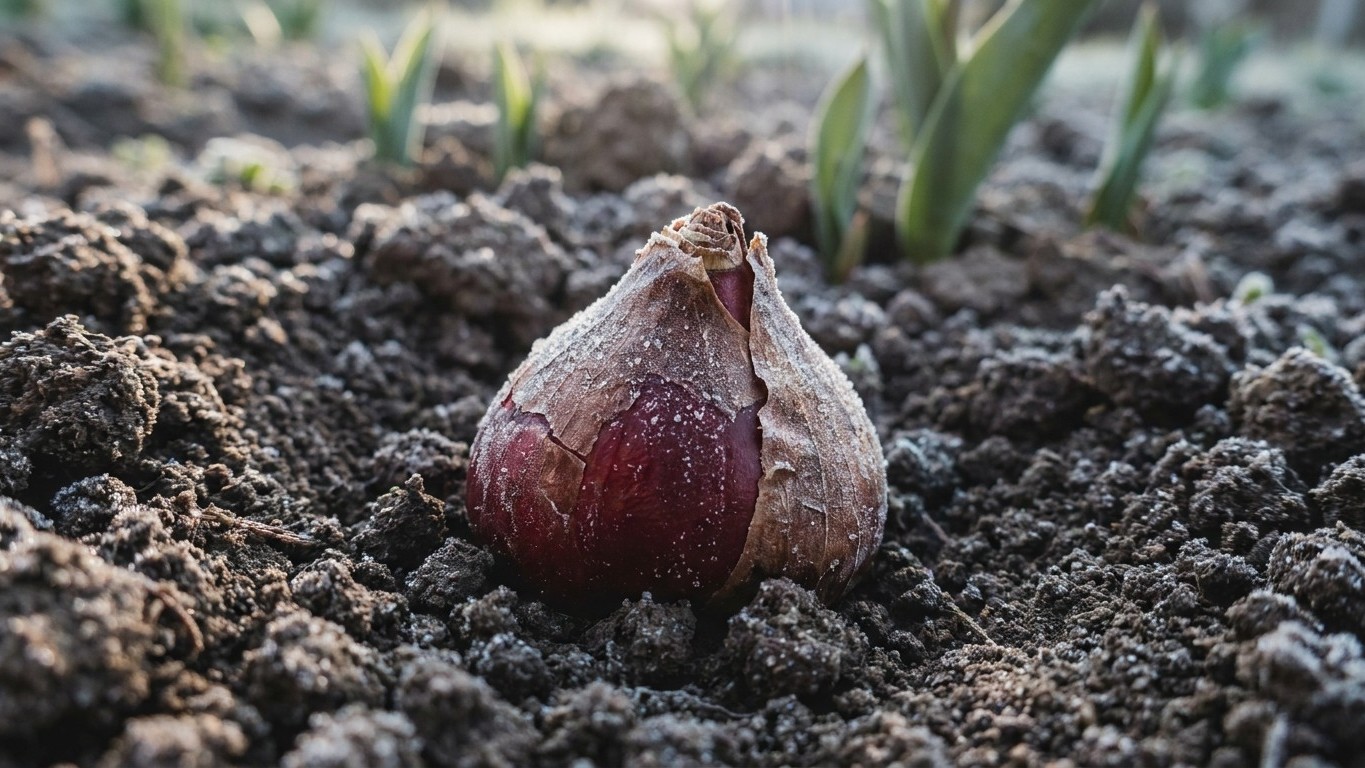

Five groups of pests go after garlic in New Mexico: thrips, bulb mites, wireworms, stem and bulb nematodes, and burrowing rodents such as pocket gophers and voles. Each hits at a different point in the garlic year. Rodents and wireworms work on cloves in fall and winter, thrips on leaves in spring, and mites and nematodes on bulbs from spring through storage. The calendar below hangs those threats on one anchor, the first fall frost.
The short answer for New Mexico
The reference first fall frost runs from October 29 to November 9. That window is the 30-70% probability band for a 32F freeze at the airport weather station used in the NOAA NCEI U.S. Climate Normals 1991-2020. It describes that one reference city, not the state. Suburban and rural gardens usually freeze earlier than an airport does, often by one to two weeks, and higher ground freezes earlier still.
Why does a frost date matter for pests? Garlic goes in the ground in autumn and comes out the following summer, so the crop spends roughly eight months underground or under snow-free winter sun. Plant too early and the cloves sprout before cold arrives, which hands soft green tops to whatever is still active. Plant after the soil has cooled and the cloves spend fall rooting while many insects wind down. The frost date sets the planting window, and the planting window decides which pests meet the crop at its weakest.
Treat any frost date as a midpoint. In one year out of two, the first freeze arrives later than the date on the chart. A garden that waits for “the” frost date to plant will, half the time, be planting into soil that is still warm and still full of active wireworms and mites. A frost date tells you when to start paying attention, never when the season is safely over.
Once the cloves are in, the pest calendar runs like this:
- Fall, right after planting: wireworms and rodents work on cloves.
- Winter: voles and pocket gophers feed from tunnels and under mulch.
- Spring warm-up: thrips and aphids move onto new growth.
- Early summer to storage: bulb mites and nematodes show up as soft, discolored, or stunted bulbs.
Working it out for your own garden
Start with the reference window, October 29 to November 9, and adjust it for your site. For a suburban or rural garden, subtract one to two weeks. October 29 minus two weeks lands on October 15, and November 9 minus one week lands on November 2. So the working window for many yards is roughly mid-October to early November. At elevation, shift earlier still, because the weather station figure does not carry that correction for you.
Turning the date into a pest schedule
Garlic planted from that window gets a predictable run of exposure. Fall wireworm and rodent pressure falls on the first few weeks after planting, while the cloves are still full of stored energy and have not yet put down much root. Thrips show up months later, once spring warmth wakes the garden, and the exact week depends on your elevation more than on any date I could print. You can pin it down by checking the leaf axils and the folds between leaves every week once new growth is moving, looking for tiny pale slivers and silvery streaking on the leaves.
A state is not one climate, so the same arithmetic gives different answers in different places. The brief for this series mentions a large lake and the coast as things that move frost dates by two weeks either way. New Mexico has neither. Elevation does all of that work here, along with the cold air that pools in valley floors on clear nights. A garden on a valley floor can freeze earlier than one on a slope a few hundred feet above it, which is the reverse of what most people expect. If you want the planting arithmetic in full, When to Plant Garlic in New Mexico: Counting Back From the First Frost works it through step by step.
Then write three dates on a calendar: your own estimated first frost, the day you plant, and the day you first start scouting for thrips. Pests respond to temperature, not to calendar dates, which is the point of working from a frost midpoint in the first place. A warm fall pushes your wireworm exposure later, and a cold, late spring pushes thrips later.
One more habit pays off. Keep a short garden log with the planting date, the first hard frost you actually saw, and the week you first spotted damage. Two or three seasons of that beats any published average, because it records your microclimate, not an airport’s.
What changes across New Mexico
The Rio Grande corridor runs the warmest of the main garlic-growing areas, and the reference window above sits in that kind of low-elevation, valley setting. Farther south, around Las Cruces and the lower Rio Grande, gardens generally see frost later and have a longer stretch of mild fall weather. That longer mild stretch is a mixed gift: soil insects such as wireworms stay active longer, and thrips tend to get going earlier in spring. Gardeners there should plant toward the later side of their window and scout earlier in the year.
Go north and up, and the pattern flips. Santa Fe, Taos, Los Alamos and the high valleys near Chama sit at much higher elevation, so frost comes earlier and winter lasts longer. Cold soil slows wireworms and holds thrips back until later in spring, but it brings its own pest: voles. Deep winter snow cover and a thick mulch layer give voles a protected runway to the cloves. The same garden might lose more bulbs to rodents than to insects.
The eastern plains, around Clovis, Portales and Tucumcari, are open, windy and exposed. Wind and dry air favor thrips, which do well in hot, dry weather, and fields of small grains nearby can send them into the garden when the grain dries down. In the northwest, the Farmington and Four Corners area has irrigated bottomland where gophers are a regular nuisance. The southwest around Silver City sits higher than its latitude suggests, so it behaves more like the north than like the Lower Rio Grande.
Gardeners in the northern mountains and those in colder states face similar issues with early freezes and rodent pressure. For a comparison across state lines, When to Plant Garlic in New York: Counting Back From the First Frost and Garlic Varieties That Suit New York Winters cover a very different winter, wetter and snowier, where the main threats shift toward moisture-driven rot. The New Mexico equivalent of that choice, which variety to plant, is covered in Garlic Varieties That Suit New Mexico Winters.
The mistakes this climate punishes
The first mistake is planting too early because the days still feel warm. New Mexico autumns are often sunny and mild well past the point where the calendar says winter should have started. Cloves planted into that warmth send up green growth before the cold sets in, and that growth gets chewed by insects or burned by the first real freeze. Waiting for the soil to cool, and for your own garden’s frost window to open, avoids both problems.
Second, saving seed garlic from a bulb that looked a little off. Stem and bulb nematodes are microscopic and travel inside cloves. An infested clove produces swollen, twisted, sometimes soft-looking plants and a bulb that rots in storage, and the nematodes stay in the soil afterward. There is no home treatment. The practical defense is clean seed stock from a source you trust and a rotation that keeps garlic and other alliums out of the same bed for several years.
Third, planting into freshly converted sod or lawn. Wireworms, the larvae of click beetles, build up under grass and go after cloves in the first weeks. A bed that was lawn last year is a poor first-year garlic bed. Cultivating the soil in summer to expose larvae, then planting something else first, is a better plan.
Fourth, mulching heavily and early on a site with vole or gopher activity. Mulch is good for garlic in a cold, dry climate, but a thick blanket laid down before the ground cools gives voles shelter all winter. Wait until cold has really arrived, and consider wire mesh under raised beds if gophers are known in your neighborhood.
Fifth, letting bulbs sit in wet soil at the end of the season. Bulb mites move in through wounds and damaged skins, and they are mostly a secondary problem that follows rot, cracking and rough handling. Lifting on time, curing in dry shade, and sorting out any bruised bulbs for the kitchen keeps them from spreading in storage. And skipping the spring scouting entirely is a mistake all its own, because thrips damage looks like drought stress until you look at the leaf folds closely. If you are weighing your overall plan for the crop, Growing Garlic in New Mexico covers the full cycle.
Checking this against your county
Everything above rests on one reference station and a general sense of the state. For frost dates and pest alerts near you, ask your county office at New Mexico State University’s College of Agricultural, Consumer and Environmental Sciences, which runs the state’s Cooperative Extension Service. County agents can tell you what is actually active in your valley this season. Those county-level figures are not published here, so take them from the extension office directly.
Common questions
What is the most common garlic pest in New Mexico?
No source in this article ranks them, so there is no honest “most common.” Thrips are the pest most gardeners notice, because they appear on the leaves in spring when you are already looking. Rodents and wireworms do their damage out of sight, which is why a missing clove often goes unexplained.
When should I start watching for thrips?
Start when spring growth takes off, and check the folds of the leaves weekly. The calendar date varies with your elevation, so a Las Cruces garden will see them well before a Taos garden does.
Can I use frost date alone to avoid pests?
No. The reference window of October 29 to November 9 is a midpoint, and in one year out of two the first freeze comes later. Use it as a starting point, then watch your own soil and your own garden.
Is store-bought garlic safe to plant?
It is a gamble. Grocery garlic can carry nematodes or mites without showing it, and it may be a variety poorly suited to your winter. Seed garlic from a reliable grower or your local extension office is the safer route.