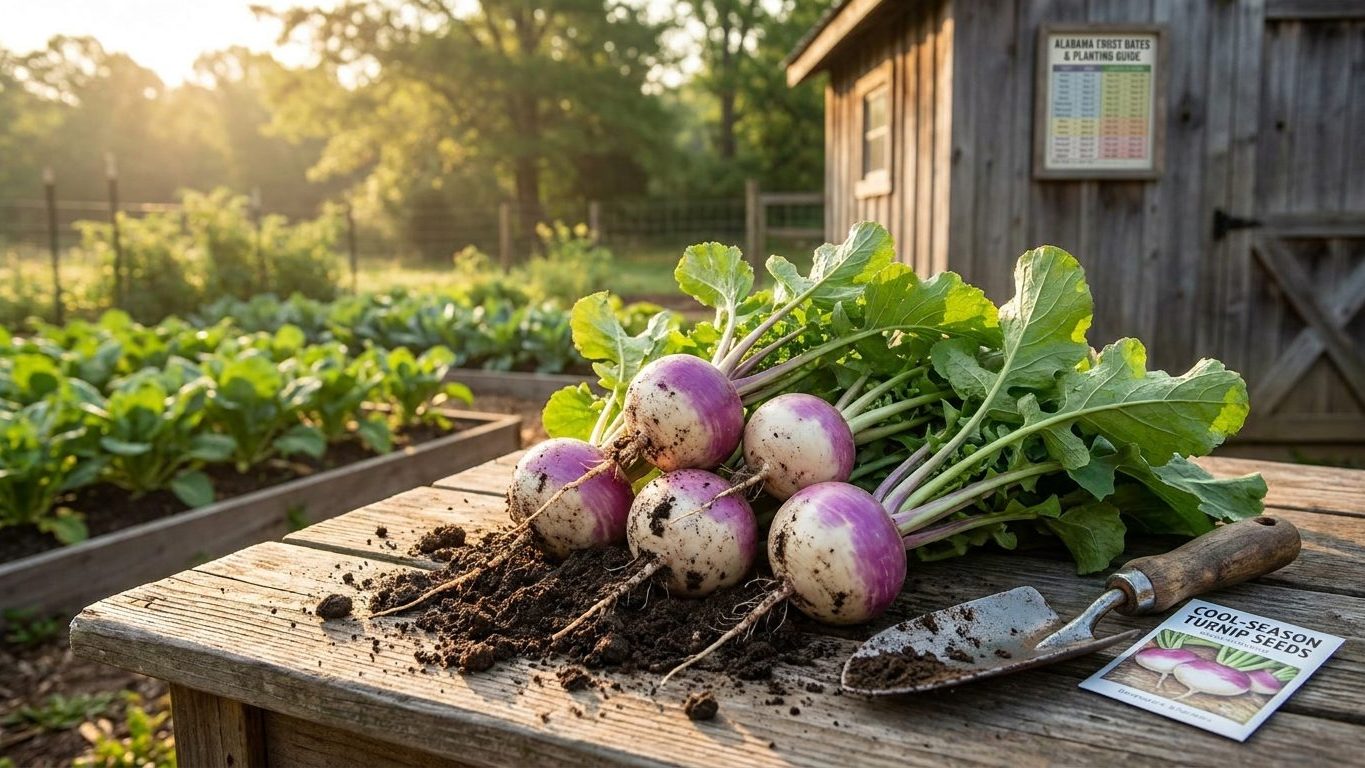

Turnips in New Mexico do best sown twice: a fall crop planted six to eight weeks before the first frost, and a smaller spring crop planted three to four weeks before the last one. The state’s high desert climate makes the fall window the safer bet, since summer heat turns spring-sown roots bitter and woody before they finish bulbing.
The short answer for New Mexico
Fall is the season that actually works for turnips across most of New Mexico. At the Albuquerque reference station, the first fall frost lands between October 29 and November 9, and turnips need roughly 40 to 60 days from seed to a harvestable root depending on variety. Counting backward from that frost window puts the ideal sowing date in early-to-mid September for most valley and mesa gardens, with cooler high-elevation spots sowing a week or two earlier so the roots finish before hard frost locks up the soil.
Spring offers a second, narrower chance. The last spring frost at the same station falls between March 31 and April 12, and turnip seedlings shrug off light frost once they’ve got a couple of true leaves. That means sowing three to four weeks ahead of that April window, in late February to mid-March, gives roots enough cool weather to size up before the state’s dry heat arrives in May and June and pushes them toward bolting and bitterness.
Both of those frost dates come from NOAA’s 1991-2020 climate normals, and they describe a 30 to 70 percent probability band for a 32-degree freeze at one specific weather station, not a hard guarantee for every backyard in the state. A garden in a low valley pocket or at higher elevation than the reference airport will often see its last spring frost later and its first fall frost earlier, sometimes by one to two weeks. Treat these dates as the starting point for planning, then adjust based on what your own soil and sky are telling you, which the last section of this page covers directly.
What will not work here

Sowing turnips in the middle of a New Mexico summer is the most common way to lose the crop before it starts. Between the spring and fall windows sits a stretch of high heat and low humidity that turnips handle badly. Roots grown in hot soil turn fibrous and sharp-tasting, and the plants bolt to seed rather than bulbing, which wastes the growing space for weeks before you notice the problem.
Rutabaga is the other casualty of this climate’s calendar. It needs closer to 90 to 100 days to mature, which is nearly double what a fast turnip variety needs, and New Mexico’s frost-to-frost growing season simply doesn’t leave much slack on either side of the summer heat wall. A rutabaga sown at the same time as a fall turnip crop is still sizing up when the first hard frost arrives, and one sown early enough to beat the frost lands its middle growth stage squarely in the hottest part of summer. Turnips slot into this state’s calendar reasonably well; rutabaga is fighting the climate the whole way.
Watering on a weekly schedule is another failure point specific to this kind of dry, high-desert soil. Turnip roots need steady, shallow moisture to swell evenly, and New Mexico’s low humidity and sandy or caliche-heavy soils in many areas dry out between waterings far faster than a gardener coming from a wetter state expects. Roots that dry out and then get soaked tend to crack or split, and the flavor turns hot and woody as the plant treats each dry spell as a signal to bolt.
Winter storage in the ground is worth a caution too. The coldest month here averages a daily minimum of 26.4°F at the reference station, which is cold enough to injure unprotected roots left in the soil past the fall harvest window, especially at higher elevations where that average minimum runs colder still. A layer of mulch buys some insurance, but leaving a full fall crop in the ground through a New Mexico winter and expecting it to hold is a bet the state’s average cold doesn’t support everywhere.
What changes across New Mexico
New Mexico’s USDA hardiness zones run from 4b up to 9a, which is one of the widest spreads of any state in the Southwest and a sign that no single sowing date applies from Taos to Las Cruces. That range is built from the average annual extreme minimum temperature, a single winter-cold measurement, but it’s a useful stand-in for how much the growing season itself shifts across the state’s elevation changes.
A garden sitting in the colder end of that range, up in the mountains or on the high northern plateau, should expect its own frost dates to run well ahead of the Albuquerque figures used above. That means shifting the fall sowing date earlier, closer to late August than mid-September, so the crop has time to finish before an earlier frost shuts things down. A garden at the warmer end of the range, down in the southern desert basins, often gets a longer stretch of mild fall and spring weather, which can stretch the sowing windows on both ends and even support a light second fall sowing where frost holds off into December.
A spread of 4b to 9a means the difference between two New Mexico gardens can be as large as the difference between two entirely different states, so a single statewide sowing date was never going to fit every county. Check the USDA Plant Hardiness Zone Map for your specific area rather than assuming your zone from the state’s overall range, since elevation changes zone faster here than almost anywhere else in the country.
Where to check this for your own county
New Mexico State University’s Cooperative Extension Service is the right next stop, and it’s reachable at aces.nmsu.edu. Every county in the state has its own extension office tied into that system, and county-level advice is going to beat anything on this page, because it accounts for local elevation, soil, and microclimate in a way a statewide summary can’t.
Once there, look specifically for two things: a local planting calendar built around your county’s own average frost dates rather than a single airport station, and any variety trial results for turnips or other cool-season roots grown in your area. County extension agents often publish exactly which turnip varieties have performed well in local trial plots, which matters more than any general guidance about turnips as a category, since some varieties handle the state’s heat swings and dry air better than others.
This page is built from statewide climate normals and a single reference station’s frost data. That’s useful for understanding the general shape of New Mexico’s growing season, but it isn’t a substitute for a recommendation built around your specific county’s soil and elevation. Treat the state-level picture here as the framework, and let your county extension office fill in the actual dates and varieties that have proven out on ground closer to your own.
Some gardeners also time this by the Moon: when to plant turnips by the moon, as almanac tradition rather than fact.
Checking this against your own garden
No calendar date beats what your own soil and plants are telling you, and three simple checks will tell you more than any frost table. First, feel the soil itself before sowing: turnip seed germinates poorly in soil that’s still cold and damp-cool to the touch, and waiting until it crumbles loosely and feels closer to room temperature than to refrigerator-cold is a better signal than any calendar date, especially in a state where elevation shifts soil warm-up time by weeks between neighboring gardens.
Second, watch for the first true leaves, the second set that appears after the small rounded seed leaves. That’s the point where the plant has switched from surviving on stored seed energy to actually building itself from the soil and sun around it, and a slow or stalled appearance of true leaves after sowing is often a sign the soil was still too cold or too dry when you planted.
Third, watch the root shoulder, the part of the swelling turnip root that pushes up and becomes visible at the soil surface. Once that shoulder reaches roughly the size of a golf ball, the root is usually close enough to harvest size to start checking regularly, and a shoulder that’s slow to appear at all late in the season is often the first sign that heat or drought stress pushed the plant toward bolting instead of bulbing. Reading these three signals against your own garden will tell you more about your particular patch of New Mexico than any statewide frost date can.