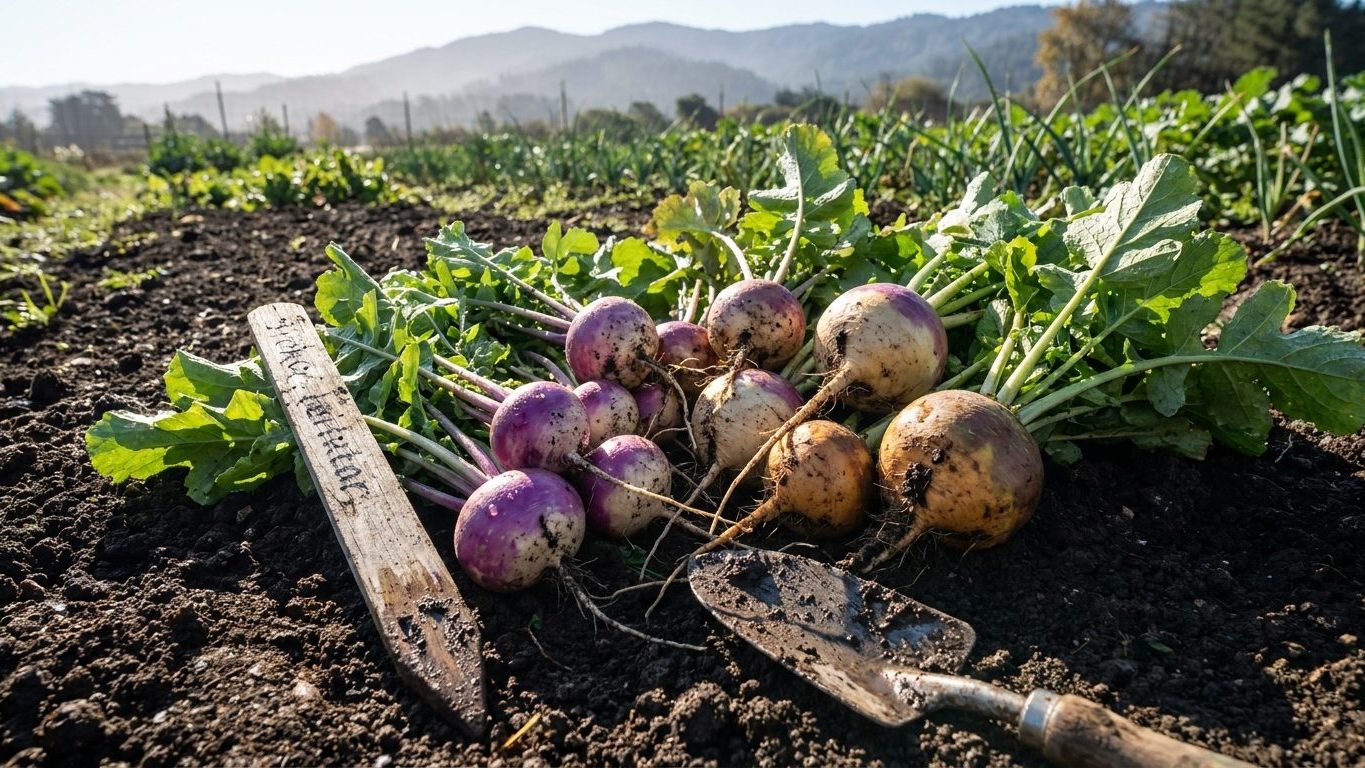

Across New Mexico, fast-maturing turnips like Purple Top White Globe and Hakurei outperform slower types, and rutabaga only works as a full-season crop planted for a late fall harvest. The state’s swing between high-desert heat and mountain cold rules out anything that lingers too long in the ground either direction.
The short answer for New Mexico
Turnips and Rutabaga are cool-season roots, and New Mexico gives them a narrow, oddly shaped window to work with. At the Albuquerque reference station, the last spring frost falls between March 31 and April 12, and the first fall frost arrives between October 29 and November 9. That sounds like a long season on paper, but the gap in the middle fills fast with dry, high-elevation heat that turnips hate and that pushes them straight into bolting and pithy roots.
That’s why the practical answer splits by crop. For turnips, pick the 38 to 55 day varieties (Purple Top White Globe, Tokyo Cross, Hakurei) and grow two short crops, one right after the spring frost date and one starting in late summer for a fall harvest that finishes in the cooler, shorter days near that October frost window. Skip the 60-plus day turnip varieties entirely unless you’re gardening at lower elevation in the southern part of the state where the season runs longer.
Rutabaga is a different math problem. It needs 90 to 100 days of steady, cool growth to bulk up, and it doesn’t tolerate the same summer heat spike turnips shrug off. Working backward from the earlier end of the fall frost window (October 29), that means getting seed in the ground by around July 21 for most of the state, so the roots finish sizing in September and October instead of trying to push through August’s peak heat. American Purple Top remains the variety most reliably matched to that timeline here, since it holds quality through a light frost and doesn’t need the extra weeks that some heirloom rutabaga types demand.
None of this replaces a soil thermometer or your own frost log, but it’s the frame: short-season turnip varieties for two windows, and a single well-timed rutabaga planting aimed at fall, not spring.
What will not work here

Spring-planted rutabaga is the clearest failure point. The gap between the last frost (early April at the reference station) and the arrival of real heat is short, and rutabaga planted in spring almost always hits 90-degree afternoons before it’s finished bulking, which turns the roots woody and bitter. Save rutabaga for the summer-into-fall window described above, and don’t try to squeeze a spring crop in unless you’re at high elevation with a genuinely cool June.
Long-season turnip varieties fail for a related reason. Anything rated past 60 days sits in the ground through the hottest, driest stretch of the New Mexico summer, and turnips respond to that stress by bolting to seed rather than filling out a root. This isn’t a minor yield hit, it’s usually a lost crop, since a bolted turnip root turns woody within days.
Watering on a weekly schedule is another near-guaranteed failure, and it’s specific to this climate rather than a general gardening rule. New Mexico’s arid air pulls moisture out of shallow-rooted crops like turnips fast, and irregular watering causes the roots to crack or grow oddly shaped even when they survive at all. These roots need consistent moisture two to three times a week during their bulking stage, not a single deep soak, especially in the low-humidity months before the summer monsoon arrives.
Tight spacing causes a different problem once the monsoon does show up. New Mexico’s July-through-September rains bring a short but real humidity spike, and turnip or rutabaga beds planted too close together hold that moisture against the leaves and crowns, inviting rot right as roots are trying to size up. Wider spacing than a seed packet suggests for a humid-climate garden is often the safer call here.
Finally, betting on the coldest month’s mild-sounding average is a mistake. The 26.4°F mean daily minimum in the coldest month decides whether an overwintered root survives, and that’s cold enough to damage exposed rutabaga left in the ground without mulch, even though the number alone sounds survivable on a given night.
What changes across New Mexico
New Mexico’s USDA hardiness zone range runs from 4b to 9a, and that’s an unusually wide spread for one state to carry, reflecting the difference between high mountain valleys and low desert basins rather than any single climate. There is no one planting date that works from Taos to Las Cruces, and a state-level guide like this one can only describe the pattern, not pin down your particular county.
At the cold end of that range, high-elevation gardens in the north and in mountain valleys see frost arrive earlier in fall and linger later in spring than the Albuquerque reference dates suggest. Gardeners there should treat the spring turnip planting as starting later than early April, and shift the fall rutabaga planting date earlier than July 21, since the growing window itself is compressed on both ends.
At the warm end, low-desert gardens in the southern part of the state, and at lower elevations generally, often get a longer stretch of workable fall weather. That can mean a rutabaga crop planted a couple of weeks later than the state figure still has time to finish, and it opens the door to a second turnip crop that far-northern gardens simply don’t have room for.
The elevation effect compounds this in ways that a zone map alone doesn’t capture well. Two gardens in the same hardiness zone can behave differently if one sits in a valley that pools cold air and the other sits on a slope that drains it, so treat the zone number as a starting estimate rather than a guarantee for your specific yard.
Where to check this for your own county
New Mexico State University’s Cooperative Extension Service, at aces.nmsu.edu, is the source built to close the gap this page can’t. A statewide article has to talk in ranges and reference-city dates; a county extension office works from local trial data and local frost records, and that’s a meaningfully more precise starting point for your own garden.
Once there, look specifically for two things. First, a county-level planting calendar, which will translate the statewide frost window into dates adjusted for your elevation and local microclimate, something no state page can do accurately for every valley and mesa in New Mexico. Second, look for variety trial results or recommended-variety lists specific to your county or region, since turnip and rutabaga performance can shift meaningfully between the high plains, the Rio Grande valley, and the southern desert counties.
A county recommendation beats a state one every time, not because this page is wrong, but because it’s necessarily general. This article works from a single reference weather station and a statewide hardiness range; your county extension agent works from what actually grew in gardens near you last season. If your county office publishes a spring and fall vegetable planting guide, that document should take priority over the dates given here.
It’s also worth calling or emailing the office directly if the online material is thin. Extension agents typically know which turnip and rutabaga varieties local growers have had success with, information that doesn’t always make it into a published calendar but that can save a season of trial and error.
Checking this against your own garden
Every date on this page is a probability, not a promise, and your own garden will tell you more than any calendar once the season is underway. Three simple checks matter more than the calculated planting window.
Soil warmth by feel is the first. Turnip and rutabaga seed germinates poorly in cold soil, so before spring planting, push a bare hand a couple of inches into the bed in the morning; soil that still feels cold to the touch, not just cool, usually means germination will be slow and patchy even if the calendar says it’s time. Waiting a few extra days for warmer soil almost always beats planting on schedule into cold ground.
The first true leaves are the second signal. Turnip seedlings that stall for more than a week or two after their first true leaves appear are usually responding to heat stress or uneven watering, and that stall is an early warning that the crop should be pulled or protected before it bolts rather than left to recover on its own.
Root shoulders pushing up through the soil surface are the third. Once a turnip’s shoulder is visible and roughly an inch across, it’s sizing on schedule; rutabaga shoulders typically show later and larger, closer to harvest. Checking shoulders directly, rather than trusting the days-to-maturity number on the seed packet, is the most reliable way to know your own microclimate’s actual pace, since a hot spell or a cool stretch can shift real growth well off the printed timeline.