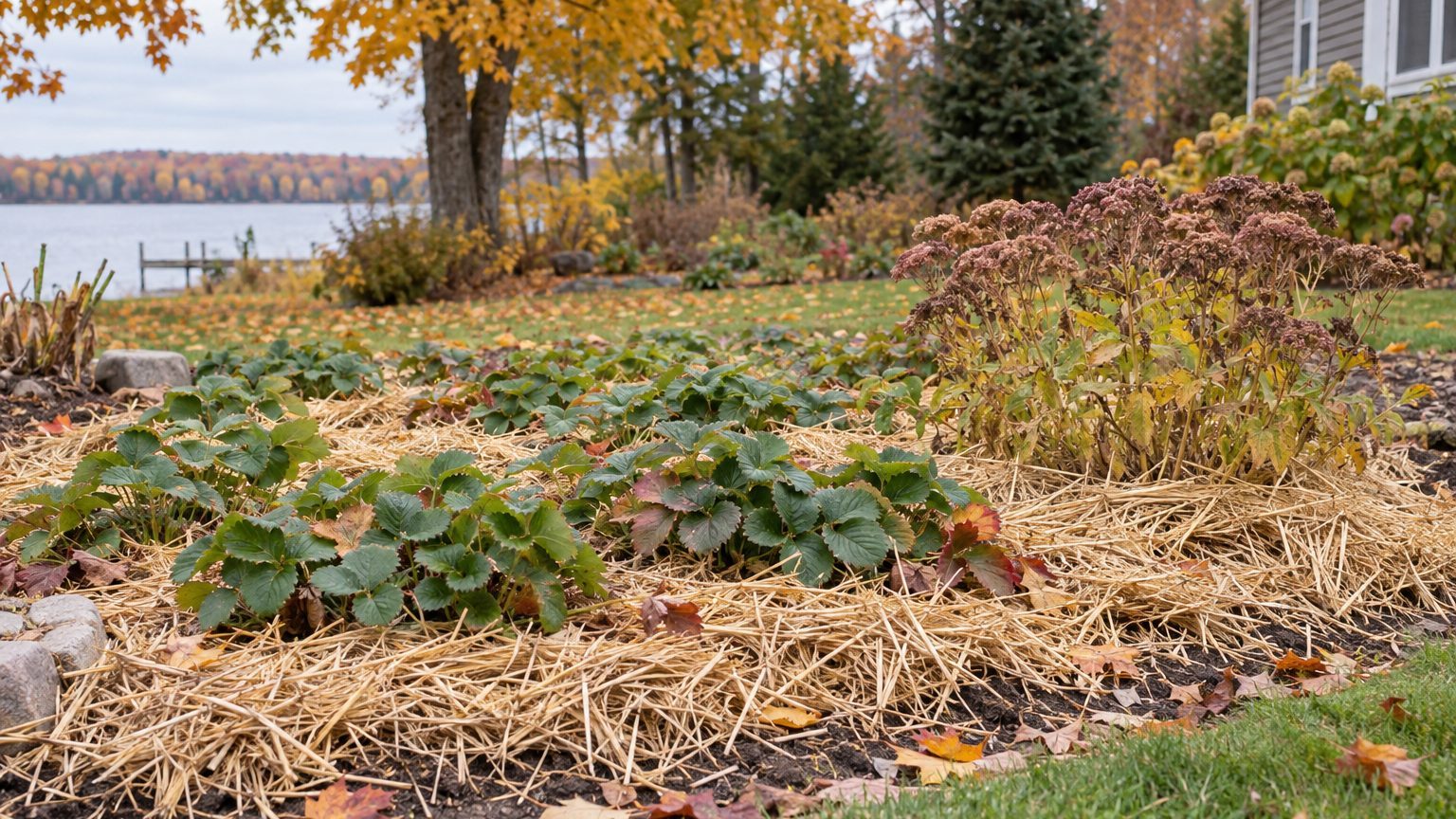

Winter mulch in New Mexico goes down after the ground starts to freeze, not before. In Albuquerque, NOAA’s 1991-2020 normals put the first fall frost between October 29 and November 9, so mulch follows that window once the soil has turned cold. Gardens that are higher, farther north, or out in the country freeze earlier and mulch earlier. Keep the layer within a 2-inch to 3-inch range and off the crowns.
When to put winter mulch down in New Mexico
Mulch does not warm the soil. It holds the cold in. A layer of straw over a strawberry bed is there so the ground stays frozen once it freezes, instead of thawing at noon and refreezing by dusk. Spread it in early fall, while the soil still holds summer heat, and you have built a cozy, insulated bed for mice and a damp blanket for crown rot.
The temperature pattern behind this is easy to see in the numbers. NOAA’s NCEI Climate Normals for 1991-2020 give Albuquerque a mean daily minimum of 26.4°F in its coldest month. That is the average overnight low, not a record, and it sits well below freezing. The sun is strong enough that daytime highs often climb back up, which means the soil surface can thaw and refreeze again and again. That cycle, more than any single deep freeze, is what mulch is meant to calm.
The window, and how to read it
For the first fall frost, the NOAA NCEI Normals list a 30-70% probability band of a 32°F freeze from October 29 to November 9 at the Albuquerque airport station. Treat the end of that range as the starting gun, not the finish line. A first frost only means one cold night. What you are waiting for is a run of hard freezes that leaves the top of the soil cold and stiff even in the afternoon. Mulch after the October 29 to November 9 first-frost window has passed, once the soil surface stays cold through the day.
One date is never the answer, and the airport is not your yard. Suburban and rural gardens usually see the first fall frost earlier than the reference station, often by one to two weeks, and more at elevation. Colder places mean earlier fall tasks, so a garden in the mountains or on a high mesa should expect to mulch ahead of the Albuquerque window, never behind it. Your county’s own frost dates, laid out in First and Last Frost Dates in New Mexico, will tell you where to shift.
Where the freeze logic fades
The state is big, and the USDA Plant Hardiness Zone Map 2023, built on the average annual extreme minimum temperature, runs from 4b to 9a across it. A single airport figure cannot speak for all of that. In the mildest low-elevation spots, where the soil rarely stays frozen for long, winter mulch has a different job: holding moisture through dry months, keeping winter weeds down, and giving you something to pull over plants on a frost night. In those places, skip the worry about heaving. Most of what follows applies to gardens that really do freeze.
Strawberries
A strawberry plant keeps its growing point, the crown, right at the soil line. That is the part you cannot afford to lose. Bare cold dries and damages it, and repeated freezing and thawing heaves the plant partway out of the ground, leaving roots in the air. New Mexico’s sunny days and sharp nights set up exactly that pattern, which is why a mulch blanket matters even in a place that looks mild on paper.
Clean straw is the standard material. It is light, it stays loose, and it lets air move. Chopped, wet, or mildewed straw is another matter, since it packs down. Hay is a poor substitute because it carries seed, and you will be pulling grass out of your berries by April. Pine needles work if you already have them, but straw is easier to lift off in a hurry.
On depth, stay inside the range NC State Extension gives in its Extension Gardener Handbook: “A 2-inch to 3-inch layer of mulch suppresses most annual weed seeds and makes it easy to hand-pull any that do germinate.” That sentence comes from a chapter on woody ornamentals, but the depth carries over to a berry bed, because straw fluffs up and a thicker pile only mats and traps moisture on the crowns. More is not better. Spread the straw over and between the plants and let it settle.
Timing follows the same rule as everywhere else. In Albuquerque-type conditions, wait until the October 29 to November 9 first-frost window (NOAA NCEI Climate Normals 1991-2020) has passed and the soil has actually chilled. Plants should already be dormant, with leaves flattened and growth stopped. If the garden sits higher or in a cold pocket, move the job earlier, as discussed under Growing Strawberries.
Spring is where gardeners slip. Straw left on past the point when the plants wake up will smother new growth and keep the crowns damp. Pull the straw back from the crowns as soon as new leaves start pushing up through it, and keep it close by in case a late frost threatens early blossoms. Raked into the aisles, it becomes a clean path and keeps the fruit off bare dirt. Check your county’s last spring frost on the New Mexico frost-date page before you put the pile away for good.
Perennials and borderline plants
Most hardy perennials in New Mexico do not need winter mulch to survive. Plants chosen for your area will ride out the cold on their own. The ones that benefit are the borderline plants: those rated close to the limit of what your spot gets, or newly planted ones whose roots have not settled in. A perennial set out this fall has not had time to anchor itself, and the same freeze-thaw cycle that lifts strawberry crowns will push a young root ball upward.
Think of woody herbs and semi-hardy flowers first. Rosemary, lavender, and some salvias fall in this group in colder parts of the state, and so do chrysanthemums that you hope will return. Perennial herbs have their own set of rules, which Getting Perennial Herbs Through the Winter covers in detail. Established clumps of native penstemon or ornamental grasses rarely need it, so look at your local zone rather than assuming.
Zone talk needs care. The USDA Plant Hardiness Zone Map 2023 gives New Mexico a spread from 4b to 9a, and it is built on one variable, the average annual extreme minimum temperature. That is a territory-wide range, not your zone. Look up your own address and compare it with the plant tag. If the tag says your zone is the very edge of what the plant tolerates, mulch it.
The shape of the mulch matters as much as the depth. Lay it in a ring around the crown, not a pile on top of it, and leave a gap against the stems so the base can breathe. For depth, return to NC State Extension, which says for trees to “Provide a 3-inch layer of mulch to reduce water loss and maintain uniform soil moisture and temperature around roots.” The two sentences cited on this page, one on weeds and one on moisture, agree on the order of depth, so work within the 2-inch to 3-inch range rather than going higher. Ring each borderline perennial with 2 to 3 inches of mulch after the ground has begun to freeze, with a clear gap at the crown.
A deep ring becomes a volcano, and volcanoes hold water against the stem. The full approach is in Mulching Without Killing the Plant. Shredded leaves, straw, and wood chips can all serve, as long as the material breathes and does not form a wet cap.
What goes wrong
Mulching too early is the most common mistake. It looks like tidy, responsible work in October, when the soil is still warm. Underneath, though, the plants stay active longer, the crowns sit in damp, and rodents move in before the cold has even arrived. Prevention is patience: wait for the first-frost window of October 29 to November 9 in the Albuquerque normals to pass, then wait for the soil to turn cold. If you are unsure, a few days too late costs less than a few weeks too early.
Matted mulch is the second problem. Whole leaves, wet grass clippings, or straw that has soaked through form a slick layer that holds water against the crowns. The giveaway is a sour smell and a dark, slimy surface when you lift a corner. Choose loose, dry material, and fluff it if rain or snow packs it down.
Then there are voles and mice. Thick, undisturbed mulch makes a sheltered nest with a food supply (your plant roots and bark) right next to it. Look for small runways and tunnel holes around the base of plants. Keep the mulch from touching stems, keep the layer within 2 to 3 inches, and do not lay it down until the ground has cooled, because early mulch gives them time to settle in.
Finally, forgetting to uncover. Plants smothered by mulch in spring come up pale, weak, or late. Rake strawberry straw back as new growth appears, and thin the ring around perennials once the soil warms, using your county’s last spring frost as the guide. Keep the removed material nearby, since a late freeze can still return.
Common questions
Is winter mulch needed in New Mexico at all?
For strawberries and borderline perennials in gardens that freeze, yes. NOAA’s 1991-2020 normals show an Albuquerque coldest-month mean daily minimum of 26.4°F, so nights freeze all winter. In milder spots where the soil rarely stays frozen, mulch is mostly for moisture, weed control, and frost-night cover. Hardy established perennials usually manage without it.
Can I mulch right after the first frost?
Not quite. One frost does not mean the soil is frozen. For Albuquerque, NOAA lists the first fall frost between October 29 and November 9, and mulch belongs after that window, once the soil stays cold through the day. Your own garden may reach frost one to two weeks earlier than the airport, and more at elevation.
What kind of mulch is best?
Clean straw is the standard for strawberries, and loose, dry material works for perennials. Whole leaves, wet clippings, and heavy compost can mat down and hold moisture against the crowns. Whatever you use, stay within the 2-inch to 3-inch depth that NC State Extension gives and keep it away from the stems.
When do I take the mulch off in spring?
When new growth begins, not on a set date. Pull strawberry straw back from the crowns as leaves push up, and keep it handy for a late frost. Your county’s last spring frost date, covered on the New Mexico guides, tells you how long to keep it on standby.