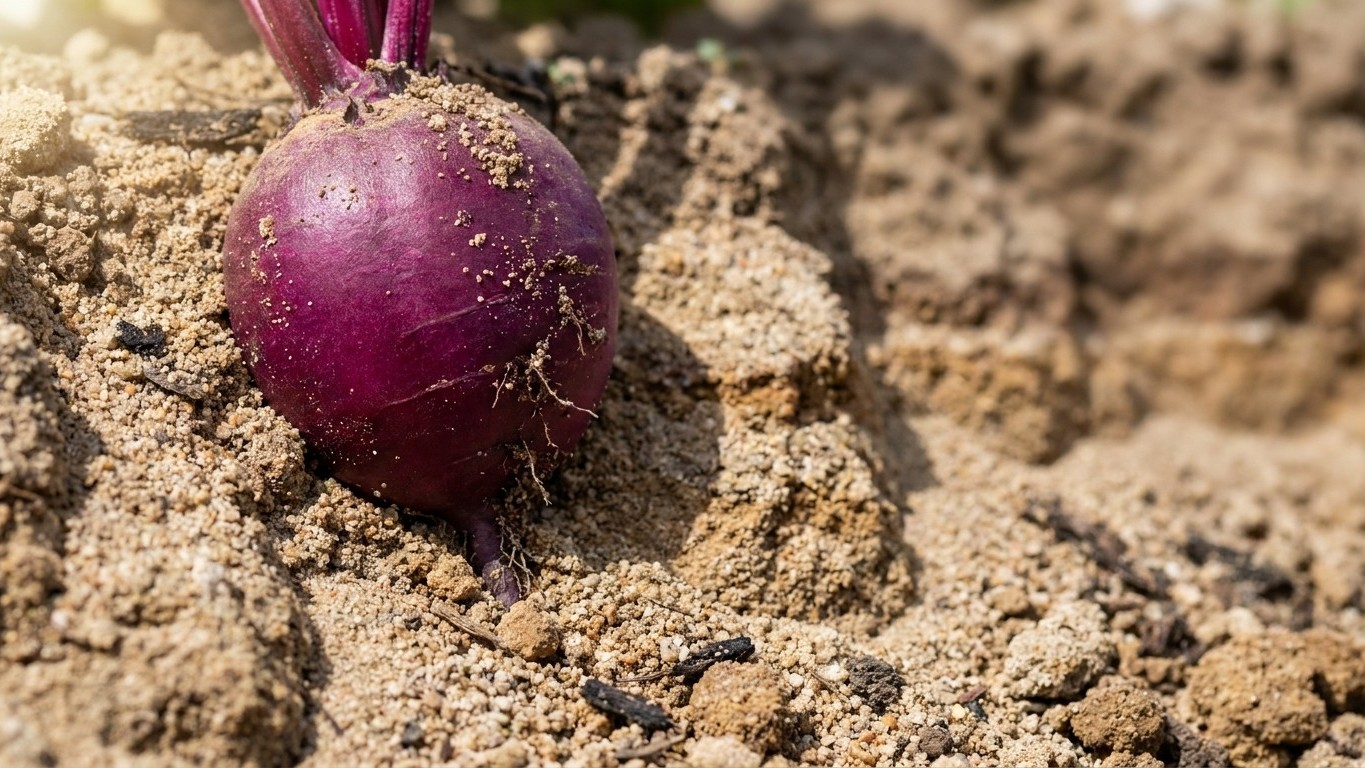

Pull spring-sown beets 60 to 80 days after seeding. In the Portland area, sowing two to three weeks ahead of the last frost puts that harvest between mid-April and late May. Storage is where gardeners slip. Topped roots keep best at 33 to 36 F, while 32 to 34 F brings more black spot and rot, the opposite of what most other root crops want. Top them first, keep the big roots, and eat the small ones now.
The short answer
The ground the root meets
Oregon’s official state soil, named by state law, is the Jory series, and it is not what a beet would order. It is an Ultisol, an old, heavily weathered and leached soil that is naturally acid and low in nutrients. USDA NRCS Soil Data Access gives representative surface values of 14 percent sand, 34 percent clay and 52 percent silt, with a surface pH of about 5.6 (slightly acid) and organic matter near 5.0 percent. It is well drained. Those numbers come from the mapped surface horizon of the series’ major components (119 of them), not from a worked garden bed.
Treat that as a starting point. Oregon spans hundreds of soil series, and a river-bottom plot, a hillside, or a lot a builder has scraped and filled can look nothing like Jory. For your own pH and texture, a soil test beats any state average. The longer story is in Beet Soil in Oregon: What the Root Will Meet.
Utah State University Extension describes the ideal beet ground as deep, sandy, well drained and rich in organic matter, amended with no more than 1 inch of composted organic matter per 100 sq ft. Jory meets two of those: it drains, and it carries organic matter. It is not sandy. With 86 percent of the mineral fraction as silt and clay, ground like this tends to hold moisture between rains and compact if you work it wet. A beet can live with that, but the water you give it, or fail to give it, matters more than it would on sand.
Heat, and the 90 F question
The brief for this page asked for the number of days a year Portland passes 90 F. That count is not published here, and I won’t guess at one. What the Extension source does supply is a lower bar: heat above 85 F combined with water stress makes the root woody. Woodiness is a late failure, one that hits a root already sizing up. It is separate from bolting, which comes from thirst in the first six weeks and gets its own section below.
The practical consequence is timing. A crop seeded in late winter and pulled by late May finishes before most summer heat arrives. A crop that lingers into July and August gets the 85 F problem. So pull on schedule, and don’t leave roots in the ground “to get bigger” through a hot, dry stretch.
The six weeks that decide it here
Portland’s last spring frost falls between March 6 and March 21, according to NOAA NCEI U.S. Climate Normals, using the 30 to 70 percent probability band for a 32 F freeze. Sowing two to three weeks before that means seed goes in the ground from roughly February 13 to March 7. Beets are sown in place, so the 60 to 80 days count from seeding, never from a transplant. That arithmetic lands the harvest between about mid-April and late May.
The first six weeks after seeding run from mid-February at the earliest to around April 18 at the latest. Western Oregon springs in that stretch are typically wet and cool, but they swing. A mild, dry week can show up in March or April, right when you have stopped thinking about watering because the rain has been steady for a month. Water stress in those first six weeks is what causes premature flowering, which is bolting. A beet that bolts puts its energy into a flower stalk instead of the root.
So the bolting risk sits in the dry gaps of an otherwise wet spring, and it is higher for the later sowings, whose six weeks run deeper into April. The Jory-type ground described above is forgiving here, since it holds moisture better than sand does. A sandy garden bed in the same valley would dry out faster, and the same dry week would cost more.
The fix is dull and effective. Push a finger an inch or two into the soil along the row every few days once rain thins out, and water if it is dry. Don’t wait for the leaves to wilt. For sowing basics beyond timing, Growing Beets in Oregon covers the rest.
One boundary matters. This window is for Portland, west of the Cascades. Central and eastern Oregon are high desert with a far shorter season, and the March 6 to March 21 dates should not be applied there. Find your own last-frost window first, then count back.
What goes wrong here
Each failure below traces to this soil, this spring, or the storage method. Slugs, leaf miners and other chewers are a separate list, covered in What Eats Beet in Oregon, and When.
In the bed
- Bolting after a dry spell. Thirst in the first six weeks triggers premature flowering. Remedy: check moisture an inch or two down during any rainless week from seeding onward, and water before the soil dries through.
- Woody roots in warm weather. Heat above 85 F with water stress toughens the root. This is a different problem from bolting and arrives later. Remedy: pull in the 60 to 80 day window, and keep water steady if a hot spell catches a late planting.
- Heavy, compacted ground. With 34 percent clay and 52 percent silt, soil like Jory tends to pack down if worked or walked on wet. Remedy: wait until a handful crumbles rather than smears, and add no more than 1 inch of composted organic matter per 100 sq ft, since beets want organic matter but not an overloaded bed.
In storage
- Storing too cold. Per USDA Agricultural Handbook 66, topped beets belong at 33 to 36 F and 98 percent relative humidity, and storage at 32 to 34 F produces more black spot and rot than slightly warmer conditions. Remedy: aim for the warmer end of the range, and in a pit or cellar keep the temperature from dropping below 31 F or rising above 41 F.
- Leaving the tops on. Bunched beets, leaves attached, keep only about 10 to 14 days at 32 F and high humidity. Remedy: top them first, then store the roots.
- Keeping the small roots. Large roots keep much better because they lose water and shrivel more slowly. Remedy: store the big ones and eat the small ones first.
Common questions
How long after sowing should I pull beets in Oregon?
Plan on 60 to 80 days from seeding. The count starts when the seed goes in the ground, because beets are sown in place and not transplanted. For a Portland-area sowing two to three weeks before the March 6 to March 21 last-frost window, that is roughly mid-April to late May.
Does the Portland frost date apply across Oregon?
No. It describes Portland, west of the Cascades. Central and eastern Oregon are high desert with a much shorter growing season, so the dates will differ and the harvest window shifts with them.
Is the Jory soil in my garden?
Maybe, maybe not. Jory is the state soil, but the state has hundreds of soil series, and fill, river-bottom ground or hillsides can be completely different. The pH of about 5.6 and the 14, 34 and 52 percent texture figures describe the mapped surface of the series, not your bed. A soil test gives your own numbers.
Should I keep beets as cold as possible?
No. Colder is not better here. Handbook 66 says topped beets do best at 33 to 36 F, and that 32 to 34 F brings more black spot and rot. Even in a pit or cellar the target range is a window, from no lower than 31 F to no higher than 41 F, so an unheated space that sits near freezing is riskier than one that holds a few degrees above it.