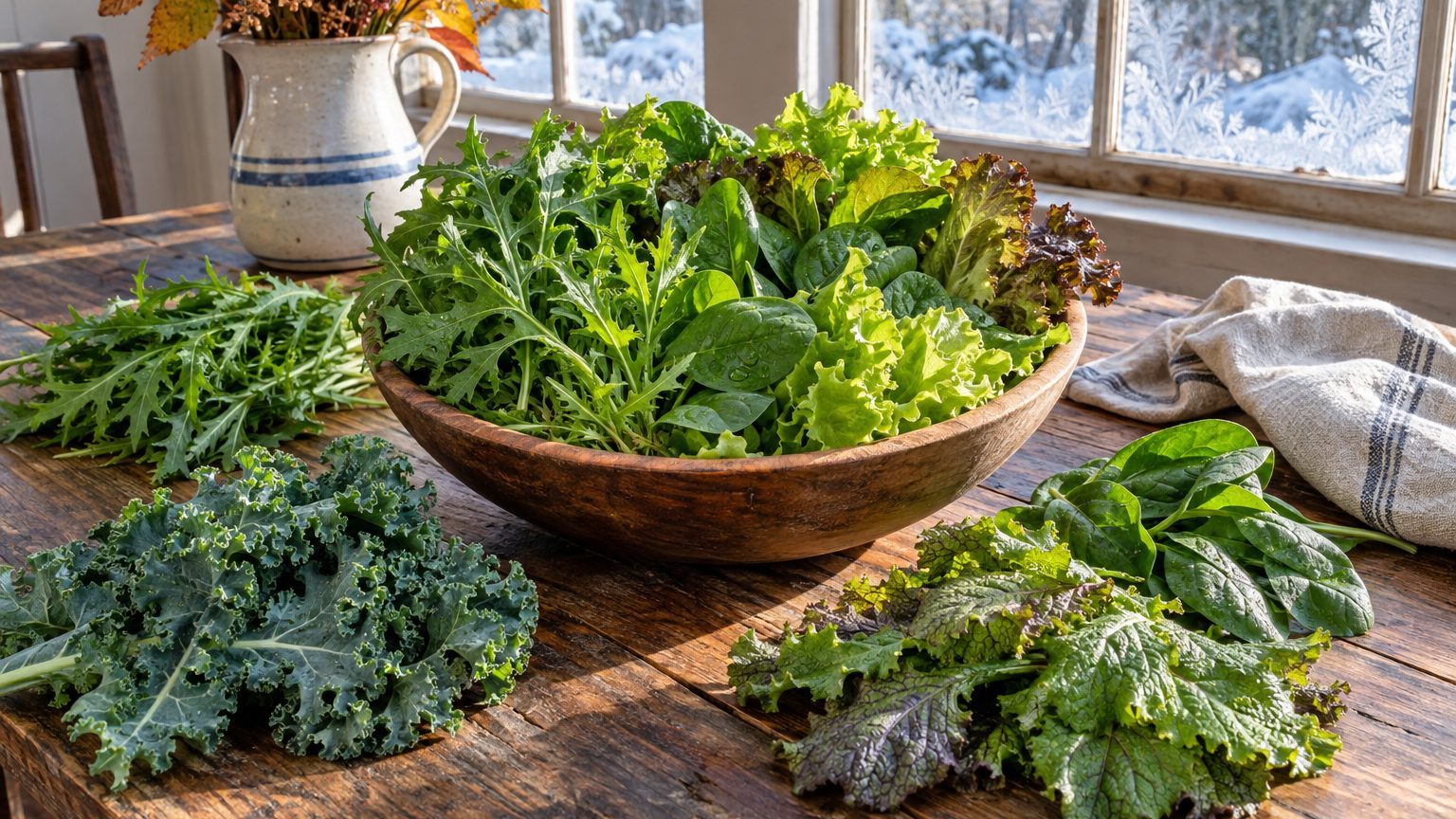

Spinach, mâche, claytonia, kale, arugula and mizuna are the best winter salads for New Mexico, with cold-tolerant leaf lettuces as a second choice under cover. They shrug off nights in the 20s, and they grow fast enough to finish before the shortest days arrive. Slow heading types, and tender lettuces sown into hot late-summer soil, are where most gardeners lose the season.
The short answer for New Mexico
Choose by type: hardy leaf greens for open beds, tender lettuces only under cover, and heading chicories only if you sow early and have a long season. The numbers explain why. At the Albuquerque reference station, the coldest month has a mean daily minimum of 26.4°F. That is a hard freeze most nights in midwinter, but spinach, mâche, claytonia and kale handle it without a blanket.
The frost dates frame the season. At that same airport station, the last spring freeze lands between March 31 and April 12, and the first fall freeze between October 29 and November 9. Those come from NOAA’s 1991-2020 normals and mark the 30 to 70 percent band of odds for a 32°F freeze. Inside those windows, the chance that the last spring freeze is behind you (or the first fall freeze has arrived) runs from 30 to 70 percent depending on the day. Suburban and rural gardens usually freeze later in spring and earlier in fall, often by one to two weeks, and more at elevation.
Here is how the main types sort out.
| Type | Examples | Cold tolerance | Best placement |
|---|---|---|---|
| Hardy leaf greens | Spinach, mâche, claytonia, kale | Take nights below freezing; slow but alive through winter | Open beds, with fabric in the coldest snaps |
| Quick mustards and Asian greens | Arugula, mizuna, tatsoi | Handle light and moderate freezes; fast to harvest | Open beds in fall, cover in deep cold |
| Leaf and romaine lettuce | Cold-tolerant types such as ‘Winter Density’ | Damaged by hard freezes | Cold frame or low tunnel |
| Heading chicories | Radicchio, endive | Good once mature, but slow to get there | Early sowing only, where the season runs long |
Sowing dates matter as much as the variety. Our When to Sow Winter Salads in New Mexico guide works through the window in detail. The short version is that hardy greens go in during late summer and early fall, early enough to reach harvest size before December. Plants that are still small in late fall mostly sit and wait for February.
What will not work here

Slow crops are the first casualty. Radicchio, Belgian endive and large heading Chinese cabbage often need a long season from sowing. Add the first fall freeze, which can arrive in the last days of October at the reference station and earlier in rural and high places, and you are asking them to finish just as growth stops. In the short days of winter, salad plants barely add leaf. Anything not near harvest size by then is a February crop at best.
Hot soil is the second casualty, and it catches people who think of fall as cool. Late summer and early fall can still run hot and dry here. Lettuce and spinach seed sown into warm soil germinates poorly or not at all, so the bed looks bare and the sowing window quietly closes. Sow in the shade of a taller plant or a shade cloth, keep the seedbed damp until it sprouts, and wait for the soil to cool if you can. Arugula and mizuna are more forgiving of warm ground than lettuce is.
A weekly watering habit is the third. Winter air in New Mexico is dry, the sun is strong, and wind pulls moisture out of shallow-rooted greens even when the temperature is low. Beds can go weeks without snow or rain. A salad bed watered once a week from habit will stress, turn bitter and stall. Check the soil a finger-joint deep and water in the morning on days above freezing, so the water soaks in before night.
Why do sealed plastic tunnels fail in sunny winters?
Clear plastic and a clear sky make a poor pair. On a bright winter afternoon the air inside a closed tunnel or cold frame can climb far above the outside temperature, even when the night before hit the 20s. Lettuce heats up, wilts, and may bolt early. Vent the cover by late morning on sunny days and close it before sundown. A light row cover that breathes is safer than plastic if you cannot be home to open and close it.
What changes across New Mexico
No single answer covers the whole state. The USDA Plant Hardiness Zone Map (2023, built on 1991-2020 normals) runs from 4b to 9a across New Mexico. That is a spread in average annual extreme minimum temperature, from mountain towns where winter lows can reach well below zero, to the southern lowlands where a hard freeze is brief. The Albuquerque reference figures sit somewhere in the middle and describe neither extreme.
If you garden in the north or at altitude, shift three things. Sow earlier, because the first freeze arrives sooner and cold slows growth sooner. Lean on the hardiest types (spinach, mâche, claytonia, kale) and treat arugula and mizuna as fall crops. Plan on a cold frame or low tunnel, because open beds will freeze solid for weeks and harvest will pause until the days lengthen. Air cools with elevation, so a garden a few hundred feet higher than the valley floor can behave like a different climate.
In the southern lowlands the problem flips. Winter is mild enough that many greens keep growing, and tender lettuces can work with only light protection. The trouble is the shoulders of the season: fall soil stays warm well into the sowing window, and spring heat arrives fast enough to bolt arugula and spinach early. Sow a little later in fall than the northern advice suggests, and plan to pull plants as soon as flower stalks appear. The overview in Winter Salads for New Mexico Gardens sets out the full approach.
For your own zone, use the USDA map and enter your ZIP code. Zone boundaries shift within a single county when elevation changes, so the map is more reliable than a guess from the nearest big town.
Where to check this for your own county
Start with New Mexico State University’s College of Agricultural, Consumer and Environmental Sciences, which runs the state’s extension service. From there, find your county extension office. Staff and Master Gardener volunteers know local microclimates, soils and water quality in ways a statewide article cannot.
Two things are worth asking for. The first is a local planting calendar for fall and winter vegetables, which will give sowing windows tied to your county’s frost dates rather than the reference city’s. The second is a list of varieties trialled or recommended in your county, so you can see which spinach, kale and lettuce cultivars actually produced where you live. Ask also about water quality and soil, since both vary across the state and affect how often to irrigate.
A county recommendation beats a state one every time. Everything above is a state-level read, anchored on one airport weather station in Albuquerque. A garden at a higher elevation, in a cold-air pocket, or on the edge of town can differ by one to two weeks on either frost date, and by more as elevation rises. Treat the dates here as a starting point and let the county office correct them.
Checking this against your own garden
Your own observations outrank any date in print. Three things are worth watching, and none needs equipment.
- Soil warmth by feel. In late summer and early fall, push your hand into the bed to wrist depth. If it feels warm, lettuce and spinach seed will struggle, and you should wait or shade the bed. When the soil feels cool and damp, germination will be reliable. A bed that cools sooner than your neighbor’s tells you it has more shade, more elevation or less stored heat.
- First true leaves. Seedlings first show two rounded seed leaves, then the first true leaves with the shape of the adult plant. If seedlings are well grown by the time nights turn cold, they are likely to reach harvest size before the short days. If they are still seed leaves then, expect a slow winter and plan on cover.
- Where frost forms first. On a clear, calm morning after the first cold night, walk the yard at dawn. White frost on the low corner but not by the south wall marks a cold pocket and a protected spot. Put tender lettuces by the wall and hardy greens in the cold corner.
Keep notes on the dates you see each of these. After one season you will have a calendar more accurate than any published one.
Common questions
Which winter salad is easiest in New Mexico?
Spinach and kale are the most forgiving, with arugula close behind for quick fall harvests. All three tolerate freezing nights, and none needs a heated space. Mâche and claytonia are even tougher if you want something that keeps going in deep cold.
Do I need a cold frame?
In the southern lowlands, hardy greens often do fine in open beds. In the north and at altitude, a cold frame or low tunnel is what keeps harvest going through December and January. Tender lettuces need cover almost everywhere.
How often should I water winter salads?
Check the soil rather than the calendar. Dry air and wind dry beds fast, so many gardens need water every week or two even in winter, while a cold, cloudy stretch can stretch that out. Water in the morning on days above freezing.
Can I grow winter salads at high elevation?
Yes, with adjustments. Sow earlier, choose the hardiest types and use a cold frame. Expect growth to pause in midwinter and pick up again as days lengthen. Your county extension office can give sowing dates for your elevation.