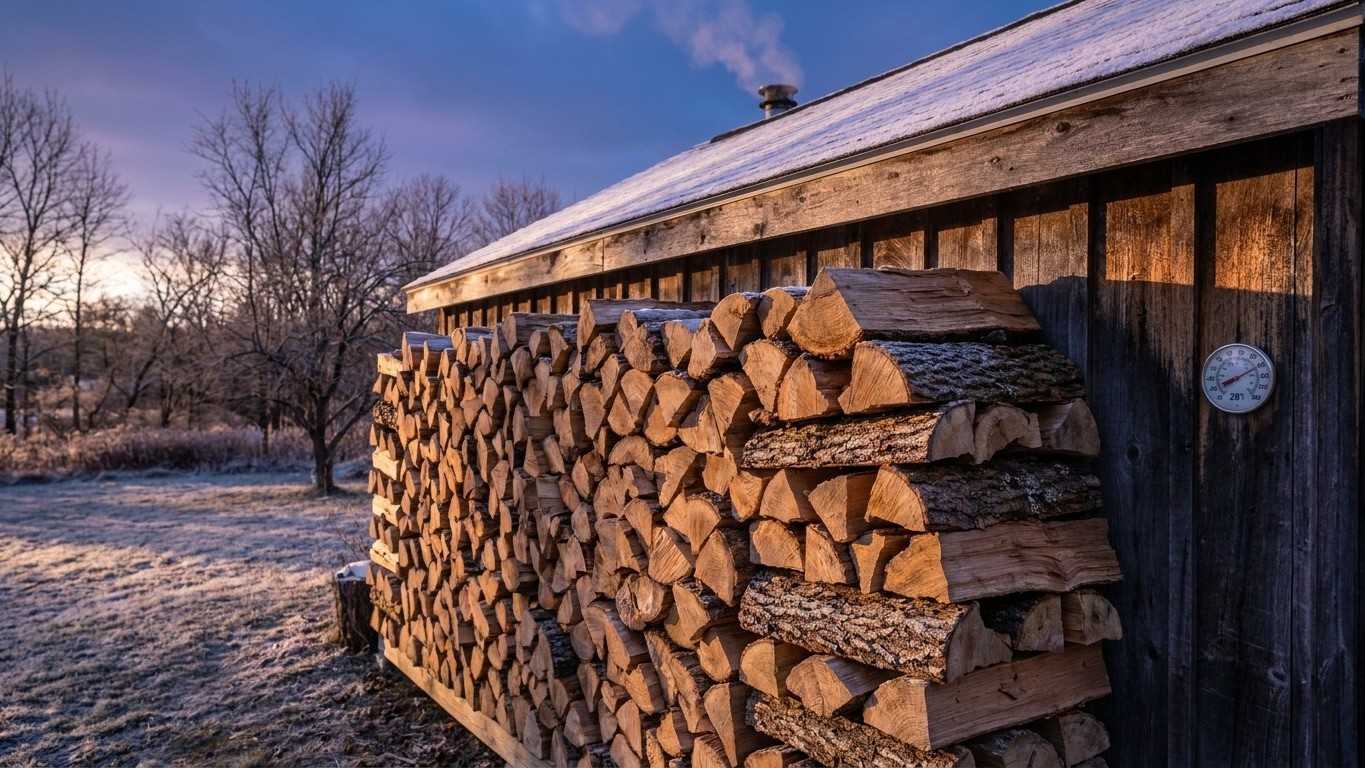

New York’s coldest month averages a nightly low of 27.9°F, measured at the New York City reference station. That single number does more to decide your firewood strategy than any species chart: it tells you how many months you’ll actually be burning, whether a dense hardwood is worth the extra splitting effort, and how much slack you can afford if a load of wood turns out to be less seasoned than the seller promised.
How cold it actually gets here

NOAA’s 1991-2020 Climate Normals put the average daily minimum for the coldest month at 27.9°F for the New York City area. That’s the mean low, not the record low and not a monthly average temperature, which means many nights sit right around freezing or a few degrees under it for weeks at a stretch. It’s not Arctic. But it’s also not a climate where a fire is optional atmosphere.
A number just under 28°F puts New York firmly in the category of places where wood heat does real work. Pipes need protection, a house needs sustained warmth overnight, and a stove or insert that goes cold at 2 a.m. means a cold house by sunrise. That’s a different set of stakes than a mild coastal winter where a fire is mostly for the mood.
Reference station versus your backyard
Worth flagging: this 27.9°F figure comes from the New York City station, and it undersells conditions almost everywhere outside the five boroughs. The Hudson Valley, the Southern Tier, the Adirondacks, and lake-effect country around Buffalo and Syracuse all run colder and longer than the city does. If you’re heating a farmhouse near Lake Ontario or a cabin in the Adirondack Park, treat the city figure as a floor, not your actual winter. Your season is longer, your low temperatures are lower, and your wood needs scale up accordingly.
What this means practically: don’t plan your cord count off a national average or a friend’s experience three states away. Plan it off your own coldest stretch, and if you’re upstate, assume it’s worse than the city’s number suggests. That’s the frame for everything that follows, from which species to prioritize to how much wood to have stacked before the first hard freeze.
Which woods are worth the effort here
A cord is a fixed volume: 4 feet by 4 feet by 8 feet, or 128 cubic feet, stacked. It doesn’t matter what’s inside that stack, the space is the same. What changes is the weight, and weight is what carries heat. Michigan State University Extension pegs a cord of well-seasoned hardwood at about 20 million BTU, roughly the heat equivalent of 145 gallons of #2 fuel oil or 215 gallons of LP gas. Denser wood packs more mass into that same 128 cubic feet, so it delivers more of that heat energy per load and burns longer before you have to reload the stove.
In a winter that bottoms out near 28°F, that density difference matters more than it would somewhere milder. The densest hardwoods, oak and hickory among them, are the ones you want for the coldest nights and for an overnight burn you don’t want to babysit at 3 a.m. Red oak deserves a special note here: it’s a strong, dense burner, but MSU flags it as unusually slow to dry because of its cell structure, so don’t count on it being ready on the same timeline as everything else in the stack.
Lighter woods, softwoods like pine and spruce, and quick-burning hardwoods like birch, still have a job. They catch fast, they’re forgiving kindling, and they’re fine for a shoulder-season evening when you just want to take the chill off. What they won’t do is hold a fire through a long January night, and in a climate with a 27.9°F coldest-month low, that’s a real limitation, not a minor one.
None of this matters if you can’t actually get a species seasoned and dry near you. A mediocre wood you can source split, stacked, and ready beats a premium species sitting green in a supplier’s yard. Availability in your part of New York, not the table below, should usually break the tie.
| Wood type | Heat output | Smoke | Sparks | Best use |
|---|---|---|---|---|
| Red oak | High | Low once fully seasoned | Low | Overnight burns, coldest nights (needs extra drying time) |
| Hickory | High | Low | Low | Long, steady heat through hard cold |
| Hard maple | Moderate to high | Low | Moderate | Everyday winter burning |
| Birch | Moderate | Higher | Moderate | Quick hot fires, not overnight holding |
| White pine / spruce | Low | High, resinous | High | Kindling, shoulder season |
These heat and burn characteristics reflect general wood density and moisture behavior; the 20 million BTU per cord figure from MSU Extension is an average for seasoned hardwood as a category, and actual output for any specific load still depends on species and how dry it really is.
How much wood a winter takes
Any number you see published for “cords per winter” is close to useless on its own, because it skips the three things that actually decide the answer for your house. The honest approach is to estimate, not to borrow someone else’s total.
- Your local cold, not the city average. If you’re upstate or in lake-effect snow country, your season runs colder and longer than the 27.9°F New York City reference, and your wood use should scale up from there.
- How well the house holds heat. A drafty older farmhouse with single-pane windows and thin insulation can burn through nearly double the wood of a tight, well-insulated home facing the identical outdoor temperatures.
- Whether wood is your main heat or a supplement. A household running a wood stove as backup to a furnace or propane system uses a fraction of what a household heating entirely with wood needs.
- Stove or insert efficiency. An older, leaky stove wastes heat up the flue that a newer, tighter unit would put into the room, which changes how much wood it takes to hit the same comfort level.
- Square footage actually being heated. Heating one main room with a stove is a different math problem than trying to heat an entire two-story house off wood alone.
Run your own situation down that list and you’ll land closer to a real number than any generic “New York homes burn X cords” statistic could give you. A poorly sealed house in a hard upstate winter and a tight, modern home in a mild city winter can post wildly different totals despite both technically being “New York.”
Drying wood in this climate
Seasoning matters more than species, everywhere, and New York’s climate shapes how long that seasoning takes. The target doesn’t move: 20 percent moisture or less at burn time, down from green wood that can run over 60 percent, according to MSU Extension. Every bit of that water has to boil off before the wood gives you usable heat, and that boiling eats the energy you were counting on.
What actually dries wood is airflow and time, not direct sun. Split rounds, then stack them loosely enough that air moves freely through the pile, ideally off the ground and away from anything blocking wind. New York’s humid summers don’t ruin this process, but they don’t rush it either, so give the wood the full season rather than assuming a few sunny weeks will do the job.
The mistake this figure sets up
Splitting wood in spring and expecting it ready for the winter that starts the same year is the most common error here, and the 27.9°F coldest-month figure is exactly why it backfires. A short summer of drying time against a winter that demands real heat output leaves you burning wood that’s still holding excess moisture, which means more smoke, less heat per log, and a harder time keeping a stove at temperature on the nights you need it most. Split and stack for the winter after next, not the one bearing down on you, and treat red oak with even more patience than that since MSU notes it dries more slowly than most other hardwoods due to its cell structure. Wood cut this spring is fuel for next winter, not this one.