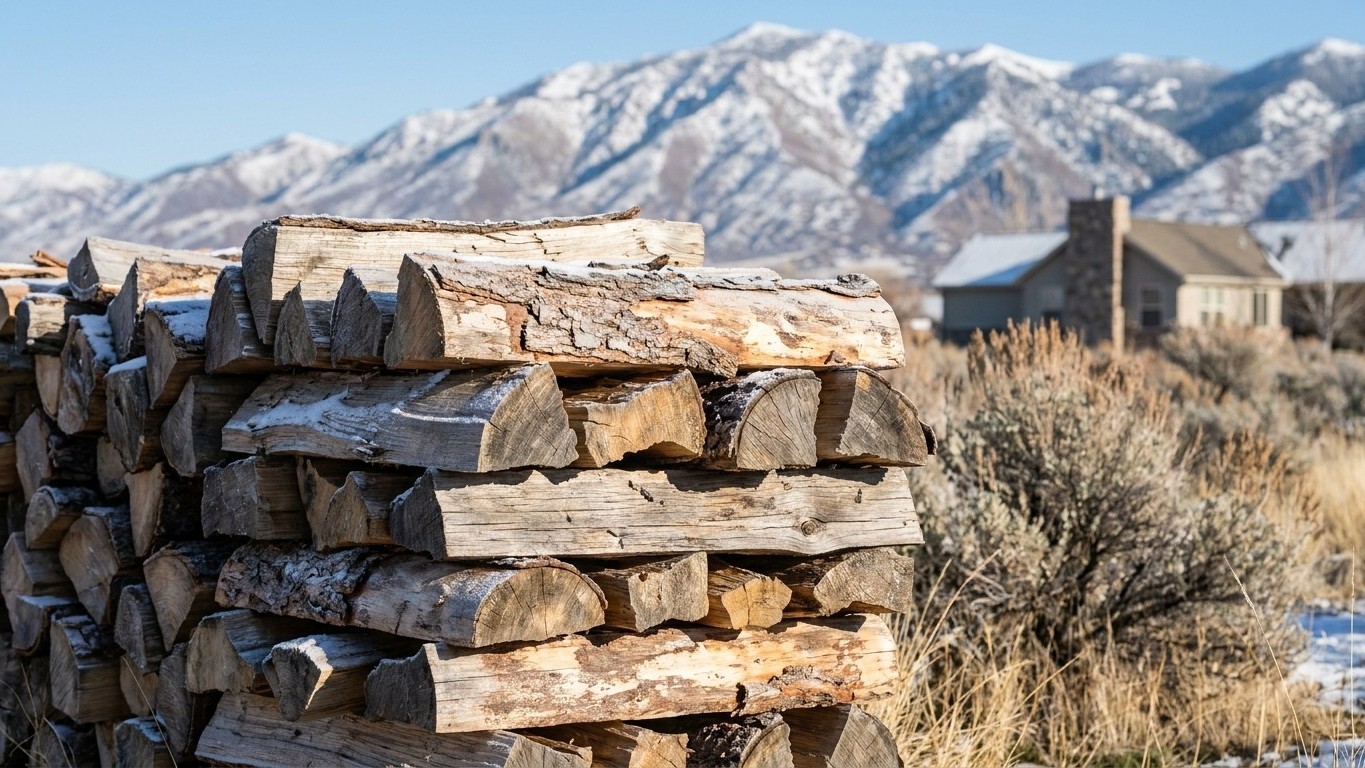

Salt Lake City’s coldest month averages a nightly low of 24.2°F, according to NOAA’s 1991-2020 Climate Normals. That single number decides most of what follows here: how many cords a household burns, how dense a wood needs to be, and whether firewood in Utah is a heating necessity or a nice-to-have for cold evenings. This guide breaks down species, quantity, and drying time for exactly that climate.
How cold it actually gets here

Twenty-four degrees is not brutal by northern-tier standards, but it is cold enough to matter. A mean daily minimum of 24.2°F in the coldest month means Salt Lake City routinely sits well below freezing overnight for weeks at a stretch, not just on the occasional bad night. That is the figure that decides winter hardiness for a heating strategy the same way it decides which plants survive outdoors: it is not the record low, and it is not a monthly average, it is what a typical night actually does to a house.
For anyone burning wood as a real heat source, a low in the mid-20s changes the math. A stove or insert has to recover heat lost overnight, and it has to do it again the next night, and the one after that, for a season that can run from October into April at higher elevations. This is not a climate where a fire is lit for atmosphere on the rare frosty evening and left unlit the rest of the winter. It is cold enough, often enough, that wood heat has to actually perform.
That said, Salt Lake City itself sits in a valley, and Utah’s terrain does the rest of the work. Mountain towns and higher benches routinely run colder than the valley floor reference station, sometimes by a wide margin, while the low desert basins in the southern part of the state stay milder. Anyone heating a cabin above 6,000 feet should treat the Salt Lake City figure as a floor, not a ceiling, and plan for more demanding conditions than the reference number suggests.
What this means practically: if wood is your primary or sole heat source anywhere in Utah’s mountain valleys, buy and season wood like it matters, because it does. If wood supplements a furnace in a Salt Lake City-area home, the calculation is gentler, but a 24-degree average low still means real heat loss on real nights, not just a chill worth romanticizing. Either way, the species and quantity decisions below should be made with that number in mind, not with a vague sense that “Utah gets cold in winter.”
Which woods are worth the effort here
Once the cold figure is on the table, density becomes the deciding factor, because a cord is a fixed volume: 4 feet by 4 feet by 8 feet, 128 cubic feet, no more and no less. A cord of dense wood packs more actual wood fiber, and therefore more pounds of fuel, into that same box than a cord of light wood does. Michigan State University Extension puts the benchmark at about 20 million BTU per cord for well-seasoned hardwood, which works out to roughly the heat of 145 gallons of #2 fuel oil or 215 gallons of LP gas. But that 20 million figure is an average. Species and moisture content push it up or down by a meaningful margin, so it should never be read as the guaranteed output of a specific load sitting in someone’s driveway.
Red oak is worth naming specifically because it comes up in the drying data too: MSU notes it dries slower than most species due to its cell structure, which means a dense, high-value wood like red oak often needs an extra season of seasoning before it earns its reputation. That is the trade-off with the densest woods generally: they carry more heat per cord and hold a fire longer through the coldest nights, but they punish anyone who tries to rush the seasoning process.
Lighter woods still earn a place in the wood shed, just not for the 2 a.m. reload. They light faster, they are more forgiving of imperfect seasoning, and they work well for shoulder-season fires in October or April when a hard overnight burn is not the goal.
| Wood type | Heat per cord (vs. ~20 million BTU average) | Smoke when seasoned | Sparks |
|---|---|---|---|
| Dense hardwood (red oak and similar) | Above average | Low | Few |
| Mid-weight hardwood | Near average | Moderate | Few to moderate |
| Softwood (pine, fir) | Below average | More, especially resinous cuts | More, with pops and spitting |
Local availability often matters as much as this table. A theoretically superior species that only comes green, unsplit, and unseasoned is worse to burn than a modest wood a supplier already has stacked and dry. Ask what is actually seasoned before asking what is technically the densest option on paper.
How much wood a winter takes
There is no honest single number for “how many cords a Utah winter takes,” because the answer depends on three things that vary house to house, not on the climate alone. A published average is close to meaningless without knowing where a specific home falls on each variable.
- The cold figure for the specific location: a valley home near the 24.2°F reference burns differently than a mountain cabin running colder overnight for a longer stretch of the season.
- How well the house holds heat: insulation, air sealing, window quality, and even how open the floor plan is around the stove all change how much wood it takes to hold a temperature.
- Whether wood is the main heat source or a supplement: a household burning wood exclusively needs a fundamentally different supply than one lighting a stove on weekends while a furnace carries the rest of the load.
The mechanism that makes these variables move the number so much is straightforward: a poorly insulated house in a demanding winter can burn close to double what a tight, well-sealed house uses in that same climate, even with identical square footage. Heat that leaks out through an uninsulated attic or a drafty door has to be replaced by more wood, full stop. That is why two neighbors on the same street, both heating with wood through the same winter, can end up with wildly different totals stacked in the yard by spring.
The practical approach is to run the estimate down that list for the actual house in question rather than trust a number pulled from a national average. Start with local cold, adjust for how the house performs, and adjust again for how much of the heating load wood is actually expected to carry. That gives a working estimate that a generic figure never will.
Drying wood in this climate
Seasoning matters more than species selection almost everywhere wood is burned, and Utah’s climate shapes how long that seasoning takes rather than whether it’s required. The target does not move: firewood needs to reach roughly 20 percent moisture or less before it burns well, down from green wood that can sit above 60 percent moisture right off the tree, per Michigan State University Extension. That water has to boil off before the wood releases usable heat, and the energy spent boiling it away is energy that never reaches the room.
What actually dries wood is air movement and time, not sunshine. Utah’s low humidity and dry summers are an advantage here compared to muggier climates, since air moves through a stack and carries moisture away more efficiently when the surrounding air isn’t already saturated. But dry air alone does not shortcut the process if the wood is not split and stacked properly. Rounds left whole, or wood piled without airflow between splits, dry far slower regardless of how arid the local summer is.
Red oak is the named exception worth remembering: its cell structure makes it dry slower than most species, so anyone counting on it for a specific winter needs to plan further ahead than they would for a faster-drying wood.
This is where the cold figure from earlier connects directly to a scheduling mistake that shows up every year across Utah. Wood cut and split in spring for that same winter is, in most cases, simply not ready by the time the cold arrives in October or November. A single summer of stacked, split drying is usually the minimum, and denser species or a damp storage spot push that timeline out further. The households that stay warm through a 24-degree overnight low are, almost without exception, burning wood that was split and stacked a full year before it ever went into the stove, not wood scrambled together the same season it’s needed.