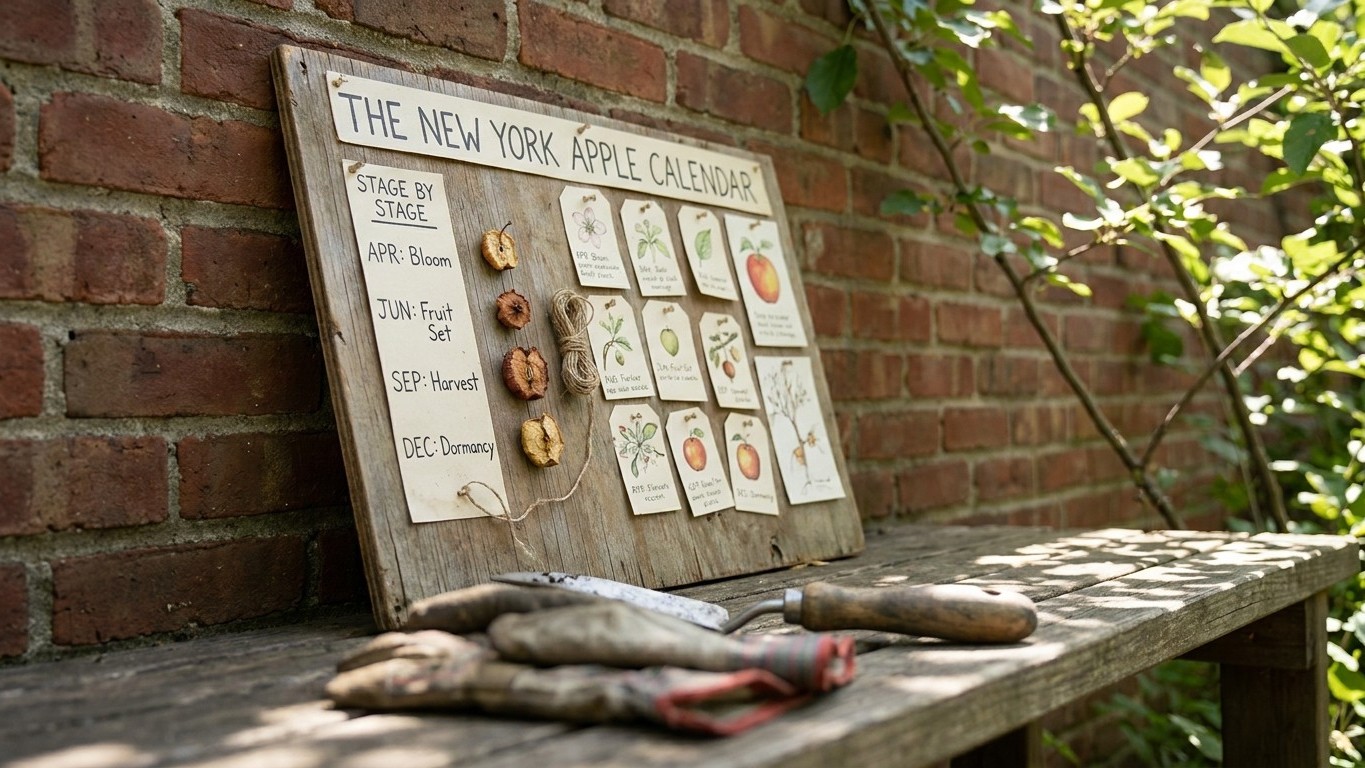

New York’s apple calendar runs on the tree’s own stages, not the wall calendar: dormancy through midwinter, green tip and pink in early-to-mid spring, bloom straddling the last frost window, then fruit set and a harvest that stretches from late summer into fall depending on the cultivar. NOAA’s NCEI 1991-2020 climate normals put New York City’s last spring freeze at March 23 to April 3 and the first fall freeze at November 14 to November 27, and those two ranges anchor everything else on this page. Check your tree’s actual bud stage against that spring window before you spray, thin, or worry about a frost forecast.
The short answer for New York
26.9°F is the average daily minimum for the coldest month in New York City, and that single number quietly answers half of what most calendars get wrong. The other half is chill, not cold — and it works in reverse. Almost every cultivar sold here survives the winter fine; upstate runs colder still. So the real question isn’t survival or bloom at all. It’s whether your variety flowers before or after your local frost clears.
That answer depends on two things that have nothing to do with the calendar month: winter hardiness and chill accumulation. Hardiness is whether the wood survives the cold at all. NOAA’s 1991-2020 normals put the coldest month’s average daily minimum at New York City at 26.9°F, a winter mild enough that almost any apple cultivar sold in the Northeast will survive there without trouble. Upstate counties run colder in winter than that city figure, though no station-level number for those counties appears in these normals, so treat the city figure as a floor rather than a state-wide reading.
Chill is the other half of the answer, and it works in the opposite direction: a tree that never gets cold enough for long enough will bloom late and unevenly, whatever the hardiness of its wood. A New York City dooryard tree and an upstate orchard both accumulate plenty of chill in a normal winter, so for most of the state the calendar question is really about frost timing at bloom, not about whether the tree can survive or flower at all. Choosing a cultivar whose bloom date clears your local frost window, a subject covered in The Best Apple Varieties for New York, matters more here than chasing extra cold-hardiness you likely don’t need.
Working through it

Once a tree is planted and established, the groundwork described in Growing Apples in New York is behind you, and the calendar becomes a matter of reading the tree’s stage against New York City’s frost window from NOAA’s NCEI normals. Here is the sequence, in the order it happens on the tree, not on a wall calendar.
| Stage | What you see | Frost sensitivity | Main task |
|---|---|---|---|
| Dormancy | Bare wood, tight buds | Very low, wood tolerates deep freezes | Pruning, dormant oil |
| Green tip | First sliver of green at bud tip | Low but rising | Watch weather, hold off feeding |
| Pink | Buds swollen and colored, still closed | Moderate, a hard freeze can kill buds | Last window for dormant sprays |
| Bloom | Open blossom, stamens visible | High, upper 20s can wipe out a crop | Frost protection, pollinator access |
| Petal fall | Petals dropping, fruitlet visible | Falling | First fungicide pass if needed |
| Fruit set | Marble-sized green fruitlets | Low | Thinning |
| Harvest | Full color break for the cultivar | None until the fall frost window | Picking before the fall freeze |
Dormancy

The tree sits leafless from the first fall freeze, November 14 to November 27 near New York City by NOAA’s normals, through the coldest weeks of winter. This is when you prune and apply dormant oil, because the wood tolerates handling and cold without setting back growth. The stage ends when accumulated warmth, not a date on the wall, triggers the next one.
Green tip

A sliver of green shows at the tip of each bud as the tree starts active growth. It is still fairly cold-tolerant at this point, but every stage from here only gets more vulnerable, so this is the point to finish any dormant-season work you haven’t gotten to yet.
Pink

Blossom buds swell and show color before opening. A hard freeze at pink stage can kill the flower before it ever opens, which costs more yield than losing an open bloom would, because there’s no second flush behind it. This stage typically falls close to New York City’s last-frost window of March 23 to April 3, so a cold snap here is the one to watch hardest.
Bloom

Open flowers are the most visually obvious stage and, in most years, the riskiest. Temperatures in the upper 20s can cut a bloom-stage crop hard, and bloom in New York often straddles the tail end of the spring frost window NOAA reports for the city. Growers who planted an early-blooming cultivar on a site with a later effective frost date, upstate or in a cold valley, are the ones who lose flowers here most often.
Petal fall

Petals brown and drop, and the fertilized fruitlet becomes visible at the base of each flower. Frost risk falls off quickly from here. This is typically the point to start a fungicide program if your site has a history of scab or other fruit diseases, since the young tissue is still soft and susceptible.
Fruit set

Fruitlets swell to marble size over the following weeks. This is when you do the thinning, removing extra fruit from each cluster so the tree isn’t carrying more apples than it can size and ripen well. Thinning at this stage, rather than waiting, is what actually decides fruit size at harvest.
Harvest
Ripening runs from a cultivar’s color break through full maturity, and different cultivars finish weeks apart. The one hard deadline is the first fall freeze, November 14 to November 27 near New York City by NOAA’s normals, by which point any late-hanging fruit needs to be off the tree or accepted as a loss.
What changes across New York
The frost dates above are New York City’s own figures from NOAA’s NCEI normals, measured at a dense urban site in Central Park. Every other part of the state moves against a different, unpublished-here frost calendar, and the direction of the shift depends on geography rather than latitude alone.
The Lake Erie and Lake Ontario shorelines, running through Chautauqua, Niagara, and the Lake Ontario fruit belt west of Rochester, sit in some of the state’s most productive apple ground precisely because a large lake moderates temperature swings. The water delays both bud break in spring and the first killing freeze in fall, which pushes bloom later into a safer window and stretches the growing season for late-ripening cultivars.
The Hudson Valley, another major commercial apple region, runs cooler than New York City as you move north from the river’s mouth, and its distance from the coast’s moderating effect means bloom generally lags the city’s timing. The Champlain Valley in the far northeast behaves differently again: on clear, calm nights, cold air drains into the valley floor and pools there, so orchard sites on a slope above the bottomland often escape a frost that settles into the low ground nearby.
Elevation does similar work in the Catskills and the Adirondack foothills, where higher ground can run a full stage or more behind low-lying sites a short drive away at the same latitude. Long Island and the immediate coast get some of the same moderating effect as the Great Lakes shorelines, just from salt water instead of fresh water, which keeps spring cold snaps and the fall’s first freeze both a little further from the extremes an inland site at the same distance from the city would see.
The mistakes this climate punishes
Most crop losses in New York apples trace back to a mismatch between a cultivar’s stage timing and the site’s actual frost risk, not to a lack of general care.
- Early-blooming cultivar on a late-frost site: shows up as a killed bloom in a year when a cold snap arrives after the tree has already opened flowers, most often on upstate or valley-bottom sites where the effective frost date runs later than New York City’s own March 23 to April 3 window from NOAA’s normals.
- Assuming winter chill is guaranteed: shows up as thin, uneven bloom the following spring after an unusually mild winter, since a cultivar bred for a longer chill requirement than the season delivered will flower late and sparsely rather than not at all.
- Feeding nitrogen too late in the season: shows up as soft, late shoot growth that the first fall freeze, November 14 to November 27 near New York City by NOAA’s normals, catches before it has hardened off, killing tender tips and weakening the tree going into winter.
- Reading the calendar instead of the tree: shows up as a spray or thinning pass done a week too early or too late because it was scheduled by date rather than by stage, which matters most in a spring running noticeably warmer or cooler than average.
Long-chill cultivars bred for colder regions further inland can also struggle near the coast and around New York City in an unusually mild winter, for the same chill-accumulation reason, even though the site’s hardiness is never in question. The pattern across all four mistakes is the same: this climate is not too harsh for apples anywhere in the state, but it punishes decisions made on a fixed date instead of on the stage the tree is actually showing that week.
Checking this against your county
For a local read on your own frost window, chill accumulation, and recommended spray timing, contact Cornell Cooperative Extension, the state’s land-grant extension service, through your county office. They keep local phenology and frost records that a single statewide page cannot, and can tell you how many stages your site typically runs behind or ahead of the city figures used here.
Common questions
Do I need two different apple trees for pollination?
Most apple cultivars need pollen from a different cultivar blooming at the same time, since almost none are reliably self-fruitful. A neighbor’s tree or a crabapple within bee range can work if its bloom overlaps yours, but if you’re planting from scratch, pick two cultivars with overlapping bloom windows rather than relying on the yard next door.
What do I do if frost is forecast while my tree is in bloom?
Cover small trees with a sheet or frost cloth overnight if the forecast low is getting close to the upper 20s, and remove it as soon as temperatures rise the next morning so pollinators can work. On a larger tree this isn’t practical, and the honest answer is that you’re managing this risk with cultivar choice and site selection ahead of time, not with plastic sheeting on the night itself.
How do I tell what stage my tree is actually at?
Walk out and look at the buds rather than checking a date. Tight and closed means dormancy or green tip, swollen and colored but shut means pink, open with visible stamens means bloom, and browning, dropping petals mean you’ve moved into petal fall. This five-minute check is more reliable than any calendar date, because bud stage can run a week or two ahead or behind the average depending on the specific spring.
Can I grow apples on Long Island or right on the coast?
Yes, and the ocean’s moderating effect on temperature swings is generally an advantage for apples rather than a problem, unlike for some other fruit crops. Salt spray right on the waterfront can damage foliage on an exposed site, so set trees back from direct spray exposure where you can, and expect bloom timing to run close to, or slightly behind, New York City’s figures.