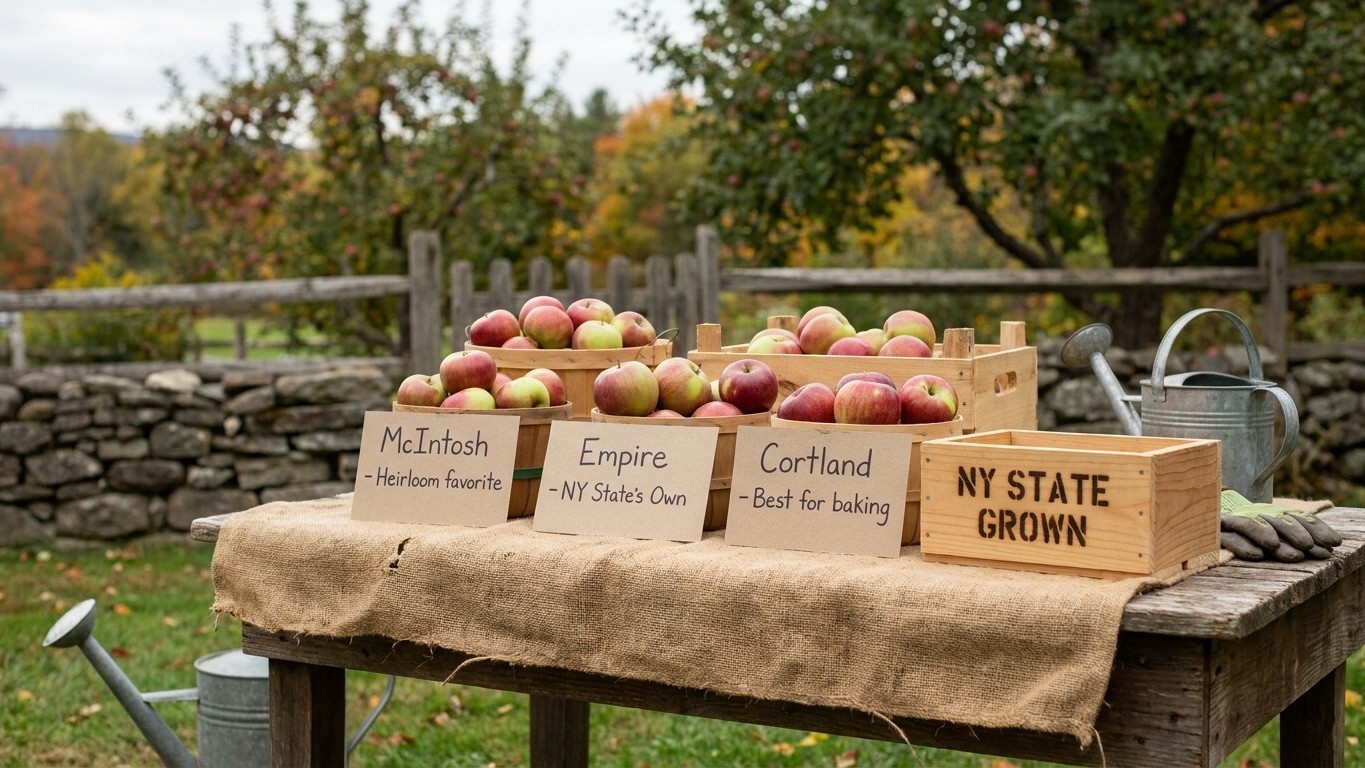

No single apple tells you the answer here — the one that thrives on Long Island can fail two hundred miles north, and the reverse holds just as true. What decides it is whether the tree’s bloom date lines up with your last frost, and whether it gets cold enough where you are, in winter, to satisfy what that variety actually needs to fruit. So before you buy anything, find out two things about the tree you’re considering: its bloom timing and its chill requirement, then check both against what your own yard actually does, not what the next county over does.
The short answer for New York
The apple that succeeds on Long Island can fail two hundred miles north in the Adirondacks, and the reverse is just as true. New York spans a genuine range of winter cold and spring frost timing, so the “best” apple is whichever one has its bloom date and cold-hardiness rating matched to your own local frost pattern, not a name that did well in a magazine trial somewhere else. For the general steps a New York planting follows before variety choice even comes up, see Growing Apples in New York.
What the NYC figures do and don’t tell you
At the New York City reference station, NOAA’s NCEI 1991-2020 climate normals put the last spring freeze at March 23 to April 3 and the first fall freeze at November 14 to November 27. That gives a frost-free window of roughly 225 to 249 days at that one station, calculated from the two ranges rather than asserted as a single date. Apples don’t need anywhere near that much time between bloom and harvest, so season length is rarely the limiting factor near the coast. What matters far more is whether a frost lands during bloom or petal fall, and upstate counties see both dates shift by weeks in either direction.
NOAA’s 1991-2020 normals also put the mean daily minimum of the coldest month at New York City at 26.9°F, mild enough that winter cold rarely threatens tree survival there. That figure describes the city reference station only. It says nothing about the Tug Hill Plateau, the Adirondack foothills, or a low-lying valley thirty miles inland, all of which run considerably colder in a typical January. Ask your nursery or county extension office for the cold-hardiness rating of any tree before you plant it somewhere the city figure doesn’t apply.
Working through it

Without a single named variety to point to, the honest way to choose is to work through the same three filters an orchardist works through before ever looking at a catalog: bloom timing against the frost window, cold hardiness against the winter minimum, and chill satisfaction against a mild winter. Each filter answers a different question, and skipping one is what causes a tree to survive fine but never fruit, or bloom beautifully and lose the whole crop to a frost that lands a week later than usual.
Bloom timing against the frost window
Apple varieties are commonly grouped by nurseries into early, mid-season, and late bloomers, and that grouping matters more in New York than the eventual harvest date does. A variety that blooms early gets ahead of the frost window at a mild coastal site, but the same early bloom lands it squarely inside the frost period at a site where the last freeze regularly runs past NOAA’s NYC-normal window of March 23 to April 3. The full stage-by-stage progression from dormancy through petal fall, and how each stage is triggered by temperature rather than the calendar, is laid out in The New York Apple Calendar, Stage by Stage.
Cold hardiness versus winter minimum
Hardiness and chill are not the same filter, and they fail in opposite ways. A tree that lacks hardiness for its site can die outright in a hard winter, trunk split or graft union killed, no matter how well it fruited the year before. A tree that lacks the winter chill it needs won’t die. It just blooms erratically or sparsely the following spring, because the buds never received enough cumulative cold to break dormancy cleanly. Near the coast, where the coldest month’s mean minimum runs a relatively mild 26.9°F, hardiness is rarely the limiting factor and chill satisfaction becomes the more useful thing to check. Upstate, where winter minimums run well below that figure, hardiness comes back into play and needs checking against whatever rating the nursery or extension publishes for that specific variety and rootstock combination.
What every choice costs
An early-blooming, low-chill variety trades frost risk for reliability. It will set fruit most years at a mild site, but a late freeze in an unusual year takes the whole crop with almost no warning, because bloom has already happened. A late-blooming, high-chill variety trades the opposite way. It dodges most spring frosts by blooming later, but in a genuinely mild winter it can under-perform because it never accumulates the chill it was bred to expect. Neither choice is free, and the trade only makes sense once you know which risk is more common at your own site.
| Bloom timing group | Frost risk near the coast | Frost risk upstate | Typical trade-off |
|---|---|---|---|
| Early-blooming | Low, most years | High | Reliable fruit set most years, occasional total loss |
| Mid-season | Low | Moderate | Balances frost risk against a shorter fall hang time |
| Late-blooming | Very low | Low | Dodges spring frost, needs a longer frost-free fall to finish |
What changes across New York
New York’s apple regions differ by elevation, by proximity to large water bodies, and by how easily cold air drains out of a valley overnight, and each of those changes the frost window independently of latitude.
The Lake Erie and Lake Ontario shore
The strip of land along Lake Erie and Lake Ontario, often called the state’s fruit belt, benefits from the lake acting as a heat reservoir. The water cools slowly in fall and warms slowly in spring, which pushes the first fall frost later and delays bud break in spring compared with inland sites at the same latitude. That lag is exactly what lets a mid-to-late-blooming variety finish more reliably there than the same variety would inland.
The Hudson Valley
The Hudson Valley runs apples on a mix of river-moderated slopes and low-lying flats. Slopes above the valley floor drain cold air downhill on a still, clear night, which is why an orchard block on a hillside often escapes a frost that settles into the flat below it at the same elevation reading on a map.
The Adirondacks and Tug Hill Plateau
Elevation is the dominant factor here. Both regions sit high enough, and far enough from the coast’s moderating influence, that the growing season runs shorter and the winter minimum runs considerably colder than anything the New York City normals describe. A variety chosen for hardiness rating alone, without checking the actual rootstock’s cold tolerance for that elevation, is the single biggest variety mistake made in this part of the state.
Long Island
Long Island’s coastal exposure keeps it closer in frost timing to the New York City reference station than most of the mainland, since both sit near the same body of water. The trade-off there runs the other way: a genuinely mild coastal winter is the one place in the state worth checking a variety’s chill requirement before assuming it will bloom fully.
The mistakes this climate punishes
Three mistakes account for most of the apple failures we hear about in New York, and each one shows up at a specific, predictable moment rather than as a vague decline.
Planting an early bloomer in a frost pocket
An early-blooming variety planted at the bottom of a slope, or in a low spot where cold air settles, blooms right on schedule and then loses the entire crop the first year a frost arrives even a week later than the New York City-normal window of March 23 to April 3 would suggest for a coastal site. The damage shows as browned, wilted blossom clusters within a day or two of the frost, and by the time it’s visible there is nothing left to do for that season. The fix is sited before it’s a variety problem: check the actual low point of the ground the tree will occupy, not just the county’s general frost date.
Assuming chill is never a problem
Most of New York gets ample winter chill even in a mild year, but assuming that holds everywhere in the state, especially near the coast, is how a high-performing catalog variety turns into a shy, uneven bloomer. This shows up as scattered, weak bloom in spring rather than the tree’s usual full flush, and it’s easy to mistake for a pest or nutrient problem when the real cause is a winter that simply didn’t get cold enough for long enough.
Feeding late into the season
Nitrogen applied in late summer pushes soft new growth that hasn’t hardened off by the time the first fall frost arrives. At the New York City reference station, NOAA’s 1991-2020 normals put that first fall freeze at November 14 to November 27, and upstate sites see it considerably earlier. New growth still soft when that frost lands blackens and dies back, and a tree that loses a meaningful share of its season’s new wood every year this way stays stunted no matter how well it was chosen for hardiness and chill.
- Frost pocket damage: blossom browns and wilts within a day or two of the frost event
- Insufficient chill: bloom is scattered and weak rather than absent
- Late feeding: new growth blackens and dies back at the first fall frost
Checking this against your county
Every figure in this article comes from the New York City reference station, and every regional pattern described above is a general tendency, not a county-specific number. Your county’s actual frost dates, winter minimum, and locally trialed variety performance can differ meaningfully from both. Cornell Cooperative Extension maintains county offices across the state with orchard trial data and site-specific advice, and it’s the right first call before you commit to a variety or a planting site. Find your county’s office through the Cornell Cooperative Extension directory and ask specifically about frost history and variety trials for your elevation and distance from open water, not just your county name.
Common questions
What’s the best apple variety for beginners in New York?
There isn’t one variety that answers this for the whole state, because the right choice depends on your local frost window and winter minimum, not on beginner-friendliness alone. Ask your county extension office which varieties have the longest local trial record at a site similar to yours, since a variety with years of local data is a safer bet than one with none.
Do I need two apple trees to get fruit?
Most apple varieties need a different variety blooming at the same time nearby for pollination, since a single tree of most cultivars won’t reliably set fruit on its own. Check the specific variety’s pollination requirement and bloom-timing group before assuming a neighbor’s tree, or a nearby crab apple, will cover it.
Can I grow apples on Long Island’s coast?
Yes, and the coast’s frost pattern is actually the gentler end of the state’s range, closer to the New York City normals described above than most of the mainland. The one thing worth checking there is winter chill, since a mild coastal winter is the most likely place in the state for a high-chill variety to bloom unevenly.
Why did my apple tree bloom fine but not set any fruit?
A late frost during bloom or petal fall is the most common cause, and it can happen even when the tree itself looks completely healthy afterward. Poor pollination from a lack of a compatible second variety, or a cold, wet spell during bloom that kept bees from flying, are the other two usual explanations.