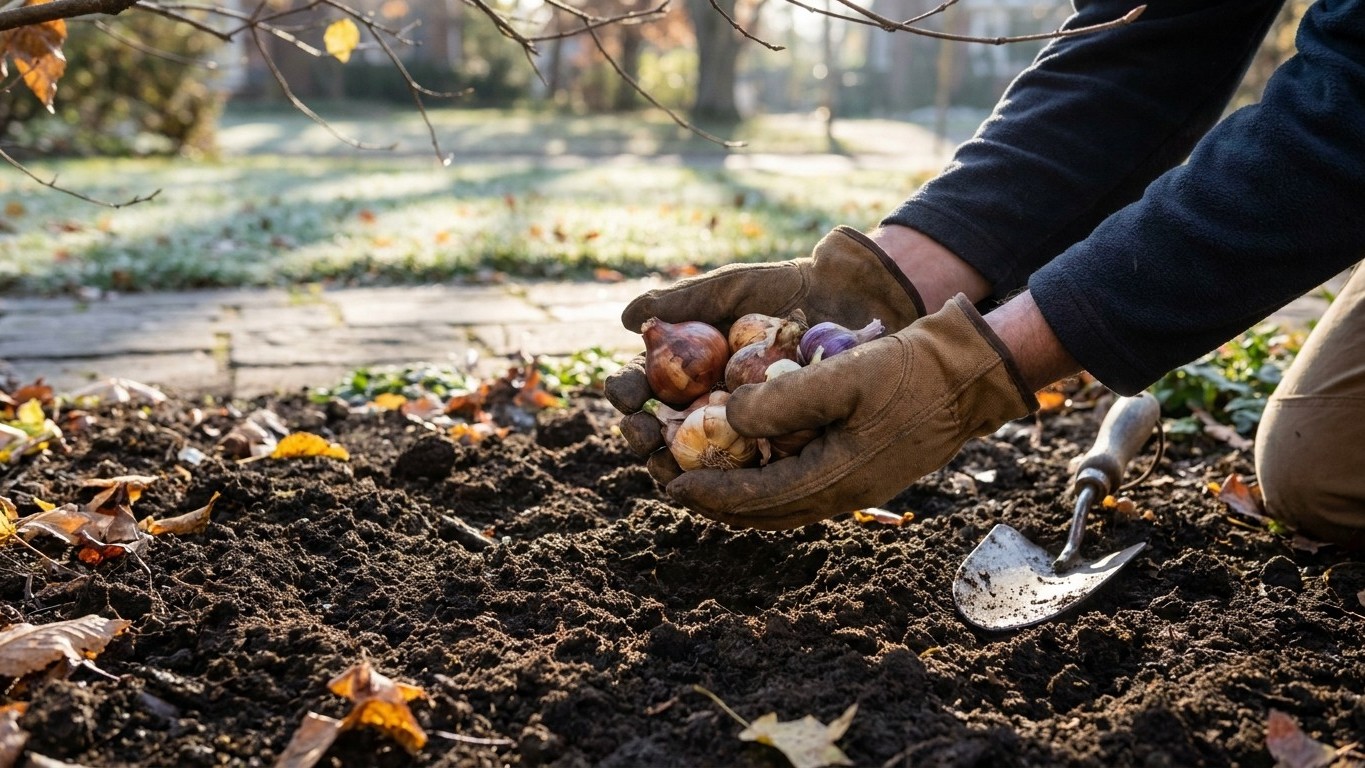

New York’s spring bulb season hinges on one number gardeners rarely check: how many weeks the soil actually stays below 45°F. Get that answer right and tulips, daffodils, and crocus bloom reliably from Buffalo to Brooklyn. Get it wrong, and you’re planting bulbs that were never going to flower here anyway.
When to plant bulbs in New York

The planting clock in New York starts with the first fall frost, and in the New York City area that lands somewhere between November 14 and November 27, based on 1991-2020 climate normals from the Central Park reference station. The rule of thumb for spring bulbs is to get them in the ground about six weeks before the soil freezes solid, which usually trails the first air frost by several weeks. That puts the workable window for most of downstate New York somewhere in the stretch from early October through early December, with upstate counties and the Adirondacks needing to start weeks earlier since frost arrives there well ahead of the city.
Plant too early and the bulb sits in soil that’s still warm from summer. It reads that warmth as spring, pushes up tender green shoots, and those shoots get shredded by the first hard freeze. The bulb survives, usually, but it’s spent energy it needed for root development, and the following spring’s bloom often shows it. Plant too late and the opposite problem shows up: the bulb goes into frozen or nearly frozen ground without enough time to grow roots before winter locks everything down. Roots are what let a bulb take up water and nutrients the moment the ground thaws in March. Skip that step and you get a bulb that emerges weeks late, blooms weakly, or simply rots because it never anchored itself. Gardeners without reliable in-ground planting sites can sidestep much of this timing pressure by Growing Spring Bulbs in Containers in New York, where soil temperature and drainage are easier to control, or by Forcing Spring Bulbs Indoors in New York to enjoy blooms weeks ahead of the outdoor season.
The frost date is an average, not a guarantee
Worth saying plainly: that November 14-27 window is a statistical average built from three decades of data, not a promise. Roughly half of all years in that record saw frost arrive earlier than the window, and half saw it later. A gardener who waits until the calendar hits November 20 because “that’s when it usually frosts” is gambling on the wrong half of that distribution as often as the right one. The safer approach is to watch the soil, not the calendar; once nighttime lows are consistently landing in the 40s, the window is open regardless of what date it happens to be.
Whether your winter is cold enough
Every spring bulb needs a long stretch of cold before it will flower. Most common varieties, tulips, daffodils, hyacinths, crocus, require somewhere between twelve and fourteen weeks with soil temperatures below about 45°F. That cold period isn’t dormancy for its own sake; it’s a biochemical trigger. Inside the bulb, cold breaks down growth inhibitors and lets the flower embryo mature. Skip the chill and the bulb still grows, but what comes up is often just leaves, or a flower stalk so short it never clears the foliage. This is the number every bulb catalog assumes you already know, and it’s the one figure that lets you judge any bulb offered to you, anywhere.
New York clears that bar with room to spare. The coldest month in New York City runs a mean daily minimum of 27.9°F, according to NOAA climate normals for the 1991-2020 period. That’s nearly eighteen degrees below the 45°F chilling threshold, and it holds for roughly four months of the year, not just the required twelve to fourteen weeks. Upstate counties, sitting in colder USDA zones, deliver even more cold, for even longer. Practically no part of New York State falls short of the chilling requirement for standard spring bulbs. Pre-chilling bulbs in a refrigerator, the workaround gardeners in warmer states rely on, simply isn’t necessary here. (For anyone curious about that method anyway: it takes about twelve weeks at refrigerator temperature, and the bulbs need to stay away from ripening fruit, since the ethylene gas fruit releases kills the flower bud inside the bulb before it ever reaches the ground.)
| Bulb | Weeks of cold required | What New York delivers | Verdict |
|---|---|---|---|
| Tulips | 12-16 weeks below 45°F | ~16-18 weeks, coldest month mean min 27.9°F | Comfortable margin, no pre-chilling needed |
| Daffodils (Narcissus) | 12-14 weeks below 45°F | ~16-18 weeks | Comfortable margin |
| Hyacinths | 12-15 weeks below 45°F | ~16-18 weeks | Comfortable margin |
| Crocus | 8-15 weeks below 45°F | ~16-18 weeks | Comfortable margin |
| Alliums | 8-10 weeks below 45°F | ~16-18 weeks | Comfortable margin, easiest of the group |
The one place this margin gets tighter is in a mild microclimate, a bulb bed tucked against a heated foundation wall on the south side of a house, for example, where reflected heat can keep soil warmer than the surrounding yard. In an open bed anywhere in the state, though, the cold requirement is a non-issue.
Which bulbs suit New York
Given how easily this state clears the chilling threshold, the limiting factor for most spring bulbs isn’t cold, it’s whether the bulb’s hardiness range covers New York’s zones at all. The state spans USDA zones 3b through 7b, so a bulb needs to tolerate at least that range to survive winter here as a perennial rather than a one-season planting.
- Tulips (Tulipa) — hardy zones 3-8
- Daffodils (Narcissus) — hardy zones 3-9
- Crocus — hardy zones 3-8
- Hyacinths — hardy zones 4-8
- Alliums — hardy zones 3-9, depending on species
- Grape hyacinth (Muscari) — hardy zones 3-9
- Snowdrops (Galanthus) — hardy zones 3-7
All seven cover New York’s zone range comfortably. The bulbs to be wary of are the ones bred for warmer regions. Ranunculus, hardy only to zone 8, will rot in a New York winter more often than not, since the combination of cold and wet clay soil is exactly the condition that kills its corms. Freesia and ixia, both rated for zones 9-10, won’t survive an unprotected New York winter at all; treat them as annuals if you want them, and don’t expect a second year. Anemone coronaria sits at the edge, hardy to zone 7, which means it might limp through a mild winter in a sheltered New York City courtyard and die outright in an exposed upstate bed the same year. Hardiness ratings describe an average outcome, not a hard boundary, so a south-facing wall or a heavy mulch layer can push a marginal bulb’s odds in either direction.
What digs them up here
Squirrels and voles aren’t random about which bulbs they raid. The pattern comes down to chemistry: some bulbs contain compounds the animals find toxic or simply unpalatable, and those get left alone almost every time.
- Bulbs squirrels and voles usually eat: tulips, crocus
- Bulbs squirrels and voles usually leave alone: daffodils, alliums, hyacinths, grape hyacinth (Muscari), snowdrops
Daffodils and alliums both contain compounds toxic enough to deter rodents outright, which is a large part of why they’re such a reliable choice for New York yards with an active squirrel population. Tulips and crocus have no such defense, and in areas with heavy squirrel or vole pressure, expect real losses without protection. The one method with a track record is physical: lay galvanized wire mesh flat over the planting bed, pinned down at the edges, and leave it in place until the ground freezes hard enough that digging isn’t worth the effort. Repellent sprays and granules get mentioned constantly, but they wash off with the first rain or heavy dew and need reapplying so often that most gardeners give up on them by December.
Where to check for your own county
Every figure in this article, the frost dates, the coldest-month minimum, is built around New York City as the reference point, and New York State stretches across several degrees of latitude and multiple USDA zones from the city to the Canadian border. A planting date that’s correct for Manhattan can be off by two to three weeks for a county in the Adirondacks or along Lake Ontario’s snowbelt. Soil in a river valley behaves differently than soil on an exposed ridge just a few miles away, even within the same county.
For county-specific planting dates, frost data, and soil guidance, Cornell Cooperative Extension maintains local offices across the state, each working from data collected in that specific region rather than a single statewide average. That local office is the better source for anyone planting outside the New York City area, and it costs nothing to call or check their county page before you buy a single bulb.