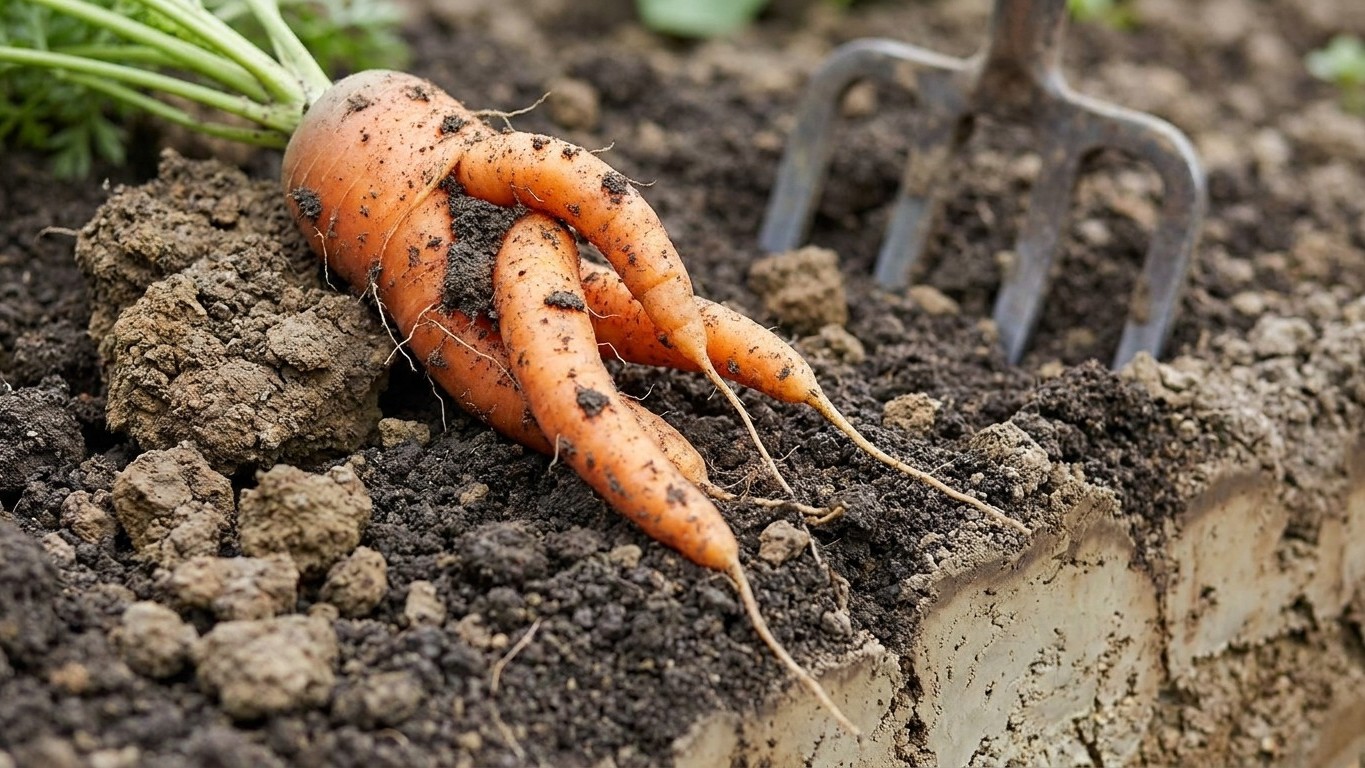

New York gardeners searching for a straightforward pest list for carrots run into a real limit: no statewide, source-backed list of carrot-eating insects for New York turns up in the verified data behind this page. What is confirmed is that most of what gets blamed on insects in a home carrot bed, forked roots, stunted growth, split shoulders, traces back to the soil itself, and to how the roots are handled after harvest.
Which pests attack carrot in New York
No named, sourced list of carrot-specific insects for New York is available in the verified facts used to build this page. That is worth saying plainly rather than papering over with guesses, because a page that invents a bug name a reader cannot verify does more harm than one that admits the gap and points to a better source: the Cooperative Extension office for the reader’s own county, which tracks local insect activity season by season in a way a single statewide article cannot.
What the verified record does cover is the ground carrots grow in. New York’s representative soil, the Honeoye series mapped by USDA NRCS, runs 26 percent sand, 19 percent clay and 55 percent silt at the surface, with a pH around 6.3 and organic matter near 3.0 percent. That is a decent loam on paper, well drained, but it is not sandy in the way carrots actually want. Utah State University Extension is blunt about what carrots need: deep, sandy, well-drained soil rich in organic matter, because heavy or rocky ground makes the root fork.
That gap between what the state’s representative soil offers and what a carrot root demands matters more here than any insect might. A clay content near 19 percent, sitting on top of silt at 55 percent, is enough to bend and split a carrot root long before any insect gets near it. A gardener who sees a forked or stubby carrot and reaches straight for a pest explanation is often looking at compaction, a rock, or a soil that has never been double dug.
None of this means insects never touch a New York carrot bed. It means this page will not manufacture a species name that no cited service documents for this state. The honest move is to separate soil-caused symptoms from anything that actually looks chewed, and send true insect questions to the office that tracks them locally, covered further down.
When each one shows up, and what it does first
Without a sourced pest calendar for New York, the timeline that can be stated with confidence is the carrot’s own. Carrots are sown directly in the ground, there is no transplant date to count from, and Clemson Extension puts harvest at about 65 to 75 days after planting, while Utah State University Extension frames the fuller window at 70 to 100 days from seeding to maturity depending on how the crop is grown. Everything a gardener notices happens somewhere inside that span.
Early on, in the first few weeks after seeding, a root that is going to fork or grow stubby usually shows it fast: the taproot hits a dense layer, a stone, or compacted clay, and instead of pushing straight down it splits or curls. This is a soil-structure problem showing up on a soil-structure timeline, not an insect arriving on a insect timeline, and it is visible well before the plant is anywhere near harvest size.
Mid-season, as the root fills out, splitting along the shoulder tends to appear after a stretch of uneven watering, a dry spell followed by heavy rain that swells the root faster than the skin can stretch. That is a moisture pattern, not a feeding pattern, and it clusters after specific weather events rather than spreading evenly through the bed.
Near the end of that 65-to-100-day window, as roots approach harvest size, is when true insect damage, if it is present in a given garden, usually becomes visible as feeding marks on the root surface. Because no sourced list names which species to expect or when in New York specifically, a root pulled at harvest with unexplained tunneling or surface damage is exactly the case to bring to a county Extension office rather than diagnose from a photo online.
Telling the damage apart from everything else
Most of what looks like a New York carrot problem sorts into a small number of causes once you know what to look for, and soil, water and storage explain far more of it than insects do.
| Symptom | Likely cause | What settles it |
|---|---|---|
| Forked or stubby root | Heavy, rocky, or compacted soil | Dig a test hole 12 inches down; check for clay layers or stones |
| Split shoulder near harvest | Irregular watering, dry spell then heavy rain | Check watering log against recent rainfall, not the plant itself |
| Stunted, pale tops | Poor drainage or nutrient lock-up in compacted soil | A soil test at the county office, not a leaf inspection |
| Ragged holes or tunnels in the root surface | Possible insect feeding | Bring the root itself to Cooperative Extension for identification |
| Soft, sprouting roots after weeks in storage | Storage too warm or tops left on | Check the storage thermometer, not the garden |
A root pulled from the ground with a clean, smooth fork is a soil story; a root with ragged, chewed-looking tunnels is worth a trip to Extension, not a guess from an article. The distinction that matters most for a home gardener is refusing to name a cause without checking it, because a wrong diagnosis (spraying for insects that were never there, for instance) wastes a season and never fixes a soil that still forks the next crop.
What actually works here, and what is a waste of time
For a soil that runs close to New York’s representative Honeoye profile, meaning decent loam but heavier than carrots prefer, Utah State University Extension’s fix for forking is specific: work in plenty of compost and double dig the bed rather than switch anything else. Double digging loosens the ground well below the depth a shovel normally reaches, which matters because a carrot root is trying to push down 8 to 10 inches or more through exactly the layer a single pass of tilling never touches.
Raised beds filled with a loosened, compost-rich mix sidestep the clay question entirely, and for a garden sitting on ground close to the state’s representative texture (19 percent clay is enough to matter), a raised bed is often less work over a season than repeated double digging of native soil.
After harvest, the number that decides whether carrots make it through winter is 33 degrees Fahrenheit, the storage temperature Clemson Extension specifies, held with high humidity. That is barely above freezing, not a cool basement or an unheated garage in a mild stretch, and a gardener who stores at 50 degrees will watch the crop sprout and soften in a fraction of the time. The other detail that decides storage life: cut the tops off before storing. Leaves keep pulling moisture out of the root, which is why bunched carrots with tops on last only about 10 to 14 days, while trimmed roots held cold and humid keep for months.
What wastes time is treating a forked or stunted root as an insect problem when the verified record points to soil structure and watering first. No product, no spray schedule, fixes a clay layer 8 inches down; only loosening the ground and adding organic matter does that.
Where to check this for your own county
New York’s land-grant Cooperative Extension system runs offices county by county, and that local office is the right place for anything this page cannot verify: a specific insect seen on a specific root, a soil pH that differs from the state’s representative Honeoye figure, or a local emergence pattern that changes from one end of the state to the other.
A state-level soil figure describes hundreds of soil series compressed into one representative profile, not the dirt in any one garden. The Honeoye series numbers on this page (26 percent sand, 19 percent clay, pH about 6.3) are a starting point for guessing what a New York garden tends to do, not a reading of what is actually in the ground behind a specific house. River bottoms, hillsides, and any lot a builder has cut or filled will differ, sometimes completely.
The next concrete step is a home soil test through the county Cooperative Extension office, which returns an actual pH and texture reading rather than a statewide estimate, and the same office is the place to bring a damaged root or a photograph for identification rather than guessing from an article. Both take a short conversation and settle questions this page is built to raise, not to answer for a garden it has never seen.
Common questions
Does New York’s state soil mean my garden’s carrots will fork?
Not necessarily. The Honeoye series is a representative profile USDA maps for the state, not a measurement of any one yard. A home soil test through the county Extension office gives the actual reading for a specific garden.
How long after seeding should I expect to harvest carrots in New York?
Clemson Extension puts harvest at about 65 to 75 days after planting, and Utah State University Extension frames the broader range at 70 to 100 days from seeding, since carrots are sown directly and never transplanted.
Can I store carrots in a cool garage instead of a refrigerator?
Only if it holds close to 33 degrees Fahrenheit with high humidity, per Clemson Extension. A garage running near 50 degrees will let stored carrots sprout and soften far faster.
Should I leave the tops on carrots in storage?
No. Tops continue drawing moisture from the root, which is why bunched carrots with tops on keep only about 10 to 14 days, while trimmed roots stored cold and humid last much longer.