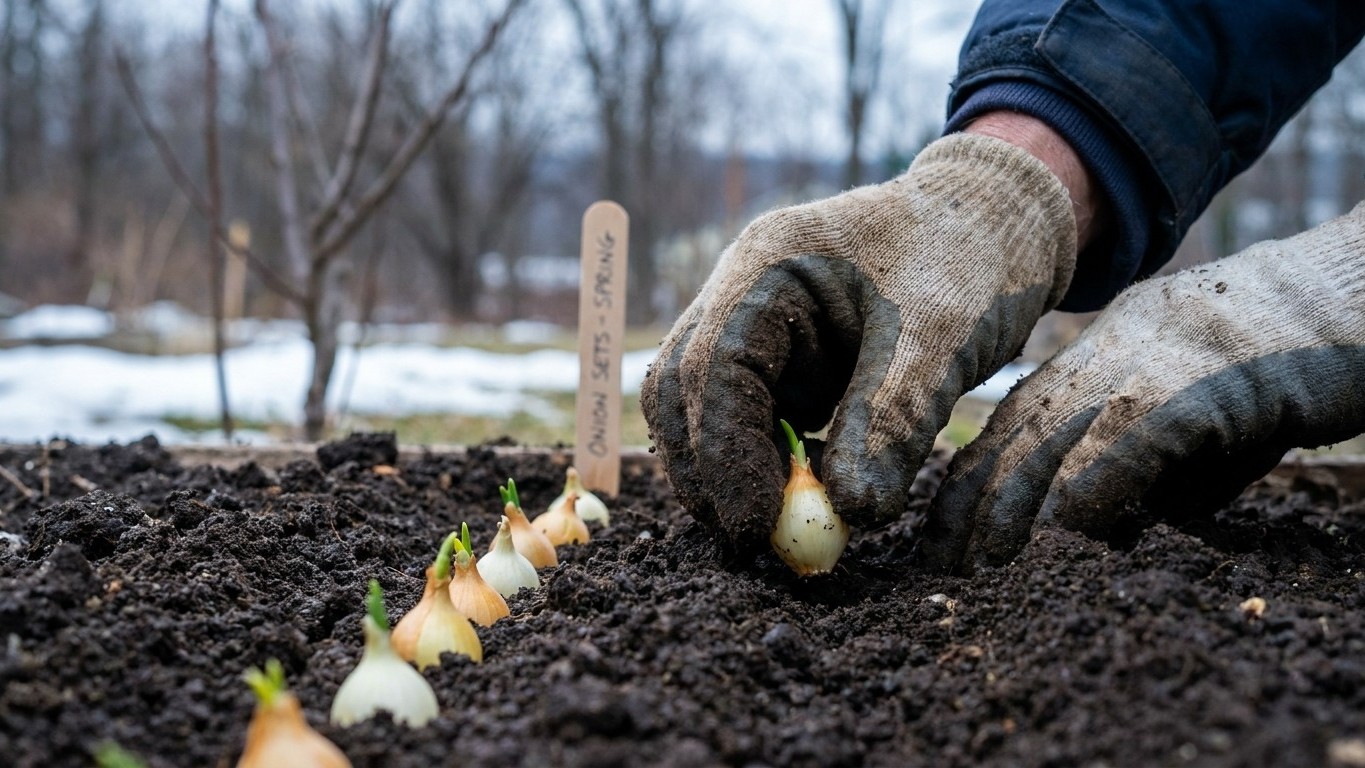

New York gardeners plant onions in late winter to early spring, not fall. The state’s cold winters would kill young plants left to overwinter outdoors, so sets or transplants go into the ground as soon as the soil can be worked, months before the summer solstice pushes day length past 14 hours. That single number, the length of the longest day, decides almost everything else: which varieties can even form a bulb here, how big that bulb gets, and whether the onion you pull in August is sweet or built to last through winter.
The short answer for New York

New York City sits at 40.78 degrees north latitude, according to NOAA’s coordinates for the Central Park weather station (USW00094728), the same station behind the region’s climate normals. On the longest day of the year, that location gets 14 hours and 56 minutes of daylight. Neither number changes because a gardener wants it to, and both together explain why the onion calendar here looks nothing like the one followed in Georgia or South Carolina.
In mild-winter states, growers Plant Onions in the fall. The bulbs never freeze out, the plants spend the cool months quietly building roots and leaves, and by the time short days give way to the 12-hour threshold that triggers bulbing, the plant already has enough size to make a decent onion. New York doesn’t get that option. A young onion left in the ground through a New York winter dies. So the entire growth window has to be squeezed into spring: sets or transplants go in as soon as the ground can be worked in late winter or early spring, and the plant has only a few months to build leaves before day length starts pulling the trigger on bulb formation.
That 14-hour-56-minute ceiling also tells you what kind of onion belongs in this garden before you even think about frost dates. Onions come in day-length groups, and a variety only starts forming a bulb once the day reaches its particular threshold. Short-day types trigger at around 12 hours, long-day types wait for 14 to 16 hours, and intermediate types sit in between. New York’s summer days comfortably clear the intermediate threshold and reach well into long-day territory, which is why the varieties that actually perform here are drawn from the long-day and intermediate-day groups, not the short-day group grown farther south.
Put those two facts together and the calendar writes itself: plant early enough in spring that the onion has real size on it by the time the daylight hits its bulbing trigger, and choose a variety whose trigger point matches a day length New York’s summer actually reaches. Skip either step and the harvest suffers, which is exactly what the next section gets into.
What will not work here
Two mistakes ruin an onion crop in New York, and neither one is a feeding or watering problem. The first is planting a short-day variety. Those onions start bulbing once the day reaches about 12 hours, a threshold New York’s spring clears well before the plant has had time to grow much leaf. The result isn’t a smaller-than-usual onion, it’s a genuinely tiny one, because a short-day variety locks in its bulb size the moment day length hits its trigger, regardless of how little top growth the plant has managed. The second mistake is the opposite: planting a long-day variety bred for latitudes farther north than New York ever reaches. Here, the day simply never gets long enough to flip the bulbing switch. The plant keeps making leaves all summer, then the season ends and the whole thing rots in the ground. No bulb at all, not even a small one.
- Gabriella (short-day, published for 20-35N): bulbs while still small this far north, giving a tiny onion.
- Madalyn (short-day, 20-35N): same early-bulbing problem at this latitude.
- Red Rock (short-day, 30-36N): triggers long before the plant has size.
- Red Sensation (short-day, 25-35N): bulbs too early for New York’s season.
- Texas Grano 1015Y (short-day, 25-35N): a Southern variety that locks in small here.
- Vidora (short-day, 25-35N): same day-length mismatch.
- White Castle (short-day, 30-38N): still triggers before New York’s plants size up.
- Powell (long-day, published for 43-47N): the day here never reaches its trigger; leaves all season, then rot.
- Redwing (long-day, 43-65N): needs more daylight than New York’s reference latitude ever delivers.
The other trap has nothing to do with variety and everything to do with timing. Planting late doesn’t push the harvest back the way it would with tomatoes or beans. An onion’s bulb size is set by how much leaf growth it managed before day length crossed its trigger point, and that trigger arrives on the calendar’s schedule, not the plant’s. A transplant that goes in three weeks late doesn’t bulb three weeks late. It bulbs on the same day as an on-time planting, just with three fewer weeks of leaf behind it, so the bulb comes out smaller. Late planting doesn’t delay an onion harvest. It shrinks it.
What changes across New York
New York isn’t one climate. The state runs from roughly 40.5 degrees north on Long Island up to close to 45 degrees north along the Canadian border in the North Country, a spread of almost five degrees of latitude. All the figures above come from the New York City area, specifically the Central Park station at 40.78 degrees north, and a gardener working farther from that reference point should treat the numbers as a starting point, not a guarantee.
| Region | Approximate latitude | What changes |
|---|---|---|
| Long Island / New York City | ~40.5-40.8N (reference) | 14h56 on the longest day; long-day and intermediate-day varieties fit directly |
| Finger Lakes / Central New York | ~43N | Somewhat more summer daylight than the reference city; Powell (43-47N) begins to enter its published range |
| North Country / near the Canadian border | ~44.5-45N | The longest days in the state; both Powell and Redwing (43-65N) fall within their published range, while short-day types are even less viable |
Move north and the growing season also compresses at the other end, since frost lingers later into spring and returns earlier in fall. A gardener near Plattsburgh or Massena isn’t just working with more summer daylight than someone on Long Island, they’re also working with fewer frost-free weeks to build leaf growth before that daylight triggers bulbing. That combination is exactly why a variety like Powell, which fails to bulb at all near New York City, has a shot at working in the far north, while a gardener in the North Country may need to start transplants earlier indoors to compensate for the shorter frost-free window outdoors.
Sweet now, or onions that last
Every New York gardener eventually runs into this trade-off, and it isn’t a matter of luck or variety marketing. According to University of Missouri Extension, sweet onions do not store as well as more pungent types, because the same volatile sulfur compounds that give an onion its bite are also what protect it in storage. Fewer of those compounds means a milder onion on the cutting board, but also one that softens and spoils faster in the pantry.
Day length lines up with this chemistry almost perfectly. Short-day varieties, grown farther south, tend to run sweeter and don’t keep. Long-day and intermediate-day varieties, the groups suited to New York’s latitude, tend to run sharper and store longer. That’s good news for a New York garden aimed at winter eating: most of the varieties that actually bulb here, names like Patterson, Frontier, or Red Carpet from the long-day group, are built for the root cellar rather than the salad plate.
There’s one notable exception worth knowing about before you order seed. Walla Walla Sweet is a long-day variety, so it bulbs reliably at New York’s latitude, but it’s bred for sweetness rather than storage, and it behaves like a sweet onion in the pantry regardless of its day-length group: eat it within a few weeks of harvest, don’t count on it lasting to Christmas. Choose the sharper long-day and intermediate-day varieties instead, and the onions harvested in August can still be sound in the pantry come March. Choose for flavor over storage, and that same batch is finished by Thanksgiving.
Checking this against your own garden
Every figure in this article comes from a single reference point, the New York City area at 40.78 degrees north. That’s a reasonable stand-in for the lower Hudson Valley and Long Island, but it stops being reliable the farther a garden sits from it, and New York State has enough north-south spread that “close enough” isn’t good enough for a crop whose whole cycle is governed by day length. Before ordering seed or sets, a few checks are worth five minutes each.
- Find your own latitude if you garden outside the New York City area, especially in the Finger Lakes, the Southern Tier, or the North Country.
- Look up your local last spring frost date and first fall frost date rather than assuming they match downstate.
- Confirm your county’s Cornell Cooperative Extension office for planting-window guidance specific to your soil and elevation.
- Compare any variety’s published day-length range against your own latitude, not just against New York City’s.
- Ask your extension office whether local growers have had success with varieties near the edges of their published range, like those in the 42-50N blurred zone.