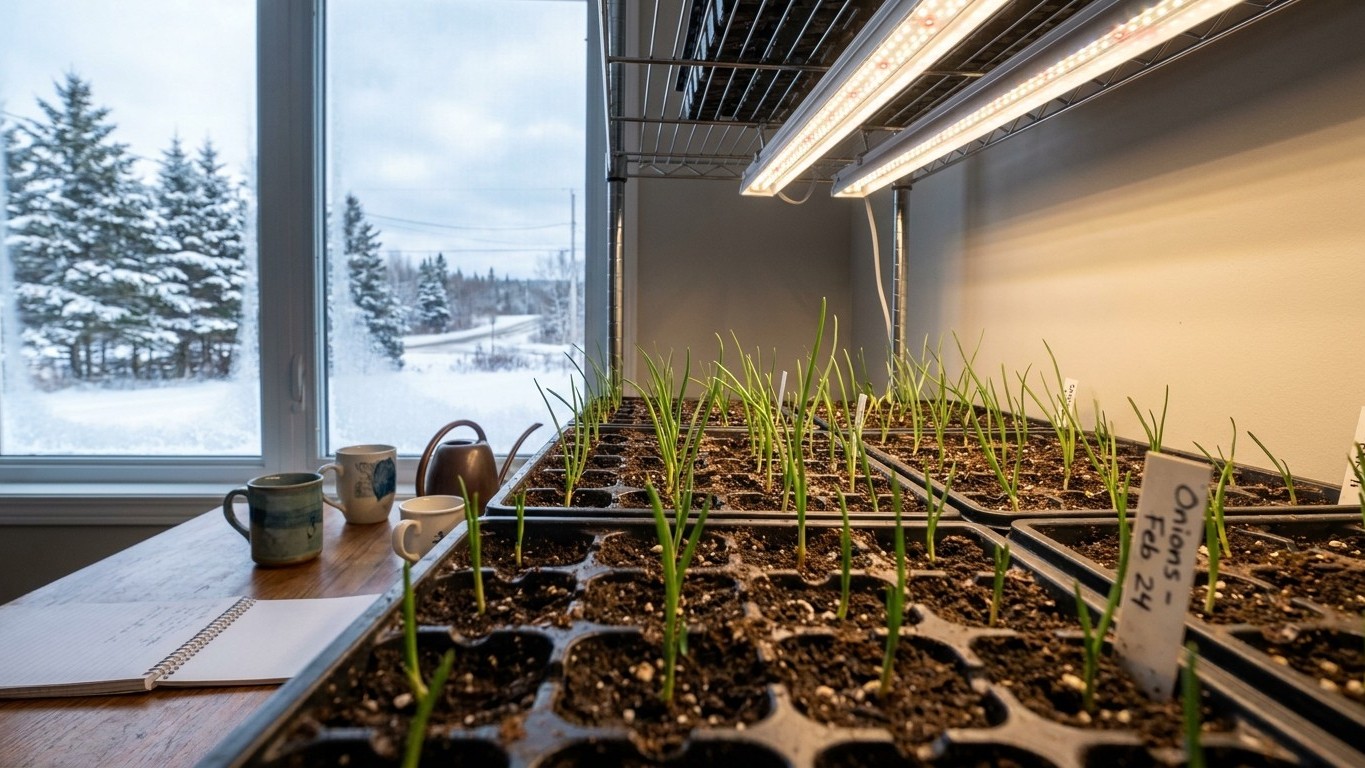

Onions in Nova Scotia go in during late winter to early spring, started indoors under lights around mid-to-late February and moved outside in April once the soil can be worked. That timing exists because of the province’s day length, not its frost dates: Halifax sits at 44.88 degrees north latitude and gets 15 hours and 25 minutes of daylight on the longest day of the year, a number that decides how big your onions get more than any amount of fertilizer or water ever will.
The short answer for Nova Scotia

Onions are triggered into bulbing by day length, not by temperature. That single fact is why Nova Scotia’s planting calendar looks nothing like the fall-planting schedule used in mild-winter states along the Gulf Coast. At 44.88N, Halifax’s 15 hours and 25 minutes of daylight on the summer solstice puts the region squarely in long-day and intermediate-day territory, well above the roughly 12-hour trigger that governs short-day varieties. There’s no autumn planting window here worth using: winters are cold enough to kill overwintering seedlings outright in most years, and the ground stays frozen or saturated for months, which rules out the fall-and-overwinter approach that works in Georgia or Texas.
Instead, the calendar runs from the other direction. Onions need a long head start of leaf growth before the solstice arrives and flips the switch to bulb production, so gardeners start seed indoors in February, about 10 to 12 weeks before the last expected frost, and set transplants into the garden in April. Direct-seeding or planting sets outdoors is possible slightly later, but every week lost in spring is a week the plant doesn’t get to build leaves before daylight tells it to stop.
This is also why the state-by-state, or in this case province-by-province, comparison matters. A gardener working from a generic seed packet calendar written for a mid-latitude U.S. state might push planting into May “to be safe” from frost. In Nova Scotia’s daylight regime, that habit costs bulb size, not just a few days of harvest. The season is short and the trigger date is fixed by the sun, so the only variable a gardener actually controls is how much of a head start the plant gets before the solstice arrives.
What will not work here
Short-day onions are the clearest mismatch for this latitude, and planting them here isn’t a marginal risk, it’s a guaranteed disappointment. A short-day variety starts bulbing once day length hits around 12 hours, which in Nova Scotia happens in early spring, long before the plant has had time to grow much leaf mass. The result is a small bulb locked in early, followed by a long season of daylight the plant can no longer use for growth. Several of these varieties are documented for latitudes well south of Halifax and simply don’t belong in a Nova Scotia garden:
- Red Sensation (short-day, 25-35N): triggers bulbing far too early at this latitude, locking in a small bulb.
- Texas Grano 1015Y (short-day, 25-35N): bred for a day-length trigger Nova Scotia hits months before the plant has grown enough leaves.
- Vidora (short-day, 25-35N): same early trigger problem, undersized bulbs regardless of soil or feeding.
- Gabriella (short-day, 20-35N): suited to latitudes far south of Halifax, not this daylight pattern.
- Madalyn (short-day, 20-35N): same mismatch, too far south of its published range.
- Red Rock (short-day, 30-36N): bulbs prematurely and stays small here.
- White Castle (short-day, 30-38N): also outside its published range this far north.
- Candy (intermediate-day, 33-40N): sits below Halifax’s latitude and bulbs earlier than the season allows for full size.
The second, quieter way this goes wrong has nothing to do with variety choice at all. Planting the right long-day or intermediate-day onion but doing it late doesn’t push the harvest back, it shrinks it. Bulbing starts the moment day length crosses the variety’s threshold, whatever the calendar says the gardener intended. A plant that only has six or eight leaves when that threshold arrives in late June or July makes a bulb sized to match those six or eight leaves, not the twelve or fourteen it would have grown from an earlier start. There is no catching up once the trigger fires; the bulb is already set at whatever size the plant reached.
What changes across Nova Scotia
Halifax, at 44.88N, is the reference point for the daylight figures above, but Nova Scotia is not a single point on the map. The province runs from roughly the southern tip near Yarmouth and Cape Sable Island up through Cape Breton in the northeast, a spread of a few degrees of latitude. That’s enough to matter for both frost timing and, more subtly, for day length on the solstice.
| Location | Approx. latitude | What it changes |
|---|---|---|
| Southern tip (Yarmouth area) | slightly below 44.88N | Marginally shorter longest-day length than Halifax; frost typically lifts a little earlier in spring, giving a slightly wider transplant window. |
| Halifax (reference city) | 44.88N | 15 h 25 min of daylight on the solstice; the baseline figures used throughout this page. |
| Cape Breton (northern areas) | above 44.88N | Slightly more daylight on the solstice than Halifax; spring often arrives later, which can push transplant dates back even as the daylight trigger stays roughly similar. |
The practical effect is small but not negligible. A gardener near Yarmouth may be able to move transplants outside a little earlier than one in Cape Breton, where lingering cold and later frost dates can delay planting by a week or two even though the daylight pattern is nearly identical province-wide. Because all of Nova Scotia sits well within long-day and intermediate-day latitude ranges, the variety guidance in this page holds across the province. The frost calendar, not the variety list, is what shifts from coast to coast and county to county.
Checking this against your own garden
The Halifax figures are a starting point, not a guarantee for every yard in the province. Before locking in a planting date, it’s worth confirming a few things specific to your own location rather than assuming the reference city’s numbers apply exactly.
- Look up your own latitude if you’re far from Halifax, particularly if you garden near Yarmouth, along the Fundy shore, or in Cape Breton, where frost timing shifts even when the daylight pattern barely does.
- Check your local average last-spring-frost and first-fall-frost dates rather than relying on a provincial average, since coastal and inland sites in Nova Scotia can differ by a week or more.
- Contact your local agricultural extension or provincial agriculture office for current-season frost outlooks and soil-temperature guidance before setting transplants out.
- Track actual soil temperature at planting depth; onion roots establish poorly in cold, waterlogged spring soil even after the air has warmed.
- Note how many true leaves your transplants have by late May, since that leaf count, not the calendar date, is the real predictor of bulb size once the solstice trigger arrives.