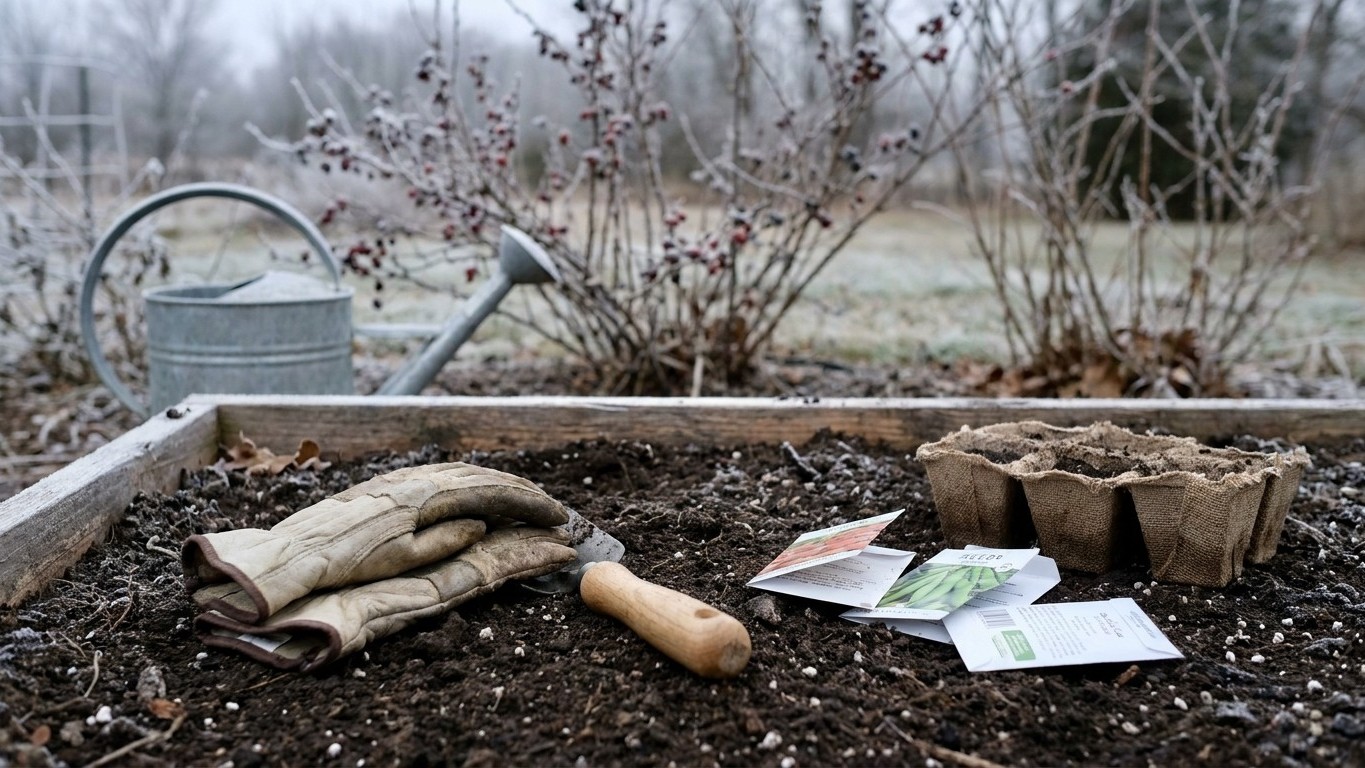

February in New York sits squarely inside the dormant season, well before the ground has any business being worked. Nothing goes into open soil across nearly the whole state this month. What actually happens instead: seed starting under lights, dormant pruning, ordering seed before good varieties sell out, chitting potatoes, forcing rhubarb, and keeping a close eye on whatever is still stored in the basement or root cellar.
What goes in the ground in February

The decision here is never the calendar. It is soil temperature and how far off the last frost sits. In New York City, NOAA’s 1991-2020 climate normals put the last spring freeze somewhere between March 23 and April 3, based on the 30-70% freeze-probability band at the Central Park station. That is the reference point closest to sea level and to the urban heat that keeps the five boroughs milder than almost anywhere else in the state. Upstate, the Adirondacks, the Tug Hill Plateau, and the higher ground of the Southern Tier run weeks to a full month behind that window, sometimes more where elevation and cold-air pooling stack against a garden.
Against that backdrop, the honest answer for February is that open-ground planting is not on the table almost anywhere in New York. Frozen soil, saturated clay, and repeated freeze-thaw cycles make direct-sowing pointless even where a warm afternoon fools the air temperature into feeling like spring.
Where the season extends anyway
A few things still move forward without waiting for bare soil. Bare-root fruit trees, brambles, and dormant perennial crowns can be planted the moment the ground is workable, which for the mildest pockets of Long Island and the lower Hudson Valley can land in the back half of the month. Cold frames and low tunnels let a gardener sneak in cold-hardy greens, spinach and mache among them, weeks before open ground would ever accept a seed. Shallot and garlic cloves held back from fall planting can still go in if a thaw leaves the soil loose enough to work, though a fall planting is always the safer bet for both. None of this contradicts the core rule: the open, unprotected garden bed stays closed for business until the frost window above has passed, and in much of upstate New York that is still two to three months away.
What to start under cover
Indoors, under lights or on a bright windowsill, February is when the seed-starting calendar actually gets busy, and the math runs backward from the local last-frost window rather than forward from any fixed date. Onions and leeks from seed want roughly 10 to 12 weeks of growth before transplanting outside, which for a gardener working off the New York City frost window puts the sowing date in the first half of February. Peppers, slower to germinate and slower to size up, want 8 to 10 weeks under lights before they go out, so a mid-to-late-February start lines up with that same reference window. Tomatoes are the one crop worth holding back: 6 to 8 weeks before transplanting is the right count, and starting them too early is the single most common mistake of the whole season.
Anyone gardening upstate needs to shift every one of those counts later, because the local last-frost date runs weeks past the city’s March 23 to April 3 range. The arithmetic still works the same way: take the local frost window, count backward by the crop’s number of weeks, and that is the sowing date, not a date pulled from a seed packet printed for a different climate.
The two ways this goes wrong are mirror images of each other. Start too early and the seedlings outgrow their pots weeks before it is safe to plant them out, turning leggy, rootbound, and stressed by the time the soil finally warms. Start too late and the plant never has enough size or root development to make full use of the New York growing season, especially upstate where that season is already short. Neither mistake is fixable once the seedlings are in that state, which is why the backward count matters more than any date printed on a calendar.
What is ready to pick
Outdoors, February gives almost nothing. That is the honest answer, and there is no point dressing it up. What keeps a household fed this month comes from what was put up earlier in the season, plus a short list of things still growing under cover or under snow.
Kale, leeks, and some of the tougher brassica family members often sit under snow cover in the garden and remain pickable through the coldest stretch, their flavor sweetened rather than ruined by repeated hard freezes. Anyone running a cold frame or low tunnel can likely still pull spinach, mache, or claytonia, all of which tolerate temperatures that would flatten a summer green without a second thought. Indoors, sprouts and microgreens fill the gap fastest, ready in a matter of days rather than weeks, and they need nothing more than a countertop and a tray.
The other job this month is checking what is already in storage. Squash should feel firm and heavy for its size; any softening at the stem end or a sweet, fermenting smell means it needs to be used immediately or composted. Potatoes that have started sprouting eyes or gone green under the skin should be pulled from the batch, both for taste and because green potato skin carries solanine, a compound worth avoiding. Onions gone soft at the neck, or sending up a green shoot, are on their way out and belong in the next few meals, not back in the bin.
The jobs that matter this month
Winter reads as a quiet month, but the task list is long, and none of it is filler. Dormant pruning tops the list: apple, pear, and stone fruit trees, along with raspberry and blackberry canes, are cut back while they are fully leafless and the tree’s structure is easy to see. Pruning now, before sap starts moving, reduces stress on the plant and lowers the risk of disease entering through a fresh cut, since many fungal and bacterial pathogens are far less active in cold weather.
Seed ordering has a real deadline too, even if it feels informal. Popular varieties, especially anything disease-resistant or regionally adapted, sell out from mail-order catalogs well before spring, and a gardener who waits until March is choosing from what’s left rather than what they actually wanted.
Soil work fits here as well. A soil test sent out now comes back with time to amend before planting, rather than discovering a pH problem in May when there is no room left to correct it slowly. Turning the compost pile, even a frozen one, keeps the decomposition process from stalling completely, and a pile left untouched all winter is a pile that will take longer to finish come spring.
Tool maintenance belongs on the list too: cleaning rust off pruners and hoes, sharpening blades, and oiling wooden handles all take an afternoon and pay back all season in cleaner cuts and less physical effort. Beds, trellises, and fencing that took a beating over the fall are easier to repair now, before spring planting competes for the same hours. And stored crops, covered above, need a weekly check rather than a one-time glance, since one soft potato left in a bin of good ones spreads rot faster than most people expect.
What not to do in February
The classic mistake this month is trusting a mild afternoon over the calendar of averages. A 55-degree day in the middle of February does not mean the soil has warmed, and seeds or transplants put into ground that is still cold and wet below the surface tend to rot before they ever germinate. The air lies; the soil, checked with a simple thermometer, does not.
A close second is uncovering mulch or row cover too early after a warm stretch. Perennial roots and dormant bulbs that get exposed to a sudden hard freeze right after a thaw suffer far more damage than if they had simply stayed buried under mulch the whole time. Mulch is there to buffer temperature swings, not just to block cold, and pulling it back the moment things feel springlike defeats that purpose.
Nitrogen fertilizer is another trap. Applied to dormant lawns or beds this early, it often washes away before roots are active enough to use it, doing nothing for the plant while adding unnecessary runoff. The better move is to wait until there’s clear, active green growth before feeding anything.
Inside, the mistake is starting tomatoes or other fast-growing seedlings too far ahead of the local frost window. It feels productive in the moment, but a leggy, rootbound tomato seedling started two months early usually performs worse once transplanted than one started on the correct backward count from the frost date.
Checking this against your own county
Everything above is a state-wide starting point, not a set of instructions for a specific backyard. New York’s USDA Plant Hardiness Zones run from 3b up through 7b, based on the 2023 USDA Plant Hardiness Zone Map, and that range alone tells you how differently a garden in the Adirondacks and a garden on Long Island experience the same February. Elevation, lake effect off Erie and Ontario, and simple north-south position shift real planting windows by weeks in either direction. Before committing to any date in this article, check it against Cornell Cooperative Extension, which publishes county-level guidance built for exactly this kind of local variation.
Common questions
Can anything be direct-sown outdoors in New York in February?
Essentially nothing, statewide. Ground is frozen or too wet across nearly all of New York this month; the exceptions are cold-frame or low-tunnel greens and, in the mildest pockets, bare-root plantings once the soil is workable.
When is the safest time to start tomato seeds for a New York garden?
Count backward 6 to 8 weeks from the local last-frost date rather than using a fixed date. For New York City that window runs March 23 to April 3; upstate gardeners need to shift their count later to match their own local frost date.
Is it too early to prune fruit trees in February?
No, this is close to the ideal window. Pruning while trees are fully dormant and leafless reduces disease risk and makes the branch structure easiest to read.
Why does New York City’s frost date differ so much from the rest of the state?
Central Park sits in a dense urban heat pocket, which keeps its recorded frost dates milder than upstate and Adirondack readings. Treat the NYC window as a reference point, not a statewide figure, and check county-level data for anywhere outside the five boroughs.