
New York’s pumpkin season runs on a tight countdown that starts at bloom, not at planting. Sow too late, and the flowers that eventually open won’t have enough days left before frost to turn a green fruit orange. The short version: aim to have flowers opening by late September at the latest, which means getting seed into 65°F soil sometime between mid-May and early June across most of the state, depending on how quickly the ground warms where you garden.
The short answer
Central Park, the NOAA reference station covering New York City and its immediate suburbs, records its first fall freeze somewhere between November 14 and November 27, based on the 1991-2020 U.S. Climate Normals. That’s a two-week spread, and it matters more than most gardeners realize, because a pumpkin vine’s real deadline isn’t tied to when you drop seed in the ground. It’s tied to when the flower opens.
Utah State University Extension puts pumpkin’s post-bloom clock at 45 to 55 days from flowering to a mature, harvest-ready fruit. Run that math against the Central Park frost window and the picture gets specific fast. Take the earliest frost date on record, November 14, and pair it with the longer 55-day maturation window, and the last flower with any real safety margin needs to open around September 20. Take the latest frost date, November 27, and the shorter 45-day window, and that cutoff stretches out to October 13. Somewhere inside that roughly three-week span, September 20 to October 13, is where the season’s real deadline sits for this area, and it shifts every year depending on how fall actually behaves.
That’s a window, not a date you can circle on a calendar and trust blindly. A flower that opens on October 1 might ripen fine in a mild fall, or it might get caught by an early freeze in a harsh one. Growers who want a cushion should plan around the earlier end of that range rather than the later one, since betting on a late frost is exactly the kind of gamble that leaves pumpkins sitting green on the vine.
One more thing worth flagging: Central Park sits in a dense urban heat island, which pushes its averages later in fall and earlier in spring than most of the state actually experiences. Upstate New York and the Adirondacks see frost arrive noticeably earlier in autumn and linger later into spring, which tightens this entire window considerably for anyone gardening north of the city and its immediate suburbs. If you’re up there, treat these dates as an optimistic best case, not your working number. Whatever the local timing, harvest with the stem attached before frost hits, and move fruit somewhere it won’t freeze, since that’s the only storage guidance Utah State’s Extension actually publishes.
When to sow here
Sowing pumpkins by the last frost date alone is one of the most common mistakes gardeners make with this crop, because air temperature and soil temperature move on completely different schedules. Here’s how the timing actually works out step by step.
- Start from the last spring frost. In the Central Park reference area, that falls between March 23 and April 3, per NOAA’s 1991-2020 Climate Normals. That date only tells you when the air stops reliably freezing.
- Add the soil lag. Ground temperature trails air temperature by weeks, not days, especially in clay-heavy or shaded plots that hold onto cold longer. In practice, that means soil in the New York City area often doesn’t climb through the 50s and cross the 65°F threshold pumpkins need until well into May, and in cooler upstate locations it can push into early June.
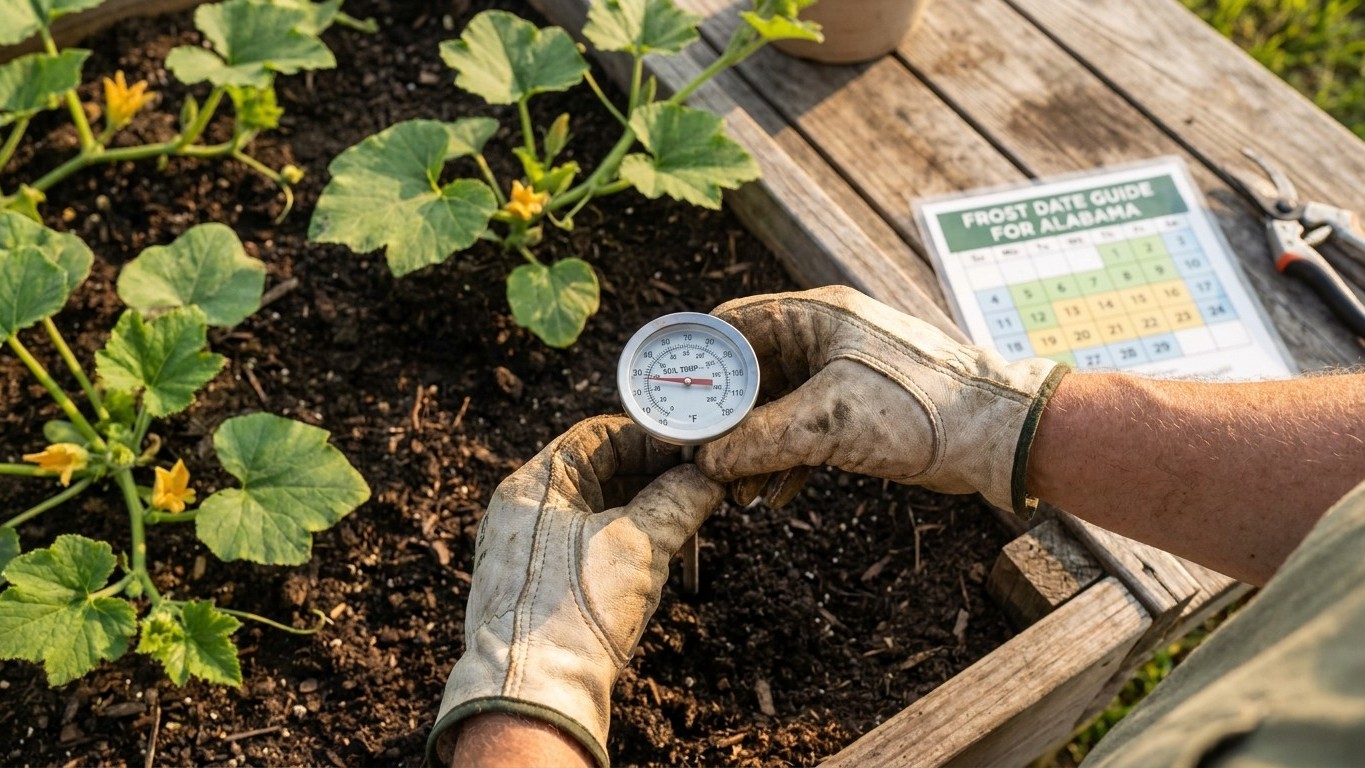
- Check the soil directly rather than guessing. A soil thermometer pushed about four inches deep, read at midday for a few consecutive days, is a far more reliable signal than counting weeks off the frost date on a calendar.
- Use row covers if you want to move sooner. Clear or lightweight row covers trap daytime heat and can effectively buy about two weeks, letting the soil beneath warm to 65°F earlier than bare, exposed ground would allow.
- Work backward from the flowering deadline. Once soil hits 65°F, sow directly. Because flowering follows sowing by several weeks and that interval isn’t uniform across varieties, the safest approach is simply to sow as soon as the soil genuinely reaches 65°F rather than waiting, since every week held back eats into the margin calculated in the section above.
None of this replaces watching the ground itself. A warm, dry spring can push soil past 65°F well ahead of typical timing, while a cold, wet one can hold it back for weeks even after the air has settled. Treat the frost date as the starting line, not the finish line, and let the soil thermometer make the actual call.
What goes wrong here
New York’s frost-to-frost window is workable for pumpkins, but it doesn’t leave much slack. Most failures trace back to losing time somewhere along that 45-to-55-day post-flower stretch.
- A late flower that never colors up: when the first female flowers don’t open until early October, there simply isn’t enough runway left before frost for the fruit to finish ripening, even under the shorter 45-day estimate. The fix is upstream: sow the moment soil hits 65°F rather than a week or two later, so flowering happens earlier in the safe window described above.
- A fruit caught green by an early frost: because the fall frost date itself swings across a two-week range, a fruit that’s on pace for a mid-November finish can still get nipped if frost lands on the early side of that spread. Watch the forecast in the final weeks, and if a hard freeze is coming and the fruit has already sized up and started to color, harvest with the stem attached rather than leaving it exposed overnight.
- A vine that dies back before the rind hardens: vines weakened by squash bugs or cucumber beetles often collapse well before the natural end of the season, cutting the maturation clock short regardless of how much time is technically left before frost. Scout leaves and stems regularly through summer so pest pressure doesn’t quietly shorten the growing window you calculated.
- Losing weeks to a slow spring: a cold, wet spring that delays soil from reaching 65°F pushes the entire schedule later, compressing the safe flowering window from both ends. Row covers, discussed above, are the main practical tool for clawing back some of that lost time.
Common questions
Can I still sow pumpkin seed in early July in New York?
It’s tight. Working from the September 20 to October 13 flowering deadline and a 45-to-55 day post-bloom clock, a July sowing leaves little to no margin for the plant to reach flowering and still finish before frost. Earlier sowing, as soon as soil hits 65°F, gives far better odds.
Does upstate New York need an earlier sowing date than New York City?
Almost certainly, though this page’s dated figures come from the Central Park reference station and apply most directly to New York City and its close suburbs. Upstate and Adirondack locations see earlier fall frosts and later spring frosts, which tightens the whole window and generally calls for sowing sooner relative to local soil warming, even though no separate NOAA figure for those regions is cited here.
How do I actually check if my soil has reached 65°F?
Push a soil thermometer about four inches into the ground and take a reading around midday for a few days in a row. That’s a more reliable gauge than assuming the soil is ready simply because the last frost date has passed.
Should I pick pumpkins before they’ve fully colored if frost is coming?
If a hard freeze is imminent and the fruit is sized and already coloring, harvesting early with the stem attached and moving it somewhere it won’t freeze is better than leaving it exposed. Utah State University Extension’s guidance doesn’t specify a storage temperature or keeping time beyond that single condition, so plan to use or sell fruit relatively soon after an early pull rather than expecting long-term storage.