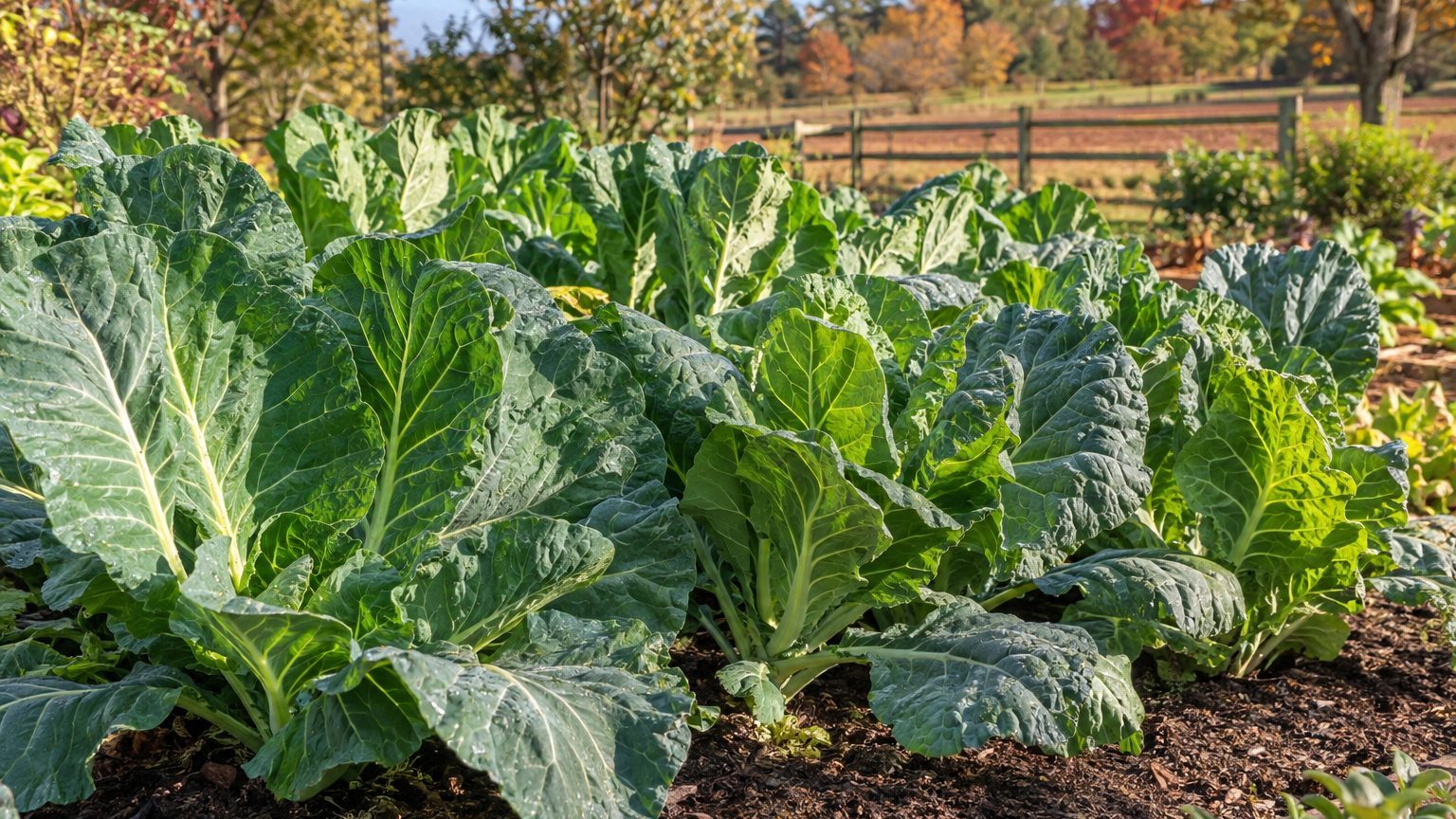

Choose quick, cold-tolerant, loose-leaf collards, set out as transplants, and plant kale beside them as insurance. Slow heirloom types bred for long Southern summers rarely finish in Newfoundland and Labrador. Collards can still be worth the space here, because the leaves handle chilly weather well and often taste better after fall frosts.
The short answer for Newfoundland and Labrador
The decision comes down to season length and heat. At the St. John’s A station, the average last spring frost falls on May 30 and the average first fall frost on October 17 (Environment and Climate Change Canada, 1981-2010 normals). That leaves about 20 weeks between the two means. Those are mean dates, though, not guarantees. In one year out of two, frost arrives later than May 30 in spring and, in the other half, earlier than October 17 in fall. Treat each date as the middle of a window, not as a safe date.
Twenty weeks sounds generous until you remember that frost-free is not the same as warm. Collards grow fastest in steady warmth, and a cool coastal summer slows them. So the varieties that suit this climate are the ones that put on leaf early and stand up to cold afterward:
- Non-heading, compact collards such as Vates or Champion, which are commonly sold as quicker and more cold-tolerant than the big Southern heirlooms.
- Kale (Lacinato and Siberian types), a close relative that outlasts collards in hard cold and fills the same kitchen role.
- Swiss chard and mustard greens, which mature quickly and fill gaps while the collards size up.
- Turnip greens, which are ready sooner than collards.
Georgia-type heirlooms and other tall, late collards are the gamble. They want a long, hot run, and the sea-cooled summers here do not give them one. Start with a fast, compact type, and try a heirloom in one corner only if you are curious and can accept a small harvest.
The cold itself is not the obstacle. The mean daily minimum of the coldest month at the St. John’s reference station is -8.7 °C (16.4 °F). Collards shrug off the light frosts of spring and fall, and kale tolerates more. The real constraints are slow summer growth and how soon in spring the soil is workable. For sowing and transplant timing in detail, see When to Plant Collards in Newfoundland and Labrador. For the crop as a whole, Growing Collards in Newfoundland and Labrador covers soil, feeding and pests.
What will not work here
Direct-seeding slow collards on May 30 and hoping for the best fails first. If the mean last frost is the midpoint of the window, half of all years still have frost after that date. A seed sown that day into cold, wet soil sits for weeks, and a late cold snap can catch the seedlings before they have grown tough. Transplants started indoors and hardened off give you a head start that seed in the ground cannot.
Late-maturing varieties fail on the back end. Frost arrives on average by October 17, and a plant that is still small at midsummer has little time to catch up. Collards will survive that first frost, so the leaves are not lost to it. But a plant that is only a few leaves tall in October gives a token harvest, not a pot of greens. A short, cool season punishes any variety that needs time to bulk up.
Wind and fog work against tall plants and tight planting. Collards carry a lot of leaf on a tall stem, and an exposed coastal garden can whip those leaves to shreds. Damp air that lingers under dense foliage also invites leaf disease and slugs. Crowding plants to squeeze out more greens, a habit that works in a dry climate, backfires in a damp one. Give each plant generous room, and put a fence, hedge or building on the windward side if the site is open.
Brassica pests also thrive in cool, moist conditions. Root maggots are a familiar problem for cabbage-family crops across the province. Fine row cover set down at planting, and kept sealed at the edges, keeps the flies from laying eggs. Clubroot is a disease that deforms the roots of every brassica. A soil test, lime where it is needed, and a rotation that keeps collards off the same patch all help. Planting collards in the same bed as last year’s kale undoes that rotation.
What changes across Newfoundland and Labrador
A province this large is not one garden. The Canadian plant hardiness zone for the reference city is 6a, from Natural Resources Canada’s 1991-2020 normals. That is a Canadian zone, and it does not convert to a USDA zone, because the Canadian system weighs seven climate variables and the USDA system weighs one. It describes that city, not the province. Other parts of the island and all of Labrador run colder, so there is no single answer for the whole territory.
The frost dates carry the same warning. They come from the St. John’s A station, and northern and upland districts run weeks behind them. Someone gardening on the Northern Peninsula, in central Newfoundland’s interior or in Labrador faces a later spring and an earlier fall than the numbers above suggest. Their frost-free window is shorter, and the gap between “soil is thawed” and “frost is back” is tighter.
For those gardeners the shifts are practical. Rely on transplants, not seed. Choose the quickest, hardiest types, which usually means kale and the compact collards. Plant in raised beds, which warm sooner in spring and drain better in wet weather. Use a south-facing spot with a windbreak, and cover young plants on cold nights. Even in the milder parts of the province, cover is cheap protection against late frost.
Do not guess your own zone from a neighbor’s or from a seed catalog. The Natural Resources Canada Canada’s Plant Hardiness Site lets you look up a municipality and see its zone directly. Use it as a starting point, then adjust for the particular exposure and elevation of your own plot.
Where to check this for your own county
Newfoundland and Labrador does not organize gardening advice by county, so think in terms of your district or region. The best starting point is the provincial Department of Fisheries, Forestry and Agriculture, which is the province’s agricultural authority and the place to ask about growing conditions and crop advice.
When you get there, look for two things. First, a planting calendar written for your part of the province, not a province-wide one. Planting dates that suit the Avalon do not suit the Northern Peninsula or Labrador, and the local version will say so. Second, any list of varieties that have been trialled near you. A variety that did well in a local trial has already survived your wind, your fog and your soil, which is more than a catalog description can promise.
A recommendation for your own area beats a provincial one every time. What is written here is a provincial overview, meant to narrow the choices and tell you what to ask. Local advisers, nearby growers and community gardens know the microclimates, the common pests and the dates that actually work in your district, and they are worth a phone call before you buy seed.
Checking this against your own garden
Your own observation outranks every date above. Three things are worth watching, and none of them needs equipment.
The first is soil warmth by feel. In spring, push a hand a few inches into the bed. If the soil feels cold and clammy and clumps together when squeezed, it is too early to set out transplants. Soil that crumbles and feels merely cool is ready for hardy greens. A bed that reaches that point days before the one across the yard tells you which spot is your warm corner.
The second is the first true leaves on your seedlings. Collard seedlings first show seed leaves, then true leaves with the familiar shape. If your indoor starts or hardened-off transplants produce new leaves steadily after planting, the site is warm enough. If growth stalls for a week or two, the spot is cold, windy or shaded, and that tells you where not to plant next year.
The third is where frost lingers. Note when frost last blackens tender plants in your yard, and when it first returns in fall, then compare that with the May 30 and October 17 averages. If frost hangs on in one low corner after it has cleared elsewhere, that is a frost pocket, and kale belongs there, not collards. Keep notes for a couple of seasons. Your own record will be a better guide than any average.
Common questions
What is the best collard variety for Newfoundland and Labrador?
A compact, quick, cold-tolerant non-heading type is the safest bet. These varieties are commonly sold with those traits. Big, slow heirlooms from the South are the riskiest choice for a short, cool season.
Can collards survive winter outdoors here?
Collards handle light and moderate frosts, and the mean daily minimum of the coldest month at the St. John’s reference station is -8.7 °C. Plants usually do not live through the whole winter in the open. Treat them as a spring-to-fall crop, and use kale if you want something hardier into late fall.
Is kale a better choice than collards?
Kale is the safer pick for cold and for exposed or upland gardens. Collards give broader, heavier leaves and a milder, sweeter flavor after frost. Many gardeners plant both and see which does better in their own plot.
When should I set out collard transplants?
Watch the soil and the forecast, not only the calendar, because May 30 is only the average last frost. Harden transplants off first and keep cover on hand for cold nights. Our planting calendar for collards gives the sowing and transplant window in more detail.