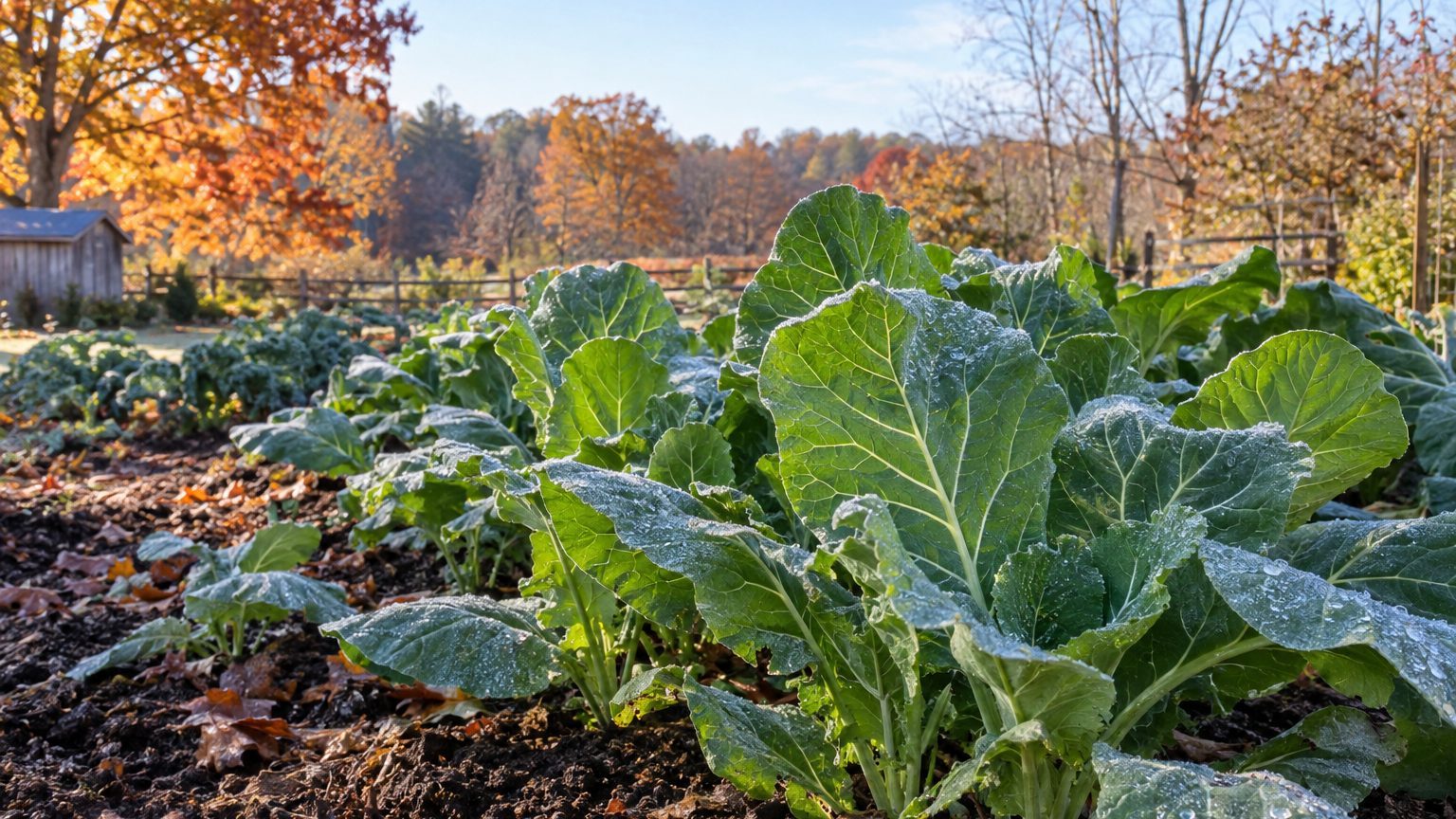

Start collards indoors in early to mid March, set hardened-off transplants outside from mid-April into early May, then sow a second round in late June to mid-July for a fall crop that keeps producing after frost. Those dates are built on a reference city, and most New Hampshire gardens run one to two weeks behind it. The full growing picture is in Growing Collards in New Hampshire.
The short answer for New Hampshire
Frost dates are a probability, not a deadline. NOAA’s 1991-2020 U.S. Climate Normals put the last spring frost at the reference city between April 16 and April 27, and the first fall frost between October 13 and October 26. Both ranges come from the 30-70% band of 32°F freeze probabilities. Inside that window, the odds of a freeze are somewhere between a long shot and a coin flip. Nothing is guaranteed on either side.
Suburban and rural gardens usually see the last spring frost later and the first fall frost earlier than an airport station does, often by one to two weeks, and more at elevation. So treat the table below as the reference-city version, then shift it for your own ground.
| Task | Reference city | Typical colder inland garden |
|---|---|---|
| Start spring seed indoors | Early to mid March | Mid to late March |
| Set hardened-off transplants outside | Mid-April to early May | Late April to mid-May |
| Sow the fall crop | Late June to mid-July | Mid-June to early July |
| First fall frost window | October 13 to October 26 | One to two weeks earlier |
The logic behind the spring row is simple. Collards are brassicas, and they tolerate light frost far better than tomatoes or beans. Seed started before the last-frost window gives you stocky transplants right when the ground becomes workable. Because the plants take a light freeze, you are not waiting for the last frost to pass. You are waiting for soil that is no longer waterlogged and for nights that stop dropping into the low 20s.
Why the fall crop matters more than the spring one
Collards are a cool-weather crop, and a plant that matures into cold nights tastes better than one that sat through July. The fall planting is the one that pays off here. Counting back from the October 13 to October 26 window, seed sown in late June to mid-July gives plants time to size up before the first freeze. After that, leaves keep coming through light frosts, and the cold turns starch into sugar. Direct sowing in the garden bed also works for the spring crop once the soil can be worked, but transplants buy you weeks you do not have to spare.
What will not work here
Southern timing. Calendars written for the Deep South put fall collard sowing in August or September, because frost does not arrive until November or later. Follow that schedule in New Hampshire and you will have seedlings the size of a hand when the first freeze hits in mid-to-late October, with a real winter right behind it. Count backward from your own fall frost date, not from a calendar written 800 miles south.
Winter survival is the second dead end. The mean daily minimum of the coldest month at Manchester is 17.1°F. That is an average of the nightly lows, which means plenty of nights fall well below it. A mature collard can shrug off the 20s, but a month of teens, dry wind and no snow cover will finish the plants. Collards that overwinter in a mild climate as a second-year crop do not make it through here, so plan on a fresh planting every year. A heavy straw mulch over plants in a sheltered spot sometimes carries a few through a mild winter, though counting on it would be a mistake.
Slow varieties lose out as well. Between the last spring frost and the first fall frost, the reference city gets about six months, and an inland garden gets less. A long-season heirloom sown in late spring may be only half-grown by the time frost arrives. This is where variety choice matters, and The Best Collards and Greens for New Hampshire sorts the faster types from the ones better suited to longer summers.
Then there is the calendar mistake that catches the most gardeners: planting out on the airport date. If your garden is in a hollow or at higher elevation, April 27 on the reference city’s table can mean a hard freeze in your yard on May 8. Hardened collards survive that better than most vegetables, but young transplants fresh from a windowsill do not.
Finally, humid July and August weather punishes tight spacing. Plants crowded closer than about 18 inches hold moisture in their leaves, and disease follows. A big collard needs elbow room. So does a seedling bed sown in midsummer, where the soil crusts over and dries between rains. Shade cloth, light mulch and a daily check on moisture matter more in July than any fertilizer schedule.
What changes across New Hampshire
New Hampshire does not have one garden climate. The USDA Plant Hardiness Zone Map (2023, built on 1991-2020 data) runs from 3b to 6a across the state. That map is built on a single variable, the average annual extreme minimum temperature, so it says how cold a winter can get, not how long your season is. But the two tend to move together: the colder the zone, the shorter the stretch between frosts. There is no single answer for the state, only a spread.
For a gardener in the north or in the mountains, the shift runs in both directions. Spring dates move later, fall dates move earlier, and the whole window narrows. Start seed indoors a week or two later than the table above, since seedlings kept indoors too long get leggy. Move the fall sowing earlier, toward mid-June. That is the difference between a crop that reaches harvest size and one that stalls. At elevation, row cover and low tunnels are worth the trouble, because they can extend the season at either end. Faster, earlier-maturing varieties also move from a nice option to a necessity.
Southern and coastal areas have the opposite advantage. Gardens closer to the Seacoast and the Merrimack Valley sit nearer the reference-city numbers, and sometimes a little ahead of them. They can plant the spring crop a bit earlier and stretch the fall harvest toward the end of the reference window.
Hilly ground complicates all of this. Cold air flows downhill at night and pools in low spots, so a garden at the bottom of a slope can see frost while one a hundred feet up the hill does not. Looking up your own zone on the USDA Plant Hardiness Zone Map by ZIP code is the quickest way to see where you fall within the 3b-6a spread. Treat it as a starting point for your own adjustment, not a finished answer.
Where to check this for your own county
The reference-city dates are a local guide, and a county recommendation beats a state one every time. University of New Hampshire Extension is the place to start. It is the state’s land-grant extension service, and its county offices field exactly these questions from gardeners every spring.
Two things are worth looking for there. The first is a local planting calendar, ideally one that lists spring and fall frost dates for the station nearest you rather than the state as a whole. The second is a list of varieties that have been grown in trials in your county, because a variety that does well in the Seacoast region may sulk in the North Country. If the website does not have either, call the county office or the Master Gardener help line. Extension staff generally know which neighborhoods are frost pockets and which spring thaws arrived early last year.
Bring a few details when you ask: your town, your approximate elevation, and what you have grown before. A question like “when does the last frost usually hit in my town, and what collards have worked locally?” gets a more useful answer than “when should I plant collards?” Extension advice built on trials in your county is worth more than any statewide table, including the one above.
Checking this against your own garden
Your own observations outrank every date here. Three are worth watching, and none needs equipment.
- Soil by feel. Squeeze a handful of soil in early spring. If it holds together in a wet clump, it is too soggy to work, and transplants will sit and sulk. If it crumbles when you poke it, the bed is ready. Soil that warms and dries early tells you that your garden runs ahead of the typical inland schedule.
- True leaves on seedlings. The first pair of leaves are seed leaves. The leaves that follow, with the familiar collard shape, are the true leaves. Seedlings with three or four true leaves are ready to harden off. If yours reach that stage well ahead of the calendar, your windowsill or greenhouse is warmer than average, and you can start later next year.
- Where frost lingers. On a cold morning, walk the yard and note where the grass is white and where it is not. Spots that frost first and thaw last are your cold pockets, and that is where the fall crop will stop growing first. Plants near the house wall or on a south-facing slope usually keep going longer.
A garden notebook that records the date you planted, the date of the last spring frost and the date of the first fall frost makes the next year’s decisions easier. Three seasons of notes will tell you more about your own plot than any regional table can.
If you follow the almanac, here is when to plant collard greens by the moon. It is a tradition, not a proven method.
Common questions
Can I sow collard seed directly in the garden?
Yes, once the soil can be worked, from mid-April in a milder spot to early May inland. Transplants started indoors a few weeks earlier get ahead, which matters in a short season. For the fall crop, direct sowing in late June to mid-July is common, as long as the seedbed stays moist.
Is it too late to plant collards in August?
For seed, usually yes. Seed sown in August leaves only about two months before the first fall frost window of October 13 to October 26 at the reference city, and less inland. Nursery transplants set out in early August have a better chance, and a row cover helps stretch the season.
Will collards survive a New Hampshire winter?
Not reliably. The coldest month averages a daily minimum of 17.1°F at Manchester, with many nights colder. Mature plants handle the 20s, but a full winter is too much. Grow collards as an annual and replant each spring or summer.
How late into the fall can I harvest?
Well past the first frost. Light freezes do not hurt established plants and often improve the flavor. Keep picking the lower leaves until a hard freeze or a heavy snow flattens the plants.