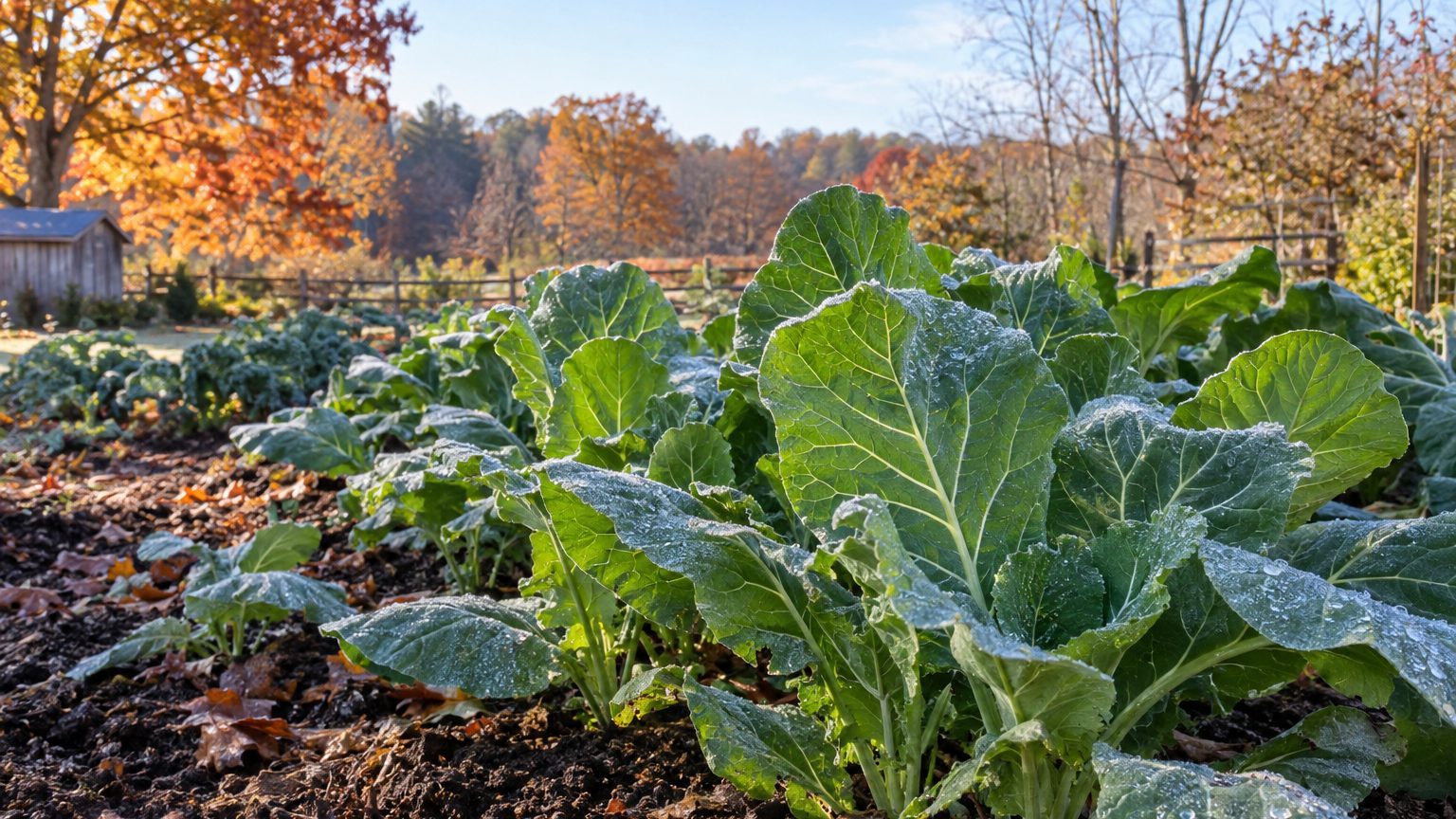

Start collard seed indoors in early to mid April and set transplants outside around the end of May, when frost risk is fading. Harvest runs through the fall, because collards shrug off the light frosts that end tomatoes and beans. The calendar is built on two average frost dates. Both are midpoints, not guarantees, so the details matter. (Variety choice matters too: see The Best Collards and Greens for Newfoundland and Labrador.)
The short answer for Newfoundland and Labrador
Sow collards indoors in early to mid April, then plant hardened-off seedlings outdoors from about May 30. That is the average last spring frost at the St. John’s airport station, according to Environment and Climate Change Canada’s 1981-2010 normals. The first fall frost averages October 17 at the same station.
Both dates are means, and a mean is a coin flip. In one spring out of two, frost arrives after May 30. In one fall out of two, it arrives before October 17. So May 30 is the middle of a frost window, not a safe date, and the same goes for October 17 at the other end. Collards are forgiving on both sides, since a hardened-off transplant handles a light frost, but a hard freeze on a tender seedling still sets it back.
Count the days between those two dates and you get about 140, roughly 20 weeks. That is the average stretch between the last spring frost and the first fall frost, and it is short for a crop that thrives in long southern seasons. It explains why transplants beat seed here. Six to eight weeks indoors, counted back from May 30, puts the sowing in early to mid April. A seedling that spends those weeks under a bright window or grow light goes out already sturdy, and it saves weeks that the outdoor season cannot spare.
| Task | Timing |
|---|---|
| Sow seed indoors | Early to mid April, 6 to 8 weeks before May 30 |
| Harden off seedlings | Over 7 to 10 days in mid to late May |
| Set transplants outdoors | Around May 30, with row cover on hand |
| Harvest | Pick the lower leaves as plants fill out, and keep going past the first frost |
Frost does not end the harvest. Cool nights tend to sweeten collard leaves, so picking in October after a light frost often tastes better than picking in August. Pairing this calendar with Growing Collards in Newfoundland and Labrador covers soil, feeding and spacing once the plants are in the ground.
These dates come from one station. A province is not one climate, and northern or upland districts run weeks behind St. John’s. Treat the calendar as a starting point to adjust, not a fixed schedule.
What will not work here
Treating May 30 as a safe date is the first mistake. Half of all springs bring frost after it, so a gardener who plants out on that day with no cover is gambling at even odds. Keep a floating row cover or old bedsheets within reach for the first two weeks of June.
Direct-seeding outdoors in late May fails more often than it works. Soil warms slowly in a cool maritime spring, and seed sitting in cold, wet ground germinates unevenly or rots. Even when it sprouts, you have spent a large share of a 140-day season just getting seedlings started. Direct sowing makes sense only for a patch of baby leaves, not for full-size plants.
The slowest collard types will also disappoint. Packets for large, late-maturing varieties often list around 60 to 80 days or more from transplanting. Add the weeks to start seed and the outdoor window gets tight before the first frost arrives. Choose varieties that mature early, and measure any packet’s days against the 140-day average, not the whole calendar year.
Planting in midsummer for a fall crop, a standard move in warmer parts of the country, does not fit either. A July sowing has few warm weeks left to reach a worthwhile size before the October 17 average frost. Here the single spring planting is the crop.
Winter is the other limit. The mean daily minimum of the coldest month at the reference station is -8.7 °C (16.4 °F). That is an average of the daily lows, not the record cold, so individual nights run well below it. Collards are biennial and can sometimes survive mild winters elsewhere, but planning on overwintering them in open ground with this kind of cold, plus wind and thaw-and-freeze cycles, is optimistic. Treat them as a one-season crop and be pleasantly surprised if a sheltered plant returns.
Last, close spacing can backfire where summers are cool and damp. Crowded leaves stay wet longer, and wet leaves invite fungal spots and give slugs a place to hide. Give each plant room for air to move through, and favor an open, breezy site over a tight, shaded corner.
What changes across Newfoundland and Labrador
The province covers an island and a large mainland region, and its climate spreads accordingly. Natural Resources Canada lists the reference city at hardiness zone 6a in the Canadian system, using 1991-2020 normals. That is the zone for that city, not the whole province, so there is no single answer for the territory.
The Canadian number cannot be read as a USDA zone. The Canadian system combines seven climate variables, while USDA relies on winter minimum temperature alone. Natural Resources Canada itself says there are no simple conversions, and it notes that Canadian zone 4a overlaps nine USDA zones, from 3a to 7a. So a Canadian 6a and a USDA 6a are different measurements. To find the zone for your own town, use the Canada’s Plant Hardiness Site map and look up your municipality.
The shifts for readers farther north, inland or at elevation follow one rule: everything moves later in spring and earlier in fall. Frost dates there run weeks behind St. John’s. If your last frost comes in mid-June instead of May 30, push indoor sowing back by the same number of weeks, so seedlings do not outgrow their pots waiting for the ground to be ready. If your first fall frost arrives well before October 17, you have fewer days to grow, so pick the earliest varieties and plan for row cover or low tunnels at both ends of the season.
Local features matter as much as latitude. A south-facing slope, a wall that holds heat, or a spot sheltered from the wind can gain you a week or more over an exposed site down the road. Cold air drains downhill and pools in hollows, so low ground frosts earlier in fall and later in spring than the slope above it.
Where to check this for your own county
The provincial Department of Fisheries, Forestry and Agriculture is the place to start. The Newfoundland and Labrador Department of Fisheries, Forestry and Agriculture is the nearest equivalent to a state extension service, and its staff and publications deal with the province’s growing conditions directly.
Look for two things. The first is a local planting calendar, ideally one keyed to your region or town, not to the whole province. The second is a list of varieties that have been trialled near you, since a cultivar that performs well in a milder coastal pocket may stall in a cooler inland district.
If you cannot find a collard-specific entry, check the brassica entries for kale, cabbage or broccoli. Those crops share the same cool-season habits, and their dates are a good proxy.
A recommendation from your own county or district beats any provincial one, and the dates above are provincial. They rest on a single station’s 1981-2010 averages, while the hardiness zone uses 1991-2020 data, and each describes the reference city, not your yard. Use the local figure where there is one, and let this timetable fill the gaps.
Checking this against your own garden
Your own observations outrank every date here, and three are easy to make without any equipment.
Soil warmth, by feel. Push your hand into the bed at planting depth in the morning. If it feels distinctly cold and clammy, it is not ready for transplants that you want to establish fast. A bed that feels merely cool and crumbles in your fingers is fine for hardy collards. Compare a sunny spot with a shaded one, and you will learn how much your microclimate differs from the average.
The first true leaves. Collard seedlings first show two rounded seed leaves, followed by true leaves with the shape of a collard. When those true leaves appear and the stems look stocky, not stretched and pale, the seedlings are ready to start hardening off. Leggy growth means too little light or too much warmth indoors, and next year you can sow a week later or move them closer to the window.
Where frost shows up first. On a clear, still morning in late spring and again in fall, walk the yard at first light and note where white frost lies. Those spots mark your coldest ground. Plant collards on the side that stays clear, and you may gain days at both ends of the season.
Write down what you see each year, including the date you set out transplants and the date of the first frost that actually hurt. After two or three seasons, that notebook will give you a better calendar than any average.
Some gardeners also time this by the Moon: when to plant collard greens by the moon, as almanac tradition rather than fact.
Common questions
Can I sow collard seed directly outdoors?
You can, but it works better for baby leaves than for full plants. Cold spring soil slows germination, and a direct-sown crop uses up weeks of a season that averages about 140 days between frosts. Indoor sowing in early to mid April gives you a head start.
Is May 30 a safe planting date?
No. May 30 is the average last spring frost at the St. John’s airport station, which means frost arrives later in about half of all years. Harden seedlings off first and keep cover ready for early June nights.
Will collards survive a winter here?
Don’t count on it. The mean daily minimum of the coldest month is -8.7 °C, and individual nights go lower. Plan for one growing season and treat any plant that returns as a bonus.
How late can I keep harvesting?
The first fall frost averages October 17, and collards tolerate light frost, so picking often continues beyond it. A hard freeze eventually ends the harvest, and leaves taken just after a light frost tend to taste sweeter.