
Long-day onions are the only realistic choice in Newfoundland and Labrador. At St. John’s, the reference point for this guide, the sun sits at 47.62 degrees north and the longest day of the year delivers 15 hours and 47 minutes of daylight. That number, not the temperature, is what tells an onion bulb to start forming. Anything bred for shorter days simply won’t get the signal it needs here, and timing your planting around the local frost calendar matters just as much as picking the right seed.
The short answer for Newfoundland and Labrador

Onions read day length the way a thermostat reads temperature. Once daylight stretches past a variety’s trigger point, the plant stops building leaves and starts building a bulb, whatever size it happens to be at that moment. At St. John’s latitude, the longest day tops out at 15 hours and 47 minutes, which places this whole territory firmly in long-day country. Anything that needs 14 to 16 hours to bulb will find that window here. Varieties built for 12-hour or intermediate triggers will not.
Fourteen of the 31 onion varieties documented on this site have a published range that covers 47.62N: Ailsa Craig, Barolo, Blush, Bridger, Frontier, New York Early, Patterson, Red Long of Florence, Red Long of Tropea, Redwing, Rossa di Milano, Safrane, Talon, and Walla Walla Sweet. Most are long-day types; two, Red Long of Florence and Red Long of Tropea, are intermediate-day but bred with ranges wide enough to still catch this far north.
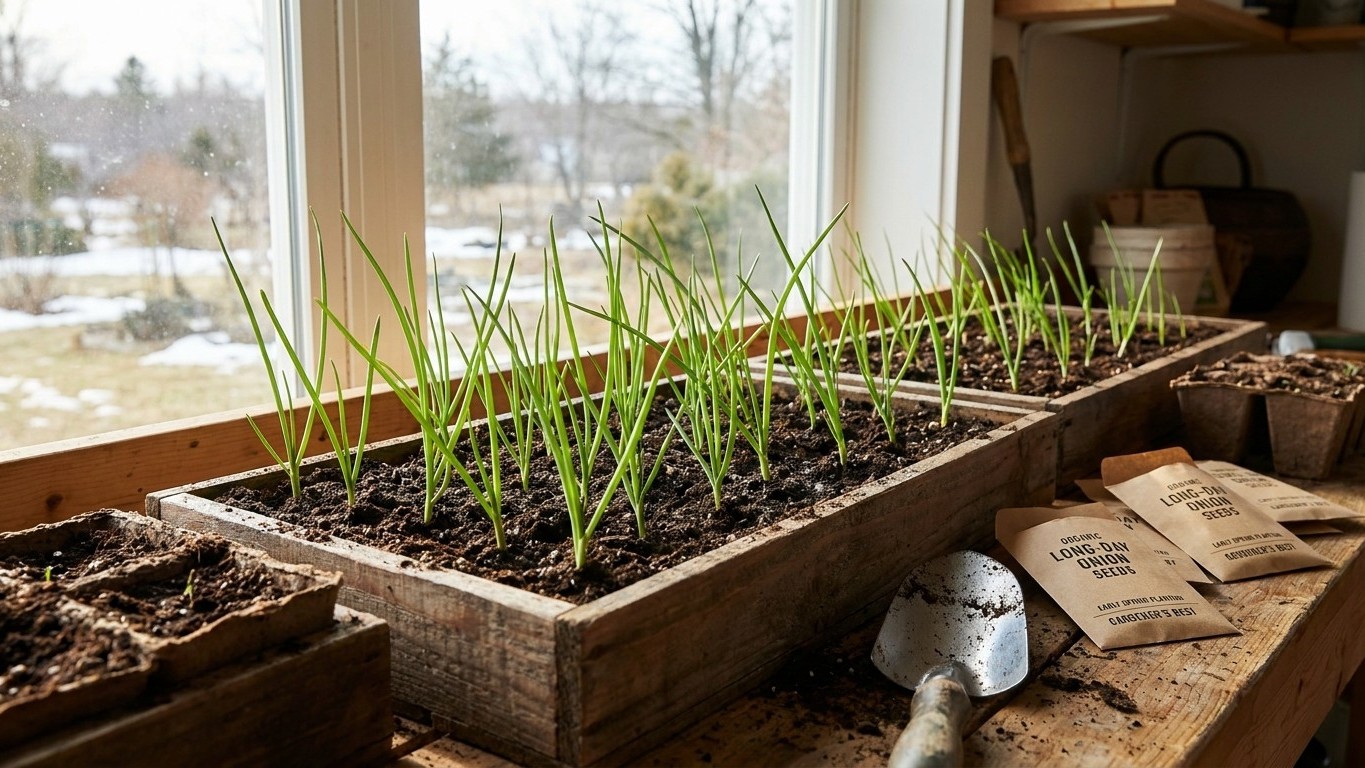
On timing, Newfoundland and Labrador does not get the option that mild-winter states have. Fall planting for overwintering onions depends on winters gentle enough that young transplants survive to spring, and this province’s winters do not qualify. The season here runs the other direction: start seed indoors in late winter, harden off transplants, and get them into the ground as early in spring as the soil can be worked, usually once the hard freeze risk has passed but while the days are still lengthening toward that June peak. Planting sets or transplants any later doesn’t ruin the crop outright, but it changes what that crop looks like by the time bulbing kicks in, which is exactly the problem the next section covers.
What will not work here
Short-day and most intermediate-day onions are not a poor fit for Newfoundland and Labrador. They are the wrong tool entirely. A short-day variety is bred to start bulbing at around 12 hours of daylight, a threshold this province blows past by early May most years. Planted here, that onion begins forming a bulb while it is still a seedling with a handful of thin leaves, because the day-length trigger fires long before the plant has built enough leaf mass to feed a full-size bulb. The result is a small, often woody onion, not a delayed one.
Sixteen of the documented varieties fall into this excluded group, and none of them belong in a Newfoundland or Labrador garden:
- Cabernet (intermediate-day, 35-45N), bulbs well south of this latitude, too early here
- Calibra (intermediate-day, 35-45N), same trigger point, same result
- Candy (intermediate-day, 33-40N), built for a much shorter summer day
- Elsye (intermediate-day, 32-45N), trigger fires before the plant sizes up
- Expression (intermediate-day, 32-45N), southern range, small bulbs here
- Gabriella (short-day, 20-35N), a 12-hour trigger, far too short a day requirement
- Madalyn (short-day, 20-35N), bulbs almost as soon as it sprouts leaves at this latitude
- Monastrell (intermediate-day, 35-46N), just south of St. John’s, still too early a trigger
- Red Carpet (long-day, 40-45N), a long-day type, but its upper bound falls short of 47.62N
- Red Rock (short-day, 30-36N), deep southern range
- Red Sensation (short-day, 25-35N), deep southern range
- Scout (intermediate-day, 32-46N), bound sits just under this latitude
- Sierra Blanca (intermediate-day, 32-45N), trigger fires too early
- Texas Grano 1015Y (short-day, 25-35N), short-day, wrong hemisphere of onion entirely for this climate
- Vidora (short-day, 25-35N), same issue
- White Castle (short-day, 30-38N), bulbs far too early to size up here
Plant any of these anyway and the pattern is predictable: green growth through most of the season, a small bulb forming once day length crosses their trigger, and then rot setting in as the plant tries to keep pushing leaves into a bulb that already thinks it’s finished. Timing makes the same mistake in a different form. Set out transplants three or four weeks late and the plant reaches the June solstice with fewer leaves built up. Bulbing still triggers on schedule, because day length hasn’t moved, but the bulb that forms reflects whatever growth happened before that trigger fired. Late planting doesn’t push the harvest back. It shrinks it.
What changes across Newfoundland and Labrador
Every figure above comes from a single weather station, ST JOHN’S A, sitting at 47.62 degrees north. That’s a fair reference point for the Avalon Peninsula and much of the island’s east coast, but Newfoundland and Labrador is not a single garden. The province stretches from the island’s southern coast up through the Labrador mainland, and Labrador in particular sits well north of St. John’s, into latitudes where summer days run noticeably longer than 15 hours 47 minutes.
That extra daylight doesn’t push any variety out of the long-day category. If anything, it makes the long-day varieties in this list, especially ones like Redwing with a published range reaching up to 65N, an even better fit the farther north a garden sits. What it does change is the calendar: daylight builds toward the solstice and falls away from it faster at higher latitudes, which compresses both the safe planting window in spring and the days available to size up bulbs before autumn.
| Location reference | Latitude | What it changes |
|---|---|---|
| St. John’s (reference city) | 47.62N | 15h47 on the longest day; baseline for every figure above |
| Island interior and west coast | Near 47-49N | Similar day length; same variety group applies |
| Labrador coast and interior | North of 50N | Longer summer days, tighter spring planting window, faster seasonal swing into fall |
Powell sits in a blurred zone here, with a published range of 43 to 47N that ends just short of St. John’s latitude. That’s close enough that it may still bulb on the Avalon Peninsula, but it’s genuinely borderline rather than a safe yes, and a Labrador garden further north sits outside its documented range altogether.
Checking this against your own garden
Every recommendation above is built on one station’s data, and a province this size doesn’t behave the same way from one coastline to the next. Before betting a season on a variety list, it’s worth confirming a few things specific to where you actually garden:
- Look up your own latitude if you’re gardening well north or south of St. John’s, since even a couple of degrees shifts the daylight trigger date
- Check your local frost-free date rather than assuming St. John’s timing applies, since coastal fog and inland cold pockets both shift that date around within the province
- Contact your local agriculture extension office or the provincial Department of Fisheries, Forestry and Agriculture for planting date guidance specific to your region
- Track when your longest day actually falls if you’re far from the Avalon Peninsula, since the solstice date is fixed but your local daylight total on that date is not identical to St. John’s
- Watch your seedlings’ leaf count heading into June, since more leaves at bulbing trigger means a larger bulb regardless of which long-day variety you planted
A provincial figure is a starting point, not a guarantee for the specific patch of ground behind your house.