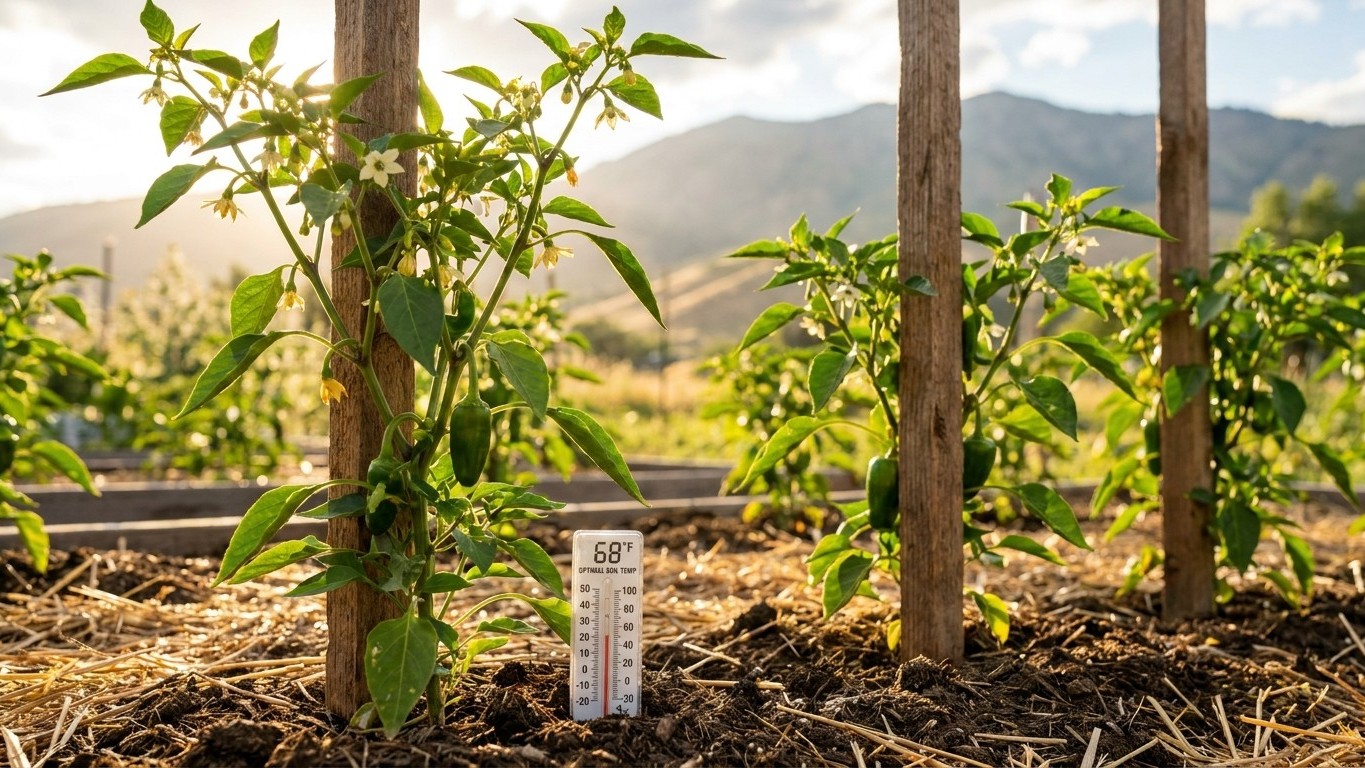

Peppers ripen reliably on Newfoundland and Labrador’s Avalon Peninsula and other coastal pockets, but heat is not the challenge here. Cool nights during flowering, a late spring frost, and a short frost-free window decide whether pods size up before fall. St. John’s records zero days a year at or above 90°F, so the fruit-set risk runs almost entirely toward the cold end of the scale, a factor this site cannot measure for you locally and one every grower needs to track in their own yard.
The short answer

Start with the number that actually gets measured: the reference station at St. John’s logs a mean of 0.0 days a year at or above 90°F, according to Environment and Climate Change Canada’s 1981-2010 climate normals. That’s not “rare.” It’s zero. For a grower in a hotter province, a run of 90-degree afternoons can stall pepper flowering for a week or two at a stretch. On the Avalon Peninsula and along most of the island’s south coast, that particular failure mode barely exists as a garden hazard.
That doesn’t mean fruit set is guaranteed, though. Pepper fruit set fails at both ends of the thermometer, and Utah State University Extension’s guidance on peppers is specific about it: flowers drop and fruit set collapses when nighttime temperatures fall below 55°F, a threshold that has nothing to do with how hot the days get. This site tracks days at or above 90°F for every territory in this series because that figure is measured and published at reference weather stations. Summer night minima are a different kind of data. This site does not carry them, and no reliable version of that number exists to substitute in here.
That gap matters more in this province than almost anywhere else covered in this series. A yard near St. John’s harbor can hold several degrees of extra warmth overnight compared with a garden twenty minutes inland, and a low spot that pools cold air on a still, clear night will chill blossoms in ways a nearby hillside garden never does. Newfoundland and Labrador isn’t one climate. It’s a string of microclimates strung along a jagged, wind-exposed coastline, and only a grower standing in that specific yard with a min-max thermometer through July and August can say with any confidence whether nights are holding above 55°F.
So the practical answer splits into two halves. On the heat side, the zero-days-above-90°F record means fruit set here almost never fails from excess warmth, which frees a grower from worrying about shade cloth or midday wilting the way a grower further south might have to. On the cool side, the answer is unpublished and personal: track your own nights. A string of nights under 55°F during flowering will drop blossoms just as surely as a heat wave would elsewhere, and no provincial average will tell you whether your particular garden is doing that on any given week.
When to start seed here
Newfoundland and Labrador’s growing season starts late by almost any Canadian standard, and the seed-starting math has to work backward from a frost date that itself comes with a caveat.
- Start with the frost date, and read it correctly. Environment and Climate Change Canada’s 1981-2010 climate normals put the average last spring frost at the ST JOHN’S A station at May 30. That’s a mean date, not a safe cutoff. In one year out of two, frost arrives after May 30, sometimes well after. Treat it as the midpoint of a window, never as a green light on the calendar.
- Check soil temperature, not just the date. Utah State University Extension recommends transplanting peppers only once soil temperature reaches 60°F and frost risk has passed, with both conditions true at the same time. In a province where the surrounding ocean keeps spring soil cool well into what would be early summer inland, soil often lags behind air temperature. A grower may need to wait past the frost date itself before soil catches up to 60°F.
- Count backward 8 to 10 weeks for indoor starting. Working from a target transplant date in early to mid June (the frost mean plus a buffer for soil lag), and counting back 8 to 10 weeks per Utah State University Extension’s guidance, seed-starting for growers near St. John’s lands somewhere in the second half of March to early April.
- Rerun the arithmetic for your own county. A garden further inland, at higher elevation, on the Northern Peninsula, or anywhere in Labrador will run behind the St. John’s normal by days to weeks. The math itself doesn’t change, but the frost date does. A grower outside the Avalon Peninsula needs to find or estimate their own local last-frost mean and redo the same backward count from there, rather than borrowing the St. John’s figure directly.
None of this arithmetic is exotic. It’s the same four-step logic gardeners run in any short-season climate: pin the frost mean, confirm soil warmth, subtract the indoor-starting window, then adjust for local terrain. What changes from one Newfoundland and Labrador yard to the next is where that frost mean actually falls, and only a local record or several seasons of personal observation can tighten that number beyond the provincial average.
What goes wrong here
Most pepper failures in this province trace back to one of three mechanisms, and each has a workaround that doesn’t require moving the garden.
- Blossom drop from cool nights. This is the dominant risk in a climate that averages zero days above 90°F: flowers open, then drop without setting fruit because nighttime temperatures during flowering sit below the 55°F threshold Utah State University Extension cites. The remedy is siting and timing, not chemistry. Choose the warmest microclimate available (a south-facing wall, a spot sheltered from prevailing wind, raised beds that drain and warm faster) and hold transplanting until nights have stabilized rather than rushing plants out the moment the calendar clears.
- Blossom drop from an occasional hot spell. Even in a province that logs no 90-degree days on average, a short, unusual warm stretch can still push flowers past their comfort range in an exposed, reflective spot such as a south-facing patio bed. Light shade cloth for a few afternoons and steady, deep watering during the spell keep plants from adding heat stress on top of an already narrow flowering window.
- Sunscald on exposed fruit. Where direct sun is strong on unshaded pods (often after heavy pruning strips away leaf cover), skin can blister and turn pale or leathery. Leave enough foliage over developing fruit to shade it naturally, and resist the urge to strip lower leaves for airflow unless disease pressure specifically calls for it.
- Blossom-end rot. A dark, sunken patch on the fruit’s blossom end usually points to inconsistent watering interrupting calcium uptake, not a soil calcium shortage by itself. Mulch to even out soil moisture between rains, water on a steady schedule rather than in feast-or-famine bursts, and avoid letting containers or raised beds dry out completely between waterings.
Common questions
Does Newfoundland and Labrador ever get hot enough to stop pepper fruit set?
Based on the St. John’s reference station’s 1981-2010 normal of 0.0 days a year at or above 90°F, that failure mode is not a realistic concern for most of the province in an average year, though a short unusual warm spell can still stress exposed plants.
How do I know if my nights are too cold for peppers?
This site doesn’t carry summer night minima for any territory, including this one, because that figure isn’t measured and published the way daytime highs are. Put a min-max thermometer in the garden through the flowering weeks and watch for stretches below 55°F, the threshold Utah State University Extension cites for fruit-set failure.
Is May 30 a safe date to transplant peppers outside?
No. It’s the mean last-frost date at the ST JOHN’S A station over the 1981-2010 period, meaning frost falls after that date in about half of all years on record. Use it as the center of a planning window, and confirm soil has reached 60°F before moving transplants out.
Should I start seeds earlier if I live outside St. John’s?
Possibly, but only after adjusting the frost date first. Inland, higher-elevation, and northern districts typically run behind the St. John’s normal, so the correct move is to estimate the local last-frost mean for your own area and then count back 8 to 10 weeks from that adjusted date, rather than shifting the St. John’s schedule by guesswork.